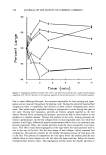
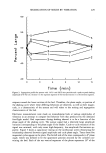
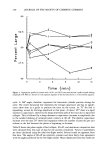
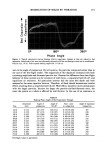
J. Soc. Cosmet. Chem., 42, 211-222 (July/August 1991) In vivo assessment of skin elasticity using ballistometry C. G. FTHENAKIS, D. H. MAES, and W. P. SMITH, Estee Lauder Research Laboratories, I25 Pinelawn Road, Melville, NY I 1747. Received July I5, I990. Synopsis We have developed a modified version of the ballistometer to assess the elastic properties of the skin in vivo through the measurement of the rebound of a hard object on the skin surface. Information about the skin's elasticity was obtained by analyzing the rebound patterns resulting from the interaction between the ballistometer probe and the skin. In order to validate this technique, we have carefully evaluated the variability of this parameter as a function of age, body sites, and product action. Accuracy of the measure- ments was such that we can resolve site-to-site variations as well as major differences in the skin elasticity of young and old subjects. Additionally, we studied the effect on skin elasticity of the topical application of a cosmetic product containing vitamin A palmirate versus a simple moisturizer. We found that the product containing vitamin A palmitate increased the skin's elasticity, whereas the simple moisturizer had no effect on this parameter. INTRODUCTION The elastic properties of the skin have been studied for many years by physicians, dermatologists, and more recently, cosmetologists to fully understand how these prop- erties change during the aging process. However, to date, no single technique has clearly established this relationship or satisfactorily quantified the effect of topical preparations in temporarily improving the physical properties of the skin. This lack of adequate technology is certainly not due to a lack of imagination, since almost every conceivable way of deforming the skin and monitoring its behavior under stress has already been tried with varying levels of success (1-3). The difficulty in establishing a superior, universal technique comes from the inhomo- geneity and anisotropy of the skin, which consists of compartments of totally different physical structure and physical properties. Once a deformation is imparted to the skin, each compartment reacts uniquely, based on its own physical configuration (fibrous vs amorphous). Thus the overall skin physical attributes are a complex combination of both viscous and elastic properties. Additional problems come from the variations of physical properties of the skin owing to body region, age, and sex, as well as to differences in temperature and relative humidity. In addition, measurements have been obtained sometimes with little or no standardization of the environmental conditions, which obviously contributes largely to inconclusive results. 211

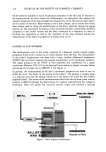
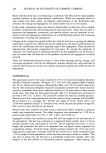
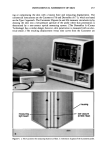
212 JOURNAL OF THE SOCIETY OF COSMETIC CHEMISTS Of all methods available to study the physical properties of the skin and its relation to the aging process, we have chosen the ballistometer, an instrument that assesses the dynamic properties of the skin through the measurement of the rebound of a hard object on the surface of the skin. Ballistometry is not a new concept, and a similar device has been already used to study the modifications of the skin's elasticity during the aging process (4). The instrument we present in this document has been considerably modified compared to this earlier version and has been connected to a computer in order to facilitate the acquisition as well as the treatment of the data obtained during the measurement of the physical properties of human skin in vivo. MATERIALS AND METHODS The ballistometer used in this study consisted of a balanced weight-counter-weight pendulum fitted with a conical tip at a fixed distance from the axis. The measurement of the probe's displacement was done with a rotary variable differential transformer (RVDT) that accurately measures the angular displacement as the pendulum oscillates. The signal produced by the RVDT is then amplified and transformed by a signal conditioner (Shaevitz ATA 101) to be digitized by an analog to digital converter before processing and storage into an IBM PC 2 (see Figure 1). In general, the measurements of the skin's viscoelastic properties are done in vivo on either the wrist, the cheek, or the temple of the subject. The panelist is usually lying in a position such that the falling conical tip of the probe will strike the skin surface perpendicularly. The release of the pendulum arm fitted with the tip from a near vertical position is effected through the deactivation of a capture solenoid from the computer keyboard. Once the probe has bounced several times and reached a resting Position of Skin Figure 1. Block diagram of ballistometer.
Purchased for the exclusive use of nofirst nolast (unknown)
From: SCC Media Library & Resource Center (library.scconline.org)