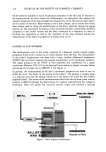
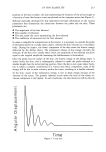
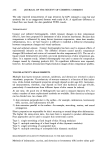
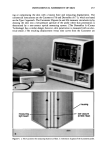
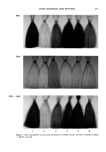
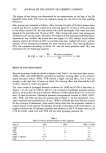
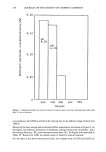
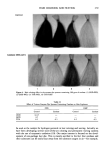
INSTRUMENTAL ASSESSMENT OF SKIN 257 ing or compressing the skin with a known force and measuring displacement. The commercial instruments are the Cutometer (70) and Dermarlex A (71), which are based on the Type 2 approach. The Cutometer (Figures 4a and 4b) measures viscoelasticity by drawing the skin into a low-pressure aperture of the probe where skin penetration is determined by a non-contact optical measuring system. [The Dermarlex A (Cortex Technology) has a similar design however, skin penetration is measured with an elec- trical sensor.] The resulting displacement versus time curves from the Cutometer are :.'•½',•'•"/)v•':--½ •.'..:!.."-.,•i•::•!•i½: "-':•:•,•: •:':•:i •:•:•:•::• e•i•.-':.½..-?' :i.*.':•P?• ¾'•¾•¾...4 ?*./3.'•:?.•??&::•:!:•:•:!:!: :•:3:i:!:•:i• !.'.::i i:!:i :i:!:i:3:i: :3:i:i:.::•:3.•: :-':. :'.:.':::::-...4.x.•..({.::::?&,,:-:-:-:• •:-:-:-:- :.:-:- :-:. :-:-:-:-:-: .-:-:-:.:.:-:-:-: .: if. ============================= :.:-:.:-:-:-:, .:.:.-:..: .:.:.:.:.:...:.:.:.:..:..* !-'!.'I '".. :::::::::::::::::::::::: :i:i:3E: t .•::' :!::!i i:i:i:•::i i:::]:i::•:•: :•:: 4- '-"•:..• :$:•: : :::::: :::::2:::: • measuring .•.•--- --•$-½,-',,-. ß •4•.. q•?..:,:8:3•:i:i:i:i:i:i :•:i:i:!:!:!: •..%.-:i:•: !:Mei:!: i:i:i:..%!(.:... • low vaccum light beam ?•"•' •" '2'' ß '" '•••••••::i•i•::•::: :::::::::::::::::::::: i::•:.::?..• '-'-':• :,.-:..:...-.-• (0-500 mbar) :::: '+':: :::-::-:::: ::::::" ::::::'::-: ::::- :-:i• - -:-:::. - . .•: •••••.• ...... .................... .':- ................................ e.' ..... '• I!::i::i::i::i::!::i fi::i:. i:?:4•... : !::?:i::iii ?':..-':,.:...:. '.......":'• : :•:•: : :••: :•: :•: 2 :•2.`. 2:::2:2 : 2 : : : : : : :.:.:.:.:..``:.:•:.:.:.:.`..:•:.:.•.:•••:.:.:.:4.:•:`:.:•:.:•:•:.:.:.: .............................................................................. :.:.x.x-x.:.:.:-:.x.x.x.:.:.:.:.:-:.:.:.:. .:.:.x.:.:.:.:.:.:.:.:.:.-..:.x.:.: .............................. :-:.x.:.:.:.:.x.:.:. - ............... :ø.'Aø.:-.'. '. .......................... ..................................... .......................... .: ................... ,,,,,,•,,•, Figure 4. a. The Cutometer for measuring elasticity of skin. b. Schematic diagram of the Cutometer probe.

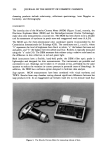
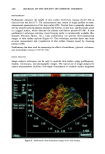
258 JOURNAL OF THE SOCIETY OF COSMETIC CHEMISTS plotted on the monitor, displaying skin penetration in the probe and skin recovery during the test cycle. Multiple parameters can be measured from the same data (stress- strain ratios, recovery, displacement, etc.) A set of apertures is provided with the instrument (2-, 4-, 6-, and 8-mm). The smaller apertures help to reduce the influence of the dermal layer to the measurement. MEASUREMENTS OF ELASTICITY PARALLEL TO THE SKIN SURFACE Measurement of constrained skin is typically conducted by extensiometry or twistometry (72-74). Commercially available instruments based on this principle are the Dermal Torque Meter (DTM) and Rheometer (Dia-Stron, Inc.). The DTM has a probe that allows rotation of a small skin surface area with a given torque (Figures 5a and 5b). Both angles of rotation and recovery are measured. Either the Type 1 or the Type 2 approach can be used with the instrument. The torque/angle ratio can be calculated to characterize skin elastic properties. This ratio reflects the resistance of the skin to stretching and is a function of skin hydration. Depending on the amplitude of the applied torque and the geometrical arrangement of the device (gap between stationary and rotational discs), the properties of either the stratum comeum or stratum comeum and underlying tissue can be studied. The gas-bearing electrodynamometer (GBE) method utilizes a free-standing probe that measures the dynamic elastic modulus (Type 4 approach). The probe consists of a small etating Element -Housing . . .• ,.- j •" "7 - .•.7 •"'"'"• ..... :' " Spacing -- "alltlllltl1111tlll from 1 to ' 5 mm Figure 5. a. The Dermal Torque Meter for measuring elasticity of skin. b. Schematic diagram of the Dermal Torque Meter probe.
Purchased for the exclusive use of nofirst nolast (unknown)
From: SCC Media Library & Resource Center (library.scconline.org)