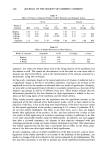
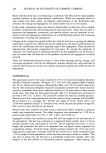
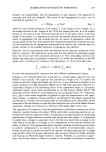
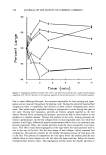
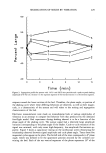
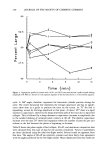
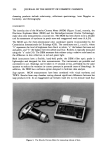
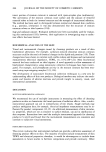
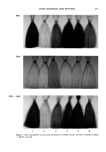
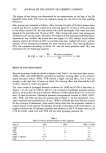
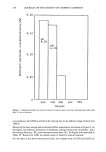
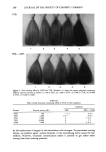
278 JOURNAL OF THE SOCIETY OF COSMETIC CHEMISTS o o o o o 0.20 0.15 0.10 0.05 pH 8.50 pH 6.50 UOD UOD GOD LAC TYR Enzyme Figure 3. Hydrogen peroxide concentration formed in various enzyme reactions. Measurements were made after 20 min of reaction. concentration, but UOD accelerated the coloring rate in the addition range of more than 1000 U. Results of the hair waving and accelerated fallout experiments are shown in Figure 6. In the figure, the reference (treatment 3) represents waving without any neutralizer. Also, the waving efficiency, Wf, and waving retention ratio, W•, for Figure 6 are provided in Table IV. Results for UOD are almost equal to those for sodium bromide. On the basis of the above-mentioned results, the oxidases such as UOD and GOD can

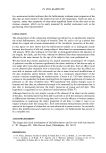
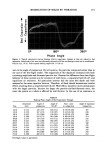
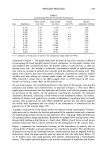
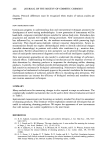
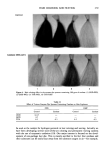
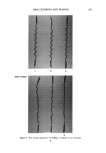
HAIR COLORING AND WAVING 279 Control: Catalase (500 ppm)' I 2 3 4 Figure 4. Hair coloring effect in the enzyme-dye systems containing 500 ppm of catalase: (1) UOD-PPD, (2) GOD-PPD, (3) TYR-PPD, (4) TYR-OHP. Table II Effect of Various Enzyme-Dye Systems Containing Catalase on Hair Lightness PPD OHP Control Catalase Control Catalase UOD 4-4.5 -- -- GOD 4.5 -- TYR 6.5 6.5 6.5 6.5 be used as the catalyst for hydrogen peroxide in hair coloring and waving. Actually we have been developing several state-of-the-art coloring and permanent waving systems with the use of enzymatic oxidation (10). Our major interest is focused on the devel- opment of one-package hair dye. This is mainly ascribed to the fact that oxidases and their substrates can be easily kept away from the substrate oxygen in air--for example,
Purchased for the exclusive use of nofirst nolast (unknown)
From: SCC Media Library & Resource Center (library.scconline.org)