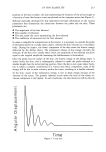
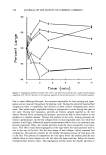
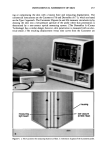
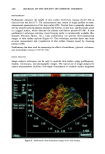
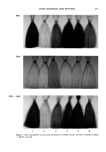
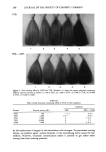
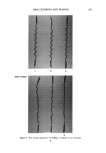
IN VIVO ELASTICITY 213 position on the skin's surface, the data representing the variation of the pivotal angie as a function of time (the bounce curve) are plotted on the computer screen (see Figure 2). Software especially developed for this experiment provides information on the various parameters that characterize the interaction between the probe and the skin. These parameters are: ß The amplitude of the first rebound ß The number of rebounds ß The area under the curve representing the first rebound ß The coefficient of restitution for the first rebound In order to simplify the interpretation of the results, it is necessary to consider the probe of the ballistometer as a totally elastic object, whereas the skin is known as a viscoelastic body. During the impact, the elastic component of the skin stores the kinetic energy delivered by the falling object. The subsequent release of this energy provides the rebound. If the skin was a totally elastic body, the amplitude of the rebound would be equal to the original amplitude (assuming the ballistometer is frictionless). Once the probe hits the surface of the skin, the kinetic energy of the failing object is stored inside the skin, and is subsequently released to make the probe rebound at a smaller height than the initial starting position. Since the skin is not a pure elastic body, but is rather a complex combination of a viscous and elastic component, some of the energy will be lost in shear viscosity within the tissue, resulting in a smaller rebound. In the skin, much of the indentation energy is lost in shear energy because of the viscosity of the tissue. The greatest rebound occurs when the ratio of the elastic-to- viscous component is the highest. In such conditions, the skin elasticity will be directly Time Figure 2. Young skin.

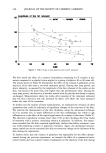
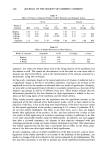
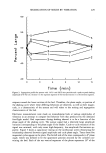
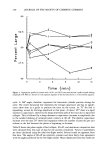
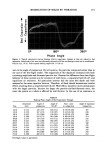
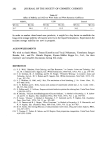
214 JOURNAL OF THE SOCIETY OF COSMETIC CHEMISTS related to the rebounds of the probe on the skin surface. For this reason, we are using the amplitude of the first rebound as one way to measure the skin's elasticity. Similarly, the number of rebounds, which is proportional to the amplitude of the rebounds, is another good way to estimate the skin's elasticity. The area under the curve of the first rebound represents the energy restituted by the skin during the impact, since this area is calculated as the product of the probe's displace- ment by time (the duration of the first rebound). The reason for using this parameter in addition to the two measurements described previously is that the area under the curve takes account of all the factors that result from the interaction between the probe and the skin during the impact. For example, this value will integrate the diminution of time between successive rebounds due to the reduction of starting height from rebound to rebound. Finally, the coefficient of restitution, which represents the ratio of the velocity of the probe before and after impact with the skin surface, was calculated in a first approxi- mation as the square root of the ratio of the height from which the probe falls to the first rebound height to which it rises. RESULTS VALIDATION OF THE METHODOLOGY In order to test the accuracy of our system, we first carried out a series of experiments on various materials that do not have the complexity of the skin. We chose an elastic membrane as an obvious model to assess the properties of a near-perfect elastic body, whereas a Teflon block was used to test a non-elastic material. The bounce patterns obtained on these two different materials are represented in Figures 3a and 3b and clearly indicate the different elastic properties of the rubber membrane and the Teflon block. These differences are further demonstrated in Table I, where we represented the mean values of the amplitude of the first rebound and the number of rebounds, as well as the area under the curve and the coefficient of restitution, together with the standard deviation associated with these results. These data cleary represent the difference in viscoelastic properties of these two materials. All four parameters provide the same insight into the elasticity of the membrane and the Teflon block. In particular, the coefficient of restitution shows that the elastic membrane is about 95% elastic whereas the Teflon block is about 50% elastic and 50% viscous, which explains the large difference in the amplitude of the first rebound and in the number of rebounds observed in this material. CLINICAL VALIDATION In a second series of experiments, we repetitively measured (ten times) the same pa- rameters on the temples of two different groups of subjects: old (59 years) and young (22 years). This experiment was run to establish the variation of the results obtained after repetitive measurements on the same site of the skin, and to ensure that this variation is independent of the age of the subjects. The results shown in Table II clearly demonstrate that the coefficient of variation is small enough to allow for the distinction between the elasticity of the skin of young and old subjects. In fact, the differences in the amplitude of the first rebound, the area under
Purchased for the exclusive use of nofirst nolast (unknown)
From: SCC Media Library & Resource Center (library.scconline.org)