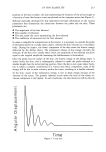
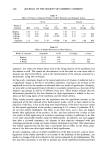
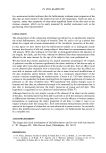
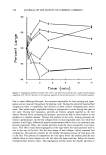
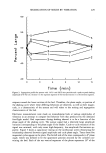
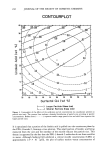
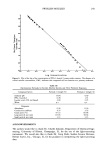
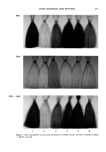
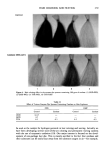
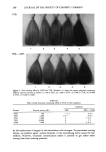
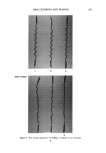
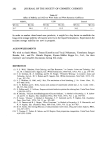
IN VIVO ELASTICITY 215 Time Figure 3a. Rubber membrane. the bounce curve, and the number of rebounds, as well as the coefficient of restitution measured on the group of old and young subjects, were found to be highly significant (p .05). This large significance is due in part to the small variability of the results obtained on both young and old subjects. Time Figure 3b. Teflon block.

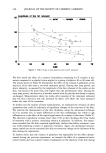
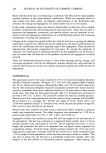
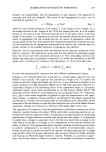
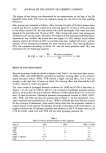
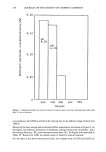
216 JOURNAL OF THE SOCIETY OF COSMETIC CHEMISTS Table I Elasticity Measurements Rubber membrane Teflon block Average -+ S.D. Average + S.D. p Value Amplitude Area No. rebounds Coefficient of restitution 54.83 0.10 15.50 0.12 0.003 13.9 0.07 3.24 0.11 0.005 8.00 0 1.00 0 0.001 0.95 0 0.51 0 0.004 Table II Assessment of the Coefficient of Variation on Young and Old Subjects Young Old Average +S.D. Average +--S.D. p Value Amplitude 29.89 0.82 19.94 0.23 0.002 Area 6.83 0.33 4.12 0.26 0.002 No. rebounds 3.00 0 2.00 0 0.002 Coefficient of restitution 0.70 0.01 0.57 0 0.001 This experiment proved that ballistometry was sensitive enough to differentiate between the physical properties of old and young skin. Furthermore, as in the case of the testing of the standard materials described previously, all four parameters provided similar information. For this reason, we will express our results only as the amplitude of the first rebound, which seems clearly related to the skin's elasticity as discussed previously. These results encouraged us to test whether this technique is sensitive enough to test and compare the elasticity of different body sites such as the wrist, the cheek, and the temple. Measurements were done on a group of subjects 21 to 31 years old, and the data are shown in Figure 4. There is a significant difference (see Table lll) between the amplitude of the first rebound measured on the wrist as compared to the measurements carried out on the temple and on the cheek. The results obtained on the temple, however, were found to be similar to the values measured on the cheek. This lack of difference in the results is quite likely due to the similarities in skin structure between these two sites. In the last series of experiments conducted to validate this technique, we assessed the effect of the subjects' age on the skin's elasticity. Measurements were carried out again on the same three sites in order to establish if the variation of the skin's elasticity with age would be similar in various parts of the body. The results are shown in Figure 5. These data clearly demonstrate that the elasticity measured on these three sites is affected in the same manner by the age of the subjects. In fact, the curves of the quadratic equations fitted through the data points obtained on the wrist, temple, and cheek were found to be parallel, indicating that the relation between age and skin elasticity was the same for each of these three sites. The same conclusions can be drawn as previously. All through the different age groups, we found that the measurements of skin elasticity on the cheek and temple were
Purchased for the exclusive use of nofirst nolast (unknown)
From: SCC Media Library & Resource Center (library.scconline.org)