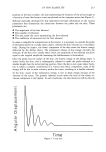
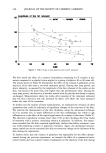
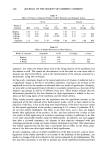
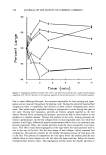
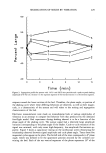
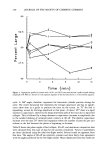
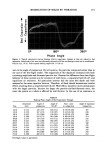
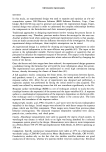
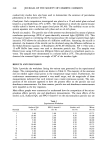
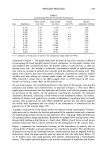
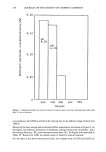
IN VIVO ELASTICITY 217 4O 3O 2O 10 WRIST TEMPLE CHEEK Figure 4. Site-to-site variation of skin elasticity. Table III Site-to-Site Variation of Skin Elasticity (age = 21-31) Amplitude of the first rebound Wrist Temple Cheek 36.19 28.77 28.19 -+2.16 +1.92 +2.26 significantly correlated to each other (R = 0.9320), whereas the data obtained on the wrist were found to have a lower correlation coefficient with either the temple (R = 0.7785) or the cheek (R = 0.7957). Because of the high clinical relevance of the measurements carried out on the temple, we carried out additional testing with a large pool of subjects (120) in order to provide a strong statistical significance to our conclusions. The results are shown in Figure 6, where the data on the variation of the amplitude of the first rebound as a function of age has been fitted with a quadratic equation. Presumably, the lower amplitude of the first rebound measured on either the wrist, cheek, and especially the temple of the old subjects, is due to the deterioration of the network of elastin fiber in the dermis, due mostly to overexposure to the sun (5). EFFECT OF PRODUCT APPLICATION ON SKIN ELASTICITY Skin elasticity of old subjects (50 to 70 years old) was measured with the ballistometer before any application of a cosmetic treatment.

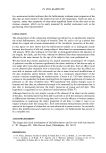
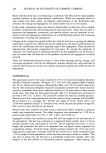
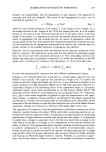
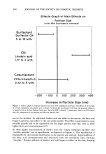
218 JOURNAL OF THE SOCIETY OF COSMETIC CHEMISTS 45 Amplitude of the 1It rebound 15 • wrlet -x- temple -v- oheek 10 20 30 40 50 Ii0 70 AGE Figure 5. Effect of age on skin elasticity (site-to-site variation). We first tested the effect of a cosmetic formulation containing 0.1% vitamin A pal- mitate compared to a placebo lotion applied to a group of subjects 40 to 60 years old. The results shown in Table IV demonstrate the effect of the vitamin A palmitate on the elasticity of the skin after a six-week treatment period. During that time period, the skin's elasticity, as assessed by the amplitude of the first rebound of the probe on the skin, was found to be more than 22% higher than the pretreatment value. During the same time period, the elasticity of the skin treated with the placebo was found to remain unchanged. Measurements taken two weeks after cessation of the treatment indicated that the skin's elasticity was still increased by about 12% above the value measured before the start of the treatment. To further test the validity of these measurements, we measured the variation of other parameters that could be indicative of significant changes in the structure of the skin. We selected the measurement of the skin thickness, using the ultrasound technique (6,7) as another way to assess differences in the skin morphology due either to age differences or to the effect of the topical application of a vitamin A derivative (Table V). We observed a significant increase (more than 15%) in skin thickness after four weeks of treatment with a product containing vitamin A palmitate. In addition, this experi- ment revealed that the skin remained significantly thicker than before treatment, even two weeks following vitamin A palmitate treatment. Again, the ultrasound measure- ments carried out on the untreated skin did not reveal any change in the thickness of the skin during the experiment. To further check that the vitamin A palmitate was responsible for the effect demon- strated during the previous experiment, we assessed the effect of a commercial mois- turizer (which does not contain vitamin A palmitate) on the elasticity of the skin during
Purchased for the exclusive use of nofirst nolast (unknown)
From: SCC Media Library & Resource Center (library.scconline.org)