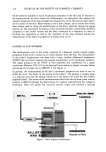
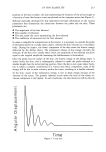
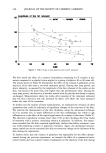
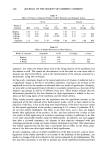
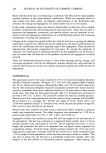
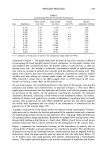
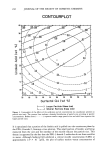
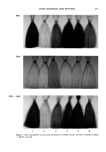
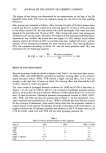
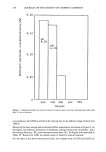
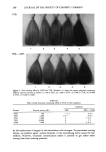
276 JOURNAL OF THE SOCIETY OF COSMETIC CHEMISTS The degree of hair dyeing was determined by eye measurement on the base of the JIS Standard Color Scale. The lower the lightness values are, the better the hair coloring effects are. Hair waving was evaluated as follows: After treating a bundle of 20 black human hairs (which was fixed to a plastic comb) with reducing agent for 10 min at 30øC according to the Kirby method (9), the hair bundle was rinsed thoroughly with water and then dipped in the neutralizer for 10 min at 30øC. After rinsing with water, hair waving was estimated as the waving index. Hereafter, the stability of hair waving (accelerated fallout experiment) was studied the waved hair was dipped in 20% sodium lauryl sulfate aqueous solution for 20 min at 60øC to accelerate wave loss, washed with water, and the stability of hair waving was estimated as a wave retention ratio. Then waving efficiency (W e) was estimated according to Kirby (9), and the wave retention ratio (W r) was determined by the following equation: Wf - Wf after accelerated Wr (%) = 100 -- X 100 Wf RESULTS AND DISCUSSION Enzyme screening results are shown in Figure 1 and Table I. As seen from these results, UOD, GOD, and GOD/MUTA provided an excellent coloring effect in the aromatic amine precursor system (PPD). TYR showed a slight coloring effect, but it was not enough to dye goat hair to brown or black. No coloring effect was observed for LAC without enzyme in either dye system. The time course of hydrogen peroxide evolution for UOD and GOD is described in Figure 2. In the case of UOD at pH 8.5, the evolution of hydrogen peroxide reached about 0.18 wt% after 20 min of reaction. However, GOD evolved about 0.07 wt% even after 30 min of reaction. Hydrogen peroxide concentrations evolved in UOD, GOD, LAC, TYR, and GAL reactions are summarized in Figure 3. In the experiment, enzy- matic reactions were performed for 20 min. UOD is evidently the most effective oxidase for hair coloring. Furthermore, these results clearly show that the enzymatic coloring is closely related to the amount of hydrogen peroxide accumulated in the formulation. A higher evolution rate of hydrogen peroxide was obtained at pH 8.50 rather than at pH 6.50 for UOD, while LAC and TYR did not form hydrogen peroxide (8). Table I Effect of Various Enzyme Systems on Hair Lightness Enzyme PPD OHP PPD 4- OHP UOD 4 -- 4.5 LAC -- TYR 7 6.5 6.5 GOD 4.5 -- 4.5 GOD + MUTA 4-4.5 -- 4.5 GAL 8 -- 6-6.5

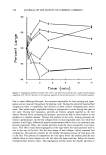
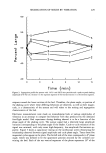
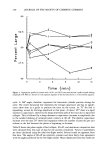
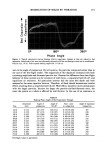
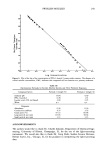
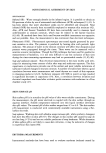
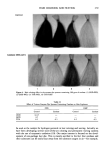
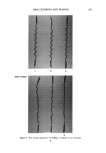
HAIR COLORING AND WAVING 277 •4 o o o •O -•-I o o 0.20 0.15 0.10 0.05 .D i I 0 10 20 30 Time (min) Figure 2. Time course of hydrogen peroxide evolution in UOD and GOD systems. Open circles, triangles and squares represent GOD, UOD at pH 6.50, and UOD at pH 8.50, respectively. In order to distinguish the coloring mechanisms of UOD, GOD, and TYR, the effect of catalase on enzymatic coloring was investigated. Catalase was used to decompose hydrogen peroxide formed in the reaction system. The results are provided in Figure 4 and Table II. UOD and GOD activities were completely inhibited in the presence of catalase. However, catalase did not affect TYR activity. LAC and TYR do not form hydrogen peroxide. The monophenol derivatives o-diphenol and polyphenol can be the substrate for LAC and TYR (8). TYR and LAC have a different mode of action from UOD and GOD in hair coloring. Results on coloring and lightness obtained for UOD and TYR are provided in Figure 5 and Table III, respectively. No increase in coloring was observed, even at higher TYR
Purchased for the exclusive use of nofirst nolast (unknown)
From: SCC Media Library & Resource Center (library.scconline.org)