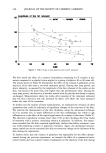
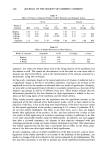
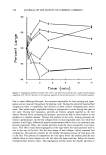
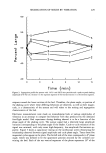
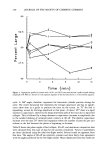
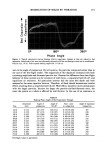
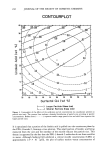
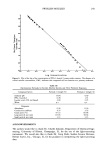
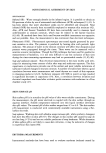
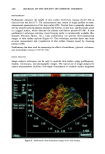
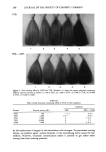
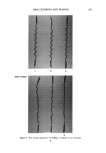
244 JOURNAL OF THE SOCIETY OF COSMETIC CHEMISTS CONTOURPLOT i zo • ',,"E3.•. %.. %.6._.% % _'• ' %"',,'q,,, %--. %, 120: , l 1 / ], / / /3.2 ]' p ,7 .a / / / / ,, , 2:8// "I '• -,/ 20 ',•Jl' ///__ / 80 -,./-60 •u oe I 5.0 tO 7.0 lO 9.0 I0.0 11.0 12.0 110 14J} Surfactol Q4 (wt %) ( ) Larger Particle Sizes (nm) ( .... ) Smaller Particle Sizes (nm) Figure 5. Contourplot of the effects of various surfactant and cosurfactant concentrations (wt %) on particle size (nm) while holding the oil (linoleic acid blend) at 2.25 wt %. selected for Formula 2. The surfactant concentration is less than the concentration present in Formula 1 because the internal phase has been decreased and more cosurfac- tant has been added. The predicted responses are also listed for each formula. Particle size analysis was not conducted on the optimized systems however, other results from the optimized systems corresponded with the predicted responses. Experimental design proved to be a practical technique in the characterization and optimization of this particular system. Results from the study imply the dual function- ality of the linoleic acid and also establish that the addition of the selected cosurfactant did not enhance the solubilization of the hydrocarbon in the micelie.

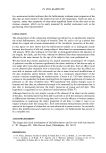
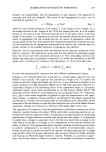
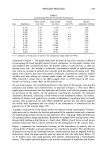
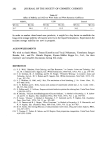
SWOLLEN MICELLES 245 u c: 4 8 0.0 - . ß I I I I I , , '-4.0 • 8 • 0 • 8 • 0 -1.8 -f..O -0 8 - o Log Concentral:ion Figure 6. Plot of the log of the concentration of PPG-3-buteth-5 versus surface tension. The absence of a critical micelie concentration, CMC, indicates this compound will not function as a primary surfactant. Table III Optimization Formulas for Swollen Miceliar Systems and Their Predicted Responses Compound factors Formula 1 (weight %) Formula 2 (weight %) Surfactol Q4 14.84 9.69 PPG-3-buteth- 5 0.28 1.35 Linoleic acid, 65% (oil blend) 4.00 2.25 Water q.s. q.s. Responses Absorbance 0.36 0.30 Conductivity (mS/cm) 4.35 3.16 Cloud point (øC) 97.13 85.96 Large particle size (nm) 125.95 58.64 Small particle size (nm) 3.11 3.23 ACKNOWLEDGMENTS The authors would like to thank Dr. Charles Zukoski, Department of Chemical Engi- neering, University of Illinois, Champaign, IL, for the use of the light-scattering instrument. We would also like to thank Dr. Craig Herb, Surface Science Division, Helene Curtis, Inc., Chicago, IL, for his guidance in interpreting the light-scattering data.
Purchased for the exclusive use of nofirst nolast (unknown)
From: SCC Media Library & Resource Center (library.scconline.org)