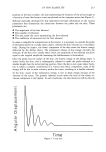
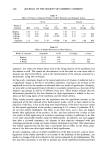
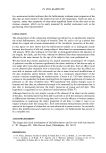
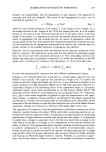
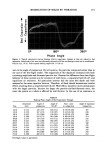
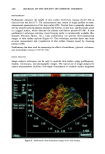
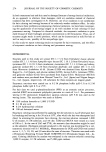
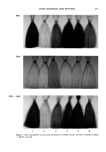
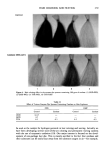
SEGREGATION OF SOLIDS BY VIBRATION 227 60 55 50 45 40 I I I I 5 10 15 20 Time (rain) Figure 1. Segregation profile for system with 14/16- and 20/25-size particles and a peak-to-peak shaking amplitude of 0.254 cm. Section 6 is the topmost segment of the bed and section 1 is the bottom segment. insignificant forces on the particles caused by air flow within the bed (4). Given these assumptions, the motion of a particle in the bed can be determined. The particle will lift off from the container bottom when the downward acceleration of the container cylinder equals gravitational acceleration and will contact the container bottom again when its free-flight path intersects that of the container. The frequency and amplitudes of the shaker were such that bed lift-off and landing always occurred on the same cycle (2). As particles lift off, the bed expands to a maximum porosity and then rapidly collapses into a compacted state as the downward moving particles are met by the upward moving cylinder. The particles are then accelerated upward until lift-off again occurs. This process is repeated during each cycle of the shaker. Thus the cycle can be divided into parts corresponding to different types of bed behavior such as lift-off, bed expansion, bed collapse, and maximal bed compaction. The flee-flight model provides a baseline from which the existence and magnitude of effects due to air drag and sequential bed lift-off caused by wall friction can be assessed.

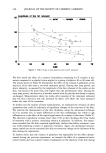
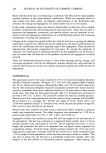
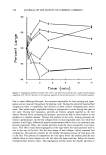
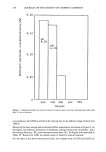
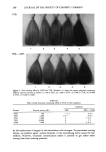
228 JOURNAL OF THE SOCIETY OF COSMETIC CHEMISTS 0 3 6 9 12 15 Time (rain) Figure 2. Segregation profile for system with 14/16- and 20/25-size particles and a peak-to-peak shaking amplitude of 0. 358 cm. Section 6 is the topmost segment of the bed and section 1 is the bottom segment. Due to these differing behaviors, the processes responsible for both mixing and segre- gation are not constant throughout the shaking cycle. During the period of maximal bed compaction there is insufficient bed dilation to allow relative interparticulate move- ment. One would expect negligible mixing or segregation to occur during this part of the cycle. During bed expansion, particles are thrown upward together as the bed dilates. Because of the increasing bed porosity, particles are able to move relative to one another in a random manner. During this portion of the cycle, mixing processes are likely to predominate. As the bed collapses from its most expanded state, but while bed porosity is still high, differential particle sedimentation effects due to air resistance may become important. Here, the smaller particles would be more susceptible to air resis- tance. This effect would favor segregation of the type where the small particles tend to rise to the top of the bed. For the later stages of bed collapse, before maximal bed compaction, the particles compete for the rapidly decreasing amount of void space left in the bed. The process of competition for void space favors the smaller particles and enables them to move deeper into the bed than the large particles, before all relative interparticulate motion ceases. This segregation process causes the smaller particles to
Purchased for the exclusive use of nofirst nolast (unknown)
From: SCC Media Library & Resource Center (library.scconline.org)