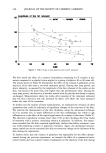
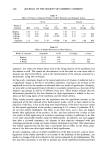
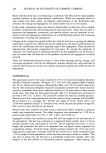
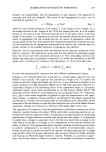
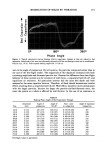
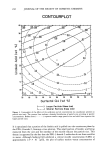
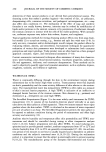
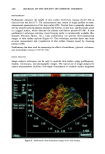
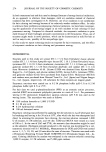
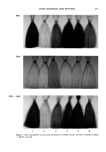
242 JOURNAL OF THE SOCIETY OF COSMETIC CHEMISTS CONTOURPLOT : , 13.0 14.0 15.0 ( ) Larger Particle Sizes (nm) ( .... ) Smaller Particle Sizes (rim) Figure 3. Contourplot of the effects of the surfactant and oil concentration (no cosurfactant present) on particle size (nm). The contour lines indicate a bimodal distribution of particle size occurring at specific concentrations. Broken lines ( ..... ) represent smaller range particle size and solid lines represent the larger particle sizes. It is speculated that a portion of the linoleic acid is pulled into the continuous phase by the PPG-3-buteth-5, forming a true solution. This small portion of linoleic acid being extracted from the core and the interface of the micelie reduces the particle size. This theory is supported by the fact that the PPG-3-buteth-5 molecules do not form micelies in water. Although Surfactol Q4 exhibited a critical micelie concentration (CMC) at approximately 2.9 x 10⁻³g/ml, the plot of surface tension versus concentration of

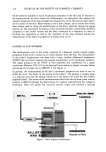
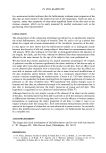
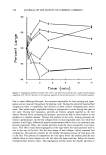
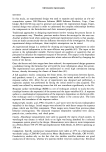
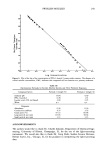
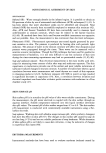
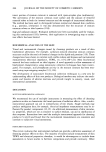
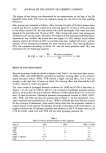
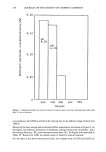
SWOLLEN MICELLES 243 (11) (•) Surfactant Linoleic Acid Figure 4. Schematic representation of the partitioning of the oil (linoleic acid) and the surfactant. (I) Linoleic acid partitioning in the micelle interface. (II) Linoleic acid collecting in the core, producing a swollen micelie. PPG-3-buteth-5 indicates that no CMC was observed (see Figure 6). Furthermore, the linoleic acid oil blend was not soluble in water until a certain concentration of PPG- 3-buteth-5 was added. For example, 3.0 wt % oil blend in water required approximately 30.0 wt % PPG-3-buteth-5 in order to form a true solution. The concentration of PPG-3-buteth-5 found in the mixtures in the experimental design was insufficient to completely solubilize all of the linoleic acid in these microemulsion systems. These observations paired with the particle size pattern illustrated in Figure 5 reinforce the theory of the extraction of the linoleic acid from the micelie structure into the contin- uous phase at higher concentrations of cosurfactant. Several conclusions were made after observing the results from the design. These include: 1. The concentration of the primary surfactant is a critical factor in the formation of the miceliar system. 2. The linoleic acid has a dual function: first acting as a cosurfactant at the interface of the micelie and then collecting in the micelie core forming a swollen micelie. This is consistent with the occurrence of bimodal distributions observed in the light- scattering experiments. 3. The addition of the selected cosurfactant does not appear to enhance the solubiliza- tion of the hydrocarbon in the micelle. After the interpretation of the results, the optimal factor settings that would produce transparent oil-in-water swollen miceliar solutions containing linoleic acid were deter- mined as listed in Table III. First, Formula ! lists a composition that contains maximum internal phase (linoleic acid) while constraining the particle size and absorbance to boundaries that should produce a clear swollen miceliar system (particle sizes less than 140 nm). A cosmetically acceptable concentration of linoleic acid, 2.25 wt %, was
Purchased for the exclusive use of nofirst nolast (unknown)
From: SCC Media Library & Resource Center (library.scconline.org)