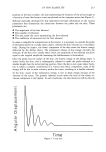
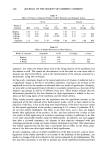
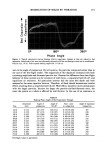
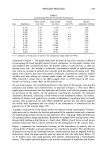
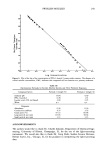
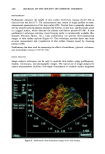
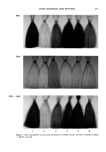
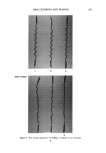
SEGREGATION OF SOLIDS BY VIBRATION 231 0 o 180 ø 360 ø Phase Angle Figure 5. Typical capacitance tracing showing relative capacitance changes as they are related to bed expansion. Amplitude of the trace was arbitrarily adjusted to fill the oscilloscope screen and is uncalibrated. Particle size, 14/16. Peak-to-peak shaking amplitude, 0.358 cm. seen in the angle of compaction. For all systems, the particles compacted earlier than in the case of the free-flight model. The magnitude of this departure increased with both increasing amplitude and decreased particle size. Reasons for differences from free-flight behavior of these systems are the existence of wall forces, a sequential bed lift-off, and significant air resistance. All particulate systems had the same bed depth and were analyzed at the same capacitor location. Therefore, all beds should demonstrate similar effects resulting from a sequential bed lift-off. Wall effects should be more predominant with the larger particles, because the larger the particle-size/bed-diameter ratio, the more the system as a whole is affected by wall friction. In the case of air resistance or Table II Shaking Phase Angles of Bed Capacitance Changes Amplitude Angle of Angle of Fract. cycle Angle of maximum Size (cm) compaction lift-off in compaction compaction 14/16 0.254 126 (155) 324 (312) 0.550 (0.436) 187 14/16 0.358 187 (215) 310 (295) 0.342 (0.230) 238 14/16 0.442 223 (248) 310 (293) 0.242 (0.125) 266 14/16 0.508 241 (271) 302 (290) 0.169 (0.053) 274 18/20 0.254 130 (155) 335 (312) 0.569 (0.436) 216 18/20 0.442 212 (248) 306 (293) 0.261 (0.125) 252 20/25 0.254 133 (155) 317 (312) 0.511 (0.436) 180 20/25 0.442 209 (248) 313 (293) 0.289 (0.125) 245 25/30 0.254 130 (155) 317 (312) 0.519 (0.436) 180 25/30 0.358 173 (215) 317 (295) 0.381 (0.230) 245 25/30 0.442 194 (248) 306 (293) 0.311 (0.125) 230 25/30 0.508 209 (271) 313 (290) 0.289 (0.053) 252 Free-flight values in parenthesis.

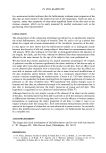
232 JOURNAL OF THE SOCIETY OF COSMETIC CHEMISTS particle sedimentation effects, it is the smaller particles that show the greatest deviation from the ideal free-flight model. For a particle moving through a fluid such as air, the resistance to its motion due to the fluid is inversely proportional to the surface area (or square of the radius if the particle is spherical) of the particle. Therefore, the smaller particles will be much more likely to exhibit a sedimentation effect as they move through the air. The smaller particles would lift off at the same time as the larger ones, but once in motion could be slowed more by air resistance. They would not be thrown as high, and therefore will compact sooner than larger particles under the same condi- tions. Higher amplitudes can be expected to exaggerate the sedimentation effect, since the particles are in motion through the air for a larger portion of each cycle. The capacitance measurements show that the differences in the sizes of the particles are sufficient to have significantly different air drag behavior at the higher amplitudes. CONCLUSIONS In the vibrated binary particle beds, both mixing and segregation processes occur, but are not of uniform magnitude throughout the shaking cycle. Two processes that result in bed segregation were found to be important in the systems studied. These two processes however, favor different types of segregation. Competition for void space during the later stages of bed collapse favors downward movement of the smaller particles, and is a function of the particle size. Sedimentation or air drag effects are most predominant with the smaller particles. At lift-off, the bed moves upward as a unit because of a large degree of interparticulate interaction, until enough void space is generated to allow individual particles to be differentially affected by air drag. From this period of the cycle until bed compaction, the smaller particles will be less mobile. Since the position of the cylinder is always lower for bed collapse than for bed lift-off, more time is spent by the particles descending than ascending while the bed is in an expanded state. This means that the more mobile large particles will tend to collapse first, thus favoring a segregation where the small particles tend to rise to the top of the bed. These sedimentation effects are a function of particle surface area. Binary system segregation studies showed the extent and nature of bed segregation to be a function of amplitude and particle size differential. Low amplitudes and large particle size differences favored maximum segregation of the type wherein the small particles go to the bottom of the bed. Increasing amplitude and decreasing particle size difference lower the magnitude of the segregation and in the extreme cases actually reverse its nature. These segregation characteristics can be explained as a competition between the two segregation processes. Increasing amplitude of vibration clearly could increase the relative importance of sedimentation effects over void space competition and cause the bed to segregate less or actually invert. Since sedimentation is a function of surface area and void space com- petition is a function of volume, decreasing the size difference of the two sizes of particles in the bed should also increase the relative importance of sedimentation effects over void space competition. ACKNOWLEDGMENT The authors wish to thank the Society of Cosmetic Chemists for their financial support of this work.
Purchased for the exclusive use of nofirst nolast (unknown)
From: SCC Media Library & Resource Center (library.scconline.org)