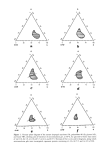
j. Cosmet. Sci., 50, 1-7 (January/February 1999) A rheological study on microemulsion gels of isopropyl myristate, polysorbate 80, glycerol, and water C. A. AYANNIDES and G. KTISTIS Department of Pharmaceutical Technology, School of Pharmacy, Aristotle University of ThessalonikL 54006 Thessaloniki, Greece. Accepted for publication December 15, 1998. Synopsis Phase studies were carried out on systems composed of isopropyl myristate, polysorbate 80, glycerol, and water at different glycerol-to-water ratios. Stable microemulsion gel regions were identified, and an influ- ence of the glycerol-to-water ratio on the area of existence of microemulsion gels was obtained. An optimum glycerol-to-water mass ratio of 2:8 was found for the largest microemulsion gel region. The rheological study indicated a pseudoplastic behavior of microemulsion gels, which makes them suitable for easier spreading on the skin. The apparent viscosity of the examined microemulsion gels decreases when the glycerol-to- water mass ratio increases. The maximum value of apparent viscosity was determined when the combined glycerol-water content was close to 40% w/w. INTRODUCTION Microemulsions have been studied in pharmaceutical (1-3) and cosmetic (4-6) appli- cations on account of their specific properties: transparency, optical isotropy, thermo- dynamic stability, small droplet diameter, and specific solubility capabilities. One of the problems associated with the use of microemulsions for topical use is the difficulty of applying these vehicles to the skin because of their fluidity. Gel formulations are very popular in pharmacy and cosmetics because they are clear and stable and display pseu- doplastic behavior, which makes them suitable for easier spreading on the skin (7,8). Microemulsion gels have a jelly-like consistency and are transparent, clear and homo- geneous, optically isotropic, and thermodynamically stable. They have been studied as possible matrices for use in transdermal therapeutic systems (9,10). Provost and Kinget (11) have examined the formation of transparent oil-water gels in the four-component system of Eumulgin © B3, Cetiol © HE, isopropyl palmitate, and water. They found that the presence of both the oil phase and the two emulsifiers is essential for their formation. In order for a pharmaceutical or cosmetic product to be spread easily on the skin without running, it must be neither too fluid nor too viscous and show plastic or pseudoplastic rheological behavior. The rheological properties of the microemulsion gels are interest-

2 JOURNAL OF COSMETIC SCIENCE ing, especially when they are predestined for skin application. Viscosity measurements show that the concentration of components plays an essential role in the microemulsion gel structure (12). In the present work microemulsion gels were prepared with isopropyl myristate as the oil phase, polysorbate 80 as surfactant, glycerol as co-surfactant, and water as the continuous phase. Stable microemulsion gel regions were designated, and the influence of the glycerol-to-water mass ratio on the concentration boundaries within which mi- croemulsion gels exist was determined and discussed. Microemulsion gels' rheological behavior was characterized, and their apparent viscosity was determined as a function of water and glycerol concentration. EXPERIMENTAL MATERIALS Isopropyl myristate (98% pure), polysorbate 80 (polyoxyethylene 20 sorbitan monoole- ate, Tween © 80), and glycerol 99% were bought from Sigma Chemicals Co. (Saint Louis, MO). All water was distilled from an all-glass apparatus. PHASE STUDIES Pseudo-ternary phase diagrams were constructed for isopropyl myristate/polysorbate 80/glycerol/water systems at 40øC. Each diagram was characterized by a fixed glycerol- to-water mass ratio of 0:10, 1:9, 2:8, 3:7, 4:6, 5:5, 6:4, 7:3, 8:2, or 9:1. The boundaries of the microemulsion gel domains were determined by slow titration of the aqueous glycerol solutions in mixtures of isopropyl myristate and polysorbate 80. All titration experiments were performed in stirred water-jacketed beakers maintained at 40 + iøC. Each sample was assessed visually for clarity, stability, and flow. Clear, homogenous, and optically isotropic samples of high viscosity, which could not flow even when the container was turned upside down, were deemed to be within the microemulsion gel region (11). Samples prepared with compositions within this area were stable for at least six months at room temperature. RHEOLOGICAL STUDY The rheological properties of prepared microemulsion gels were studied using two cone- and-plate viscometers: Ferranti-Shirley (Ferrant Ltd., Moston, U.K.) and HAAKE VT 24 (HAAKE Mess-Technik GmbH u. Co., Germany). A Ferranti-Shirley viscometer was used with the medium cone (radius 2 cm and angle 20' 40"). The viscometer was calibrated with Bayer silicones 100 M and 1000 M (Caelo Caesar and Loretz, Hilden). The temperature of the plate was maintained constant at 37 _+ 1øC by a water circulator. The speed of rotation was increased from 0 to 100 rev/min -• over a period of one minute and subsequently decreased to 0 rev/min -• in the same time interval. Rheograms were plotted automatically on an X-Y recorder (Philips, Japan).
Purchased for the exclusive use of nofirst nolast (unknown)
From: SCC Media Library & Resource Center (library.scconline.org)