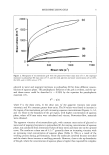
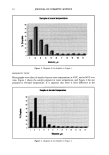
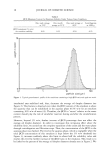
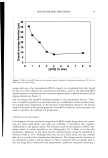
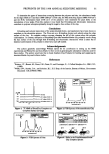
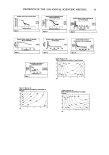
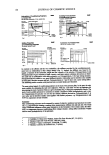
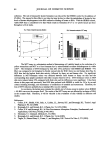
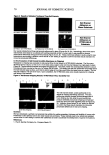
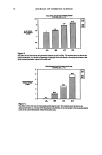
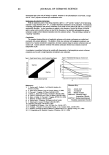
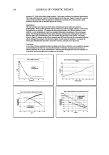
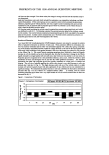
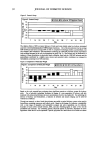
PREPRINTS OF THE 1998 ANNUAL SCIENTIFIC MEETING 65 AN EVALUATION OF SENSORY-INDUCING CHEMICAL PROBES COMPARING WOMEN'S SELF-PERCEPTION OF SENSITIVE SKIN James P. Bowman, 1 Anna K. Floyd, 1 Albert M. Kligman, 2 M.D., Tracy Stoudemayer2 and Otto H. Mills 3 /Hill Top Research, Inc., 2S.K.I.N., Inc., SUMDNJ & Foundation for Basic Cutaneous Research latroduction Approximately 1000 caucasian females (aged 18 to 65) in five geographically diverse locations (Arizona, Ohio, New Jersey, Manitoba and Florida) were recruited to answer a 20 item questionnaire which specifically asked "Do you have sensitive skin?" and also documented dermatological parameters and reactions to products. This study was conducted between November and February. Three probes were applied to each volunteer, 10% lactic acid in distilled water and 10% balsam of Peru in petrolatom were swabbed on the naso labial area and a 10:90 chloroform methanol solution was applied in a silicone ring to the cheek. Burning/stinging responses were recorded each minute for up to ten minutes utilizing the following grading scale: 0=none, l=mild, 2=moderate, 3=severe. Erythema was also graded. The endpoints for analysis are: a) time in minutes to perceived burning/stinging, b) maximum score over the ten minute period. Results The effects of placing Balsam of Peru, Lactic Acid and Chloroform/Methanol on the face of subjects self perceived as having sensitive or non-sensitive skin were investigated. Approximately 200 subjects from each of five testing sites were enrolled (approximately 40% who said they have sensitive skin and 60% who said they did not have sensitive skin). The results indicated statistically significant differences between groups for each of the probes for the time to onset of a burning/stinging response. For the Balsam of Peru, the non-sensitive group took approximately one minute longer to experience a response, for the Lactic Acid approximately a minute and a haft longer and for the Chloroform/methanol approximately 30 seconds longer (see Figure 1.). The peak responses for each group for each of the probes were also slatistically significantly different. The sensitive skin group had higher peak responses in each case (0.2 to 0.3 points higher on the 3 point grading scale) (see Figure 2.). Time to Onset - Burning/Stinging 6P LA Chlor ims-,., .Non-SensWve ] Peak Grade - Burning/Stinging BP LA Chlor llSensitive INon-Sensltlve I Figure I Figure 2 Time to peak response was statistically different for the Balsam of Peru (30 seconds different) and Lactic Acid (90 seconds different) probes, however, for the Chloroform/methanol group the difference was less than 15 seconds on average and not statistically significantly different. The grade at onset of reaction was higher for the sensitive skin group for each probe, but was only significantly different for the Balsam of Peru and Lactic Acid groups. Balsam of Peru reactions were shown to decrease with age, this was not the case for the other probes. Evaluations did not indicate significant differences between responses at different test locations.

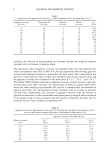
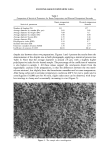
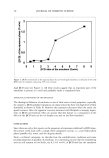
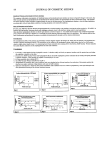
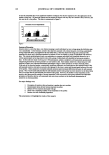
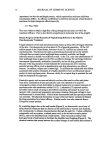
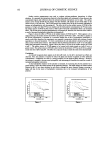
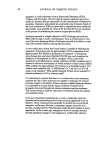
66 JOURNAL OF COSMETIC SCIENCE It must be noted that there were significant numbers of subjects who did not respond at all to the application of the probes to their face. Of particular interest arc the number of subjects who say tbey have sensitive skin, however, did not react at all to the probes. This data is summarized in Figure 3. lOO 75 25 o Figure Percent of non-responders 54 ? 11 BP LA Chlor Sensitive ßNon-Sensitive I 1. Perception of sensitive skin and reaction to probes does not correlate. 2. Questionnaire items did not forecast reactions to probes. 3. Balsam of Peru reactions decreased with age 4. There was a surprising number of non-respondcrs to the probes 5. Results were not climatically dependent This presentation will highlight the results of this research. Our major findings were: Summary/Discussion Sensitive skin is a term that has a very distinct meaning to each individual, but over a large group the definition may vary considerably. In the literature, sensitive skin has been assessed with a facial sting test, involving a potentially strong irritant like lactic acid applied to the naso-labial fold. It has been shown that sting tests conducted with materials like lactic acid, chloroform/methanol or balsam of Peru can identify a group of individuals with sensitive skin. The current epidemiological study was undertaken to compare individuals who classified themselves on a written questionnaire as having sensitive skin with a group of individuals self-classified as having non-sensitive skin. In this multi-site study involving over 1000 participants, subjects completed a self-assessment questionnaire categorizing themselves as having sensitive or non-sensitive skin. Each subject underwent a facial sting test with solutions of lactic acid, chloroform/methanol and halsam of Peru to assess sensitivity to these chemical probes. With each of the chemical probes, a statistically, significant difference was found between the responsiveness of the serf-assessed sensitive skin and non-sensitive skin groups for the time to onset and the peak grade achieved for each of the probes. Other parameters evaluated indicated statistical and directional differences between the serf-assessed groups. The overall results indicated that the self-assessed sensitive skin group was more sensitive to the facial sting tests on average than the self-assessed non-sensitive skin group. However, the number of non-responders in the sensitive skin group and the number of strong responders in the non-sensitive skin group indicates that individual perception of sensitive skin by self-assessment may not always conform to the functional determination of sensitivity to chemical probes.
Purchased for the exclusive use of nofirst nolast (unknown)
From: SCC Media Library & Resource Center (library.scconline.org)