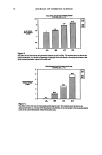
PREPRINTS OF THE 1998 ANNUAL SCIENTIFIC MEETING 95 The extract complexed with manganese and magnesium was tested for free radical scavenging ability. In the hypoxanthine/xanthine oxidase model, the complexed extract reducea free radical formation by 30%, 70%, and 92% for 0.0001, 0.01, and 1% concentrations. When tested for its ability to protect cellular proteins from oxidation, the complexed extract was found to have activity at 0.04, 0.2, and 1.0%, giving a dose dependent reduction in oxidation. For the anti-apoptosis assay, it was found that the complexed extract gives a protective effect to the DNA that is equal to that offered by a combination of ascorbic acid and glutathione. In the assay to measure protective effect against Langerhans cells, it was found that the complexed extract showed a 35, 64, 75, and 100% protection at concentrations of 0.5, 2.0, 3.5, and 5.0%. The extract was complexed with zinc in order to maximize anti-microbial and anti-sebum effect. It was tested for its ability to inhibit the formation of testosterone via an inhibition of the enzyme (50• reductase) responsible for transforming testosterone into dihydrotestosterone. At a 10% concentration, the complexed extract totally inhibited the activity of 50• reductase. An in vivo sebum reduction assay was run on twelve volunteers. After twice daily treatment with a product containing 5% of the complexed extract, there was a 67% reduction in surface sebum levels as shown by sebumeter readings. In an in vitro anti-microbial assay, the complexed assay was shown to inhibit the formation ofPropionibacterium acnes by 45 and 75% at a 1.6 and 5.6% concentration.

96 JOURNAL OF COSMETIC SCIENCE ONE ATOM-AT-A-TIME CHEMISTRY OF THE HEAVIEST ELEMENTS Darleane C. Hoffman, Ph.D. Nuclear Science Division, MS- 70/I/3307, Lawrence Berkeley National Laboratory and Department of Chemistry, University of California, Berkeley, CA 94720 Uranium, discovered in 1789 in pitchblende from Saxony, Gemany by Martin Klaproth, was the heaviest known chemical element for more than 150 years until 1940 when E. M. McMillan and his student, P. H. Abelson, in experiments initially designed to investigate the newly discovered (1939) phenomenon of nuclear fission, chemically isolated and identified the new element neptunium at Berkeley in the products of neutron irradiation of uranium. Shortly thereafter in December 1940, G. T. Seaborg, E. M. McMillan, A. C. Wahl, and J. W. Kennedy identified an isot6pe of plutonium, and in February 1941 the first chemical separation of plutonium was performed by Seaborg's first graduate student, Art Wahl. Although these experiments were conducted as part of the investigators' academic research and without governmental financial support, the discoverers voluntarily withheld publication until 1946 because of wartime security concerns about the fissionability of plutonium. By 1961 the elements through lawrencium (atomic number, Z,=103) had been discovered, thus completing the actinide series. Since that time nine transaetinide (Z103) elements have been produced and identified so the elements through 112 are now known. The names and symbols for the transfermium elements approved by the International Union of Pure and Applied Chemistry (IUPAC) in August 1997 are: 101, Mendelevium, Md 102, Nobelium, No 103, Lawrencium, Lr 104, Rutherfordium, Rf:, 105, Dubnium, Db 106, Seaborgium, Sg 107, Bohrium, Bh 108, Hassium, I-Is 109, Meitnerium, Mt. To avoid confusion, I shall continue to use hahnium for element 105 in this presentation as hahnium has been used in all of our previous publications on the chemistry of element. 105. Hahnium was approved by the American Chemical Society in 1994 prior to the IUPAC approval of the compromise names given above. Hahnium was the name suggested by the Berkeley discoverers to honor Otto Hahn, one of the co- discoverers of nuclear fission. IUPAC is now considering claims to priority of discovery of elements 110, 111, and 112, and will then request suggestions from the discoverers for names for these elements. Based on the "actinide concept" proposed by Glenn Seaborg in 1945, the actinide series should end with element 103, Lr, with the filling of the 5f electron shell, a series analogous to the lanthanides in which the 4f electron shell is being filled. Then element i04, Rf, the first of the transactinides would be expected to be the first member of a new 6d transition series and should be placed in the periodic table under the group 4 elements, zirconium and hafnium. It would be predicted to have a most stable 4+ oxidation state in aqueous solution while Lr has a most stable 3+ oxidation state. Similarly, Ha and Sg would be the heaviest members of groups 5 and 6 and exhibit chemical properties similar to those elements. Early studies (1970s) continned that, indeed, Lr and Rf had chemical properties generally similar to those expected, but no studies of the chemical properties of Ha in aqueous sollstion were performed. Some early studies of the gas phase properties of both Rf and Ha were reported by a Russian group, but these were not definitive because their detection method did not positively identify the element they were
Purchased for the exclusive use of nofirst nolast (unknown)
From: SCC Media Library & Resource Center (library.scconline.org)