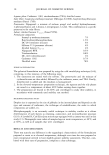
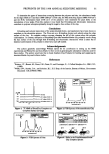
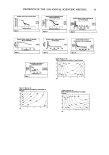
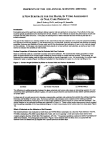
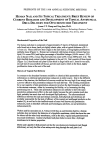
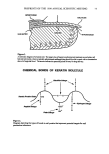
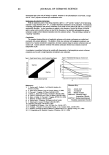
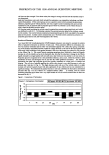
PREPRINTS OF THE 1998 ANNUAL SCIENTIFIC MEETING 69 A NEW SUBSTRATE FOR THE RAPID, IN VITRO ASSESSMENT OF NAIL CARE PRODUCTS John P. Sottery, Ph.D., and Jorge H. Jaramillo Innovative Measurement Solutions Inc., Milford, CT 06460 Introduction Formulators around the world are working to deliver superior nail care products to consumers. Their efforts in this area would be greatly accelerated by the development of fast, reliable, in vitro methods to assess the performance of both nail enamels and nail polish removers. In the past, the development of these methods has been limited by the lack of a suitable substrate. The goal of this research is to develop reliable in vitro nail methods that are predictive of the consumer perceived benefits. Our approach involves two phases: (1) the development of a reproducible, synthetic nail substrate that exhibits the wetting properties, thickness and flexibility of human nails, and (2) the development and validation of new in vitro methods based on this substrate. In this paper, we present preliminary results on a new synthetic nail substrate, as well as a new in vitro method to evaluate the durability of nail enamels. Surface Properties of Substrates Used to Evaluate Nail Care Products Glass is commonly used as a substrate to assess nail enamel adhesion. We examined the wetting properties of clean glass via measurement of the contact angle exhibited by various liquids in contact with this surface. Concurrently, we measured the contact angles made by these same liquids on human fingernails in vivo. Not surprisingly, the contact angle obtained for water on glass (Figure la) differed markedly from that obtained for water on a human nail (Figure I b). Figure 1: Contact Angle Exhibited by Water on Human Nails and Various Substrates o ß ,ß-. , ..... =.• . .., ,.j .•., (a) Glass (b) Human Thumbnail (c) VITRO-NAILS This difference in wetting properties between the glass substrate and human nails raises an interesting question: If a nail enamel has been optimized to adhere to glass, is it safe to assume that this nail enamel will also deliver optimal adhesion to human nails? In phase one of our work we set out to develop a reproducible, synthetic nail substrate that exhibits the wetting properties, thickness and flexibility of human nails. Numerous synthetic nail prototypes were created and the wetting properties subsequently evaluated by measuring of the contact angle exhibited by various liquids in contact with this substrate. The results obtained on an optimized prototype are presented in Figure lc. These contact angle measurement results suggest that the wetting properties of this new substrate (Figure lc) much more closely mimic human nails than does glass (Figure la). Effect of Substrate on the Adhesion of Nail Enamels Nail enamel adhesion was evaluated on both Glass and VITRO-NAILS substrates via a Gardner Paint Adhesion Test Kit, PA 2000, employing a PA-2056 Coarse Blade (Six Teeth, with 2 mm spacing)• 6 rail nail enamel draw downs were created using. the Gardner 8 Path Wet Film Applicator, AP-1SS. • The general guidelines outlined in ASTM Test Method D- 3359 were followed. The photographs presented in Figure 2 were obtained after the films were (1) scored with the Gardner Cross Cut Blade and (2) stripped with a special pressure-sensitive tape.

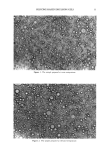
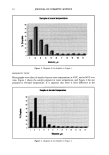
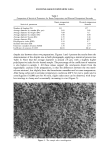
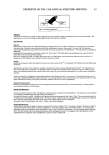
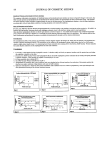
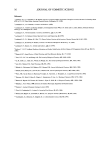
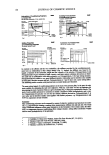
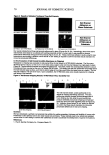
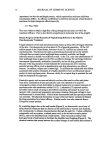
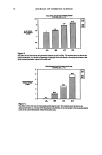
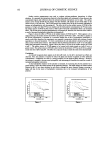
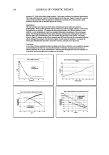
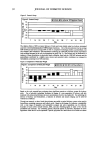
70 JOURNAL OF COSMETIC SCIENCE Figure 2: Results of Adhesion Testing on Three Nail Enamels Nail Enamel Adhesion on Glass Substrate (a) Product I (on Glass) (b) Product 2 (on Glass) (c) Product 3 (on Glass) Nail Enamel Adhesion on VITRO-NAILS Substrate (j) 3X View of Enamel J Summary , r I • r r Ii F I: D B A L J 1 In Vitro Evaluation of Nail Enamel Durability (Resistance to Chipping) Resistance to chipping was evaluated on nail enamel films (8 mils) drawn on VITRO-NAILS substrate. The films were allowed to dry for 2 hours, cut into 2 cm x 5 cm strips using a paper cutter and mounted between two rigid plastic holders (Figure 3). Twelve different enamels were tested simultaneously. The plastic holder was subsequently clamped to secure the strips and then mounted on the rod of a Tekmar RW 20 mixer. The rotating rod was then positioned horizontally above the hard textured target surface, such that the bottom edge of the strips would strike the target once per rotation. The rod was then rotated at 100 rpm for 6 hours. Upon completion, the VITRO-NAIL strips were visually inspected for chipping and flaking of the enamels. Figure 3: Nail Enamel Chipping Results: VITRO-NAILS 6-Hour Durability Test ( The nail enamels tested, varied significantly in the degree of chipping and flaking observed. The best performing products showed minimal damage after 6 hours (Figures 3e, 3d), while the worst performing products exhibited pronounced chipping and flaking at the 6 hour time point (see magnified views of Figures 3j, 3f). Validation versus actual "in use" testing is required to confirm that these results translate into consumer perceivable differences in wear and chipping. (f) 3x View of Enamel F We have developed a synthetic nail substrate that exhibits the wetting properties, thickness and flexibility of human nails. Preliminary in vitro adhesion and in vitro wear results look promising. These methods need to be refined and validated versus actual "in use" testing to confirm their usefulness as tools to accelerate the development of superior formulations. References 1. Paul N. Gardner Company Inc., Pompano Beach, FL. (d) Product I (on VITRO-NAILS) (e) Product 2 (on VITRO-NAILS) (f) Product 3 (on VITRO-NAILS) Our results indicate that all three nail enamels adhere well to glass (Figures 2a, 2b, 2c). Interestingly, when these same nail enamels were tested on a substrate with wetting properties similar to human nails, it was possible to observe performance differences among the three products (Figure 2d, 2e, 2f). These preliminary adhesion results using the new substrate are encouraging validation versus actual "n use" testing is required to confirm that these results translate into consumer perceivable differences.
Purchased for the exclusive use of nofirst nolast (unknown)
From: SCC Media Library & Resource Center (library.scconline.org)