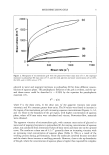
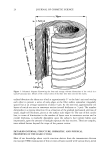
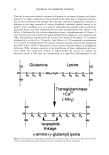
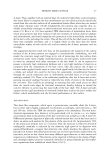
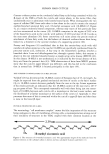
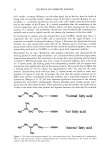
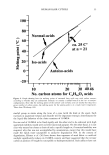
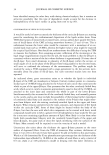
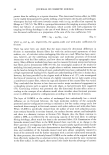
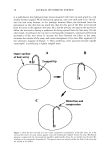
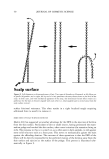
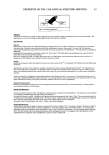
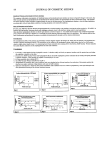
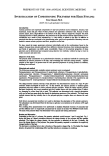
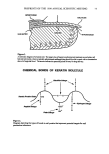
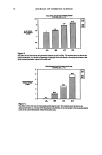
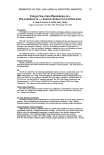
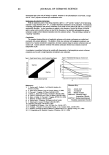
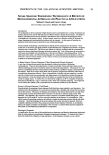
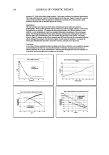
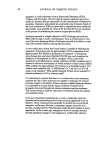
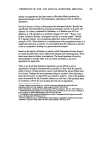
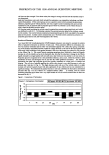
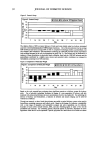
32 JOURNAL OF COSMETIC SCIENCE cell's surface. A major difference, on the other hand, lies in the fact that the lipids of living cells are laterally mobile, whereas those of the hair's cuticular lB-layers are im- movably (i.e., covalently) anchored at one end to the cell's surface proteins and possibly also to the surface of the 8-layer. It is indeed remarkable that the membranes of the cuticle's pregenitor cells in the hair follicle, which will have possessed all the charac- teristics of a "normal" cell membrane, should have been biochemically transformed so radically and at such a tightly specific site during the formation of the hair shaft. In attempting to explain why the unusual fatty acid, 18-MEA, should have been in- corporated into the cuticle's CMC and so specifically into the upper lB-layer, it is pertinent to consider its physical behavior. Figure 5 illustrates the distinction between normal-, iso-, and anteiso-fatty acids. One of the striking aspects of having a methyl group located three carbon atoms from the free end of the saturated aliphatic chain of an anteiso-fatty acid such as 18-MEA, is its effect upon local segmental mobility. Remarkable for its time, Weitkamp (46) isolated, identified, and characterized the melting points of a wide range of normal-, iso-, and anteiso-fatty acids from degras (fatty extracts from sheepskin). For convenience, his results have been replotted and are shown in Figure 6. Weitkamp found that, over a range of saturated aliphatic fatty acids of up to 31 carbon atoms, the melting points for corresponding normal- and iso-isomers were similar but were significantly less for the anteiso-isomers. He reported that 18-MEA had a melting point of 55.6øC, which was approximately 20C ø less than for the other isomers. Anteiso-fatty acids with less than 13 carbon atoms are liquid at room tem- perature (cf. figure 6), and this encourages the view that the anteiso-terminus of 18- MEA must exhibit considerable molecular mobility and a liquid-like behavior. In this connection, Menger et al. (47,48) have reported significant reductions in the melting temperatures of synthetic phosphatidyl cholines attendant upon methyl groups intro- duced near the alkyl chain termini. Their argument is that the methyl side chains induce a kink in the main chain that permits the segment between the kink and the terminal CH2 CH2 H3 C•* *CH•' *CH2 ...... COOH 'Normal' fatty acid CH3 I CH CH 2 H3 C/ •CH•" *CH2 ...... COOH 'Iso' fatty acid CH2 CH2 H3 C•' *CH" 'CH2 ...... COOH 'Anteiso' fatty acid I CH3 Figure 5. The distinction between normal-, iso-, and anteiso-fatty acids. The normal-acid is unbranched. The iso- and anteiso-acids contain a methyl branch that is located respectively on the second and third carbon atoms from the end of the lipid chain.

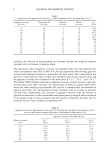
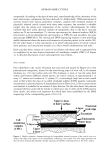
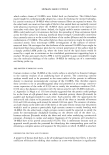
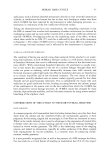
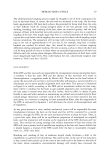
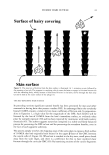
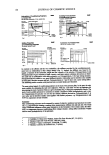
HUMAN HAIR CUTICLE 33 100- 80- 60- 40- i -20- Normal-acids ca. 25 C ø atn=21 Iso-acids Anteiso-acids I ' , i , ' , ill liii,i ,i,l l i 10 20 30 4046 No. carbon atoms for CaHz. Oz acids Figure 6. Graph showing how the melting points of saturated fatty acids vary with carbon content, according to whether they are unbranched (normal-) or contain a methyl branch in the iso- or anteiso- configurations. Note that the melting points of the normal- and iso-fatty acids are similar but that, for a given number of carbon atoms, the melting point for the anteiso-acids is at a much Dower temperature. Taken from Weitkamp (46). methyl group to rotate along the locus of a cone (with the kink at the apex). Such increases in segmental volume and disorder will be important entropic determinants for the liquid-like behavior of the chain terminus of 18-MEA. For one end of 18-MEA to be fixed rigidly and the other end to be endowed with high segmental mobility would seem to belie functional purpose. On the other hand, it is not clear why nature has chosen a chain of such a specific length or, if terminal mobility was required, why this was not accomplished by unsaturation, except that this would have made the lipids more susceptible to oxidative degradation (49). In the context of degradation, K6rner et al. (50) have shown that exposure of wool fabric to artificial sunlight significantly reduces its 18-MEA content and have suggested that the tertiary carbon at position 18 might be susceptible to hydroperoxidation. Such adducts have not
Purchased for the exclusive use of nofirst nolast (unknown)
From: SCC Media Library & Resource Center (library.scconline.org)