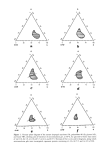
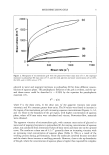
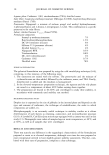
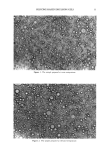
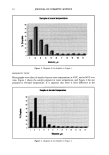
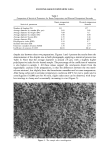
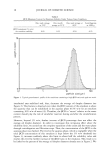
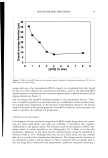
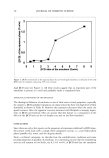
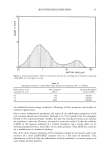
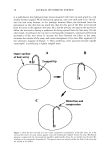
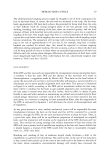
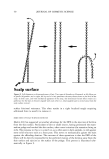
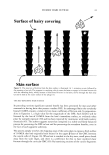
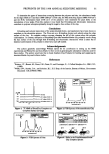
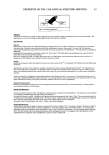
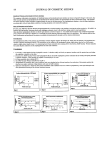
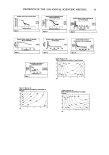
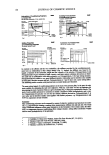
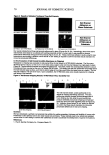
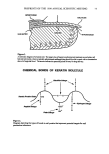
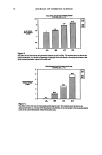
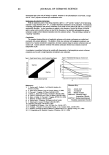
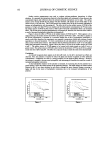
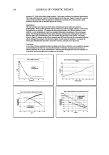
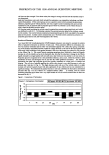
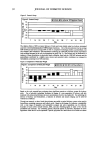
PREPRINTS OF THE 1998 ANNUAL SCIENTIFIC MEETING 79 UNIQUE SOLUTION PROPERTIES OF A POLYAMPHOLYTE --ANIONIC SURFACTANT COMPLEXES G. Matz, B. Durost, R. LaMar and A. Melby Calgon Corporation, P O. Box 1346, Pittsburgh, PA 15230 Introduction: Polyampholytes are polymers synthesized from monomers containing a quaternary ammonium group and monomers containing an ionizable acid group. Unlike cationic polymers, which have been used in hair care formulations for over twenty five years s-2 ,polyampholytes are a more recent addition to the tool kit available to formulators aaø. The mode of action for cationic conditioning polymers in shampoos has been well documented in the literature •'•2. The generally accepted mechanism involves the coulombic attraction of polymer cationic sites for the anionic head groups of the surfactant. In the presence of excess polymer or excess anionic surfactant, clear solutions are obtained. However, the complex precipitates as it approaches a 1:1 stoichiometric ratio. Under use conditions, deposition is reported to occur as the formulation is diluted during application and the complex precipitates. Figure 1 outlines this phenomenon. For ampholytic polymers, a variable situation is observed. The net polymer charge (the difference between cationic charge and artionic charge on a polymer) can lead to "cationic polymer behavior", as described above, or clear formulations that do not precipitate upon dilution. Results and Discussion: Polymer composition, pH and surfactant ratio have a measurable effect on the interaction between ampholytic polymers and artionic surfactants when compared to cationic polymers. The trends observed are outlined below: The pH of a carboxylic acid containing polyampholyte solution will have a marked effect on the •net" charge on the polymer. This is a direct result of the acid-base equilibrium shifting as pH changes. Figure 2 shows how •net" charge varies with degree of neutralization and pH for Polyquatemium 22, a 64/36 m/m DMDAAC/AA copolymer (Merquat ¸ 280 from Calgon Corporation) Polyquatemium 39, a 35/35/30 m/m AA/Am/DMDAAC copolymer (Merquat ¸ Plus 3330 from Calgon Corporation) and Polyquatemium 47, a 45/45/10 m/m AA/MAPTAC/MA copolymer (Merquat ¸ 2001 from Calgon Corporation). The charge on cationic polymers does not change with pH. Polymer Ionic Composition The molar ratio of cationic to anionic monomer units employed in a polyampholyte composition affect the overall 'net • charge on the resulting polymer. Molar excess of one versus the other will sway the "net" charge in that direction. Non-Ionic Monomer Incorporation Uncharged monomers can be incorporated into a polyelectolyte to dilute the overall charge density of a polymer, provide hydrophilic sites on the polymer to encourage the formation of "clear' polymer- surfactant complexes or provide hydrophobic sites to promote polymer-surfactant complex precipitation. Artionic Surfactant - Polymer Interaction When the pH and polymer composition effects are coupled with the addition of artionic surfact,ants to polyampholyte solutions, a complicated interaction develops. As the pH and "net" cationic charge on the polymer varies, the polyampholyte demonstrates a variable ability to form insoluble complexes with artionic surfactants. This complexing tendency being most prominent at lower pH, where the polyampholyte carries a stronger 'net" positive charge. This is in contrast to cationic polymers, which show very little variation in polymer-anionic surfactant complex appearance as a function of pH. The data

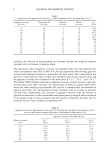
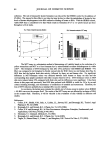
80 JOURNAL OF COSMETIC SCIENCE demonstrate that as the ratio of anionic to cationic monomer in the polyampholyte is increased, a larger area of "clear • polymer-surfactant-pH combinations exist. Implications for substrate interactions With the isoelectric point of hair being reported at pH 3.4 - 4.5 I• and the 'surface" pH of skin being reported to range between pH 4 - 614, a complex deposition mechanism can be postulated. Formulations containing polyampholytes and anionic surfactants can be made at near neutral pH (pH of 6-7) which are aesthetically desirable. As the formulation is applied to the substrate of choice the actions of dilution and/or contact with an acidic surface can lead to the formation of an insoluble polyampholyte-anionic surfactant complex which enhances deposition onto the substrate surface. Thus providing a method for "targeting" deposition. Conclusions The complex forming behavior of ampholytic polymers with anionic surfactants was studied and contrasted with cationic polymers. The ability to form clear solutions with ampholytic polymers was found to be a function of polymer composition, the molar cationic charge to anionic surfactant ratio and solution pH. Cationic polymer solutions with anionic surfactants formed clear solutions relatively independent of pH. A mechanism is postulated wherein the variable pH characteristic of polyampholyte-anionic surfactant complexes can be used to target deposition of polymers onto substrates. Figure 1: Claseic Callonlc Polymer - ArtIonic Surflctant Phase Diagram ARImllC Surfactant (lOg Scale) Figure 2: Polyampholyte Net Charge as a Function of pH 6. 5 References: 1) J. Faucher and E. Goddard, J. of Colloid & Interface $ci., 55 313-318 (1976) 2) A. Sykes and P. Hammes, Drug & Cosmetic Industry, 2 (1980) 3) S. Chen and C. Vaughan, US Patent 5,609,862 (1997) 4) J. Boothe, L. Morse and W. Klein, US Patent 4,764,365 (1994) 5) D. Cohen, E. Hitchcock and S. Pohl, US Patent 5,393,305 (1995) 6) G. Matz, A. Melby, S. Chen and C. Vaughan, EP 522,756 (1993) 7) T. Dhaliwal, US Patent 5,591,425 (1997) 8) A. Darkwa and A. Villanueva, US Patent 5,679,327 (1997) 9) C. Dubief and D. Cauwet, US Patent 5,650,383 (1997) 10) Hollenberg and Matzik, DE 4421031 (1995) 11) E. Goddard and R. Harman, J. Am. Oil Chem. Soc., 54 561 (1977) 12) 13) 14) Monomer Key: AA: Acrylic Acid Am: Acrylamide MA: Methyl Acrylate DMDAAC: Dimethyl Diallyl Ammonium Chloride MAPTAC: Methacrylamidopropyl Trimethyl Ammonium Chloride E. Goddard, J. Faucher, R. Scott and M. Turney, J. Soc. Cosmetic Chem., 26 539 (1975) C. Robbins, Chemical and Physical Behavior of Human Hair 2 • ed., Springer-Verlag, NY (1988) G. Yosipovitch and H. Maibach, Cosmetics & Toiletries, 111 101 (1996)
Purchased for the exclusive use of nofirst nolast (unknown)
From: SCC Media Library & Resource Center (library.scconline.org)