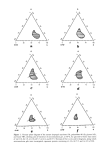
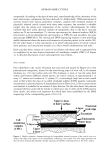
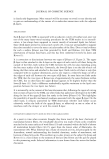
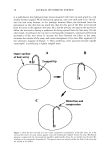
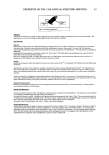
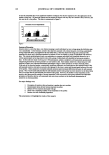
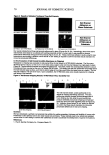
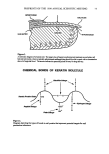
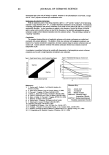
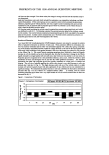
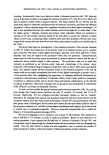
38 JOURNAL OF COSMETIC SCIENCE it is well-known that laboratory hair tresses mounted with their tip-ends glued to a tab readily become tangled. With mechanical agitation, such root-ends tend to be "driven" into the hair array because, in the jostlings between fibers, the frictional forces for movements in this direction are much less than for this part of the fiber to be ejected from the array in the opposite direction. By a similar process, one expects the tip-end to follow the root-end in having a preference for being ejected from the hair array. On the other hand, if perchance the tip-end is mechanically entrapped, continued preferential movement of the root serves to increase the force between the fibers in the array, decreases the volume of the array, and causes entrapment of yet more fiber segments (cf. the schematic diagram of Figure 7). Once underway, these processes become rapidly catastrophic in producing a tightly tangled mass. Outer surface A B of hair array d tip C Distortion and compressio Figure 7. How the free root-end of a hair causes compressive entanglement of the hair array. At A the root-end (R) enters the array surface against a tip-end mechanically trapped within the array. Mechanical agitation, coupled with the directional friction effect, preferentially drives the root further into the array (B), resulting in its compressive distortion (C). This process can occur entirely within the bulk of the array and not merely at its surface.

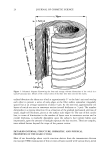
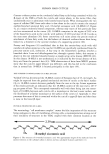
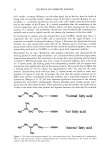
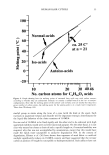
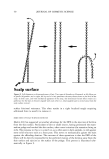
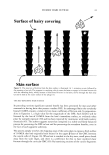
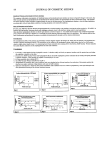
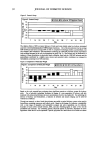
HUMAN HAIR CUTICLE 39 The aforementioned tangling process might be thought to be of little consequence for hair on the head where, of course, the root-ends are anchored in the scalp. On the other hand, approximately 100 hairs daily achieve the potential for being shed from the scalp as their follicles reach the resting (telogen) phase of the hair growth cycle. During washing, brushing, and combing of the hair, these are removed quickly, and the brief presence of hairs with detached root-ends seems not normally to give rise to significant tangling of the hair. One might argue that here is a critical proportion of loose hairs in a given hair style below which tangling does not occur but above which tangling might become calamitous. The proportion will increase with increasing time between groom- ings at the rate of approximately 0.1% per day. If, for example, long hair is neither brushed nor combed for several days, this would be expected to increase tangling difficulties during subsequent washing. On rare occasions, such as in those who have lain sick for long periods of time or in those where an unusually high proportion of their hair follicles reach the resting phase (telogen effluvium), the proportion of shed hairs could reach dangerously high levels. This could explain the rare, calamitously tangled, state known as "bird's nest hair" (62,63). HAiR ALIGNMENT If the DFE and free root-ends are responsible for entanglement among mammalian hairs, a corollary is that the same DFE and the absence of free root-ends will result in disentanglement, a suggestion made by Martin (64). Thus hairs on the head (where of course the root-ends are not free to move) predictably will possess a natural tendency to disentangle and to attain parallel alignment with each other. This process is illustrated in Figure 8 in which, according to the DFE and to movements within the hair array, there will be a tendency for the hairs to gain parallel alignment and, interestingly, for the hair array to extend away from the skin surface. Such an effect is clearly of great benefit to man and other animals in maintaining an ordered and extended style for their natural pelage. Systematic scientific study of this effect has not been reported, but one anticipates, as a converse to tangling in loose mammalian fibers, that the magnitude of the DFE as expressed by Equation 1 will determine the extent of disentanglement and of alignment. At any given moment in time, random mechanical events will be responsible for some misalignment between the hairs on the head, and this will be countered by a natural tendency, through the DFE, for the same mechanical events to align the hairs. Thus, in a given hair style, there will be an equilibrium proportion of misaligned (or tangled) hairs, and that proportion will increase as the magnitude of the DFE decreases and vice versa. This conveys the strong message that toiletry treatments of hair that reduce the DFE will cause a greater level of equilibrium tangling in the hair and, heaven forbid that it should happen, a reversal of the DFE would drive the hair to catastrophic entangle- ment (i.e., bird's nest hair). Brushing and combing of hair of moderate length clearly facilitates a shift in the equilibrium to a greater level of ordering. The caveat to this, in the case of very long hair, is that crossed hairs picked up by the tines of the comb tend to be drawn to the ends of the hairs, where cumulative environmental damage will usually have increased the
Purchased for the exclusive use of nofirst nolast (unknown)
From: SCC Media Library & Resource Center (library.scconline.org)