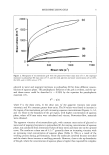
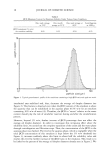
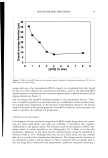
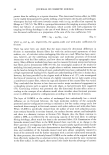
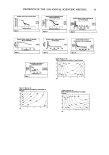
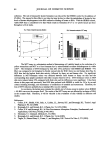
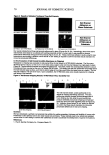
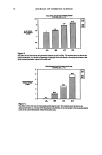
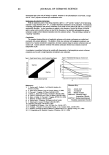
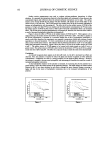
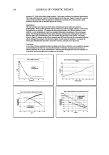
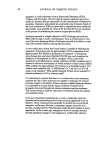
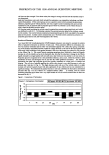
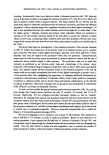
PREPRINTS OF THE 1998 ANNUAL SCIENTIFIC MEETING 59 INVESTIGATION OF CONDITIONING POLYMERS FOR HAIR STYLING Peter Hossel, Ph.D. BASF AG, Ludwigshafen (Germany) Introduction Cationic polymers are impotlant components of haft-care products such as shampoos, mousses, hair treaUnents, rinses and gels. Most of these products are quaternmy substances that, because of their cationic nature, have a high affinity to the surface of the hair, which is negatively charged. The most important function of these substances, the protection of the haft surface and the improvement of wet- combability are a result of their substantivity, i.e. their ability to adsorb to the haft. In addition to practical tests that are conducted in the haintressing salon, quick and reproducible laboratory tests are needed to assess cationic polymers and their properties on the hair. We have tested the major quaternary polymers individually and in the combinations found in the markel. Because these cationic polymers have different chemical structures, their technical properties and fields of application can differ quite considerably. Many of the practical properties of these polymers can be determined and compared using objective test methods, without having to resort to costly consumer and salon tests. Objective of the study The present study concentrates on a polyelectrolyte fitration, an analytical method for assessing the adsorption of cationic polymers to the haft, and correlating this with their charge density. Another purpose of this paper is to present tests for such practical properties of styling products as stiffness, combing force and lack. Materials and method The following commercially available cationic polymers were investigated: Polyquatemium-4 and Polyquatemium-10 (quaternized cellulose), Polyquatemium-6 (polydiallyldi- methyl-ammonium chloride), Polyquaternium-7 (diallyldimethylanunonium chloride/ acrylamide copolymer), Polyquatemium-11 (vinylpyrrolidonedquatemized dimethylaminoethylmethacrylate copolymer), Polyquaternium-16 (vinylpyrrolidoned vinylimidazolium chloride (VI) copolymers) and Polyquaternium-46 (vinylcaprolactam/vinylpyrrolidone/vinylimidazolium methylsuffate). The charge density (cationic activity) of the polymers was determined by means of a Type 90 pho- toelectric tiwator developed at BASF AG •. In this method, the cationic polymer is titrated against potassium polyvinyl surfate to yield a polymer-polymer complex. When the entire cationic polymer lma been complexed, the excess polassium polyvinyl sadfate reacts with the toluidine blue O indica- tor, changing its colour from blue to pink. The endpoint was determined with a special photometer with one red and one green diode that match the absorption spectrum of the indicator. This dual beam method ensures that any turbidity due to the polymer-polymer complex does not obscure the end- Dark brown caucasian hair swatches were used to determine the adsorption of the cationic polymers. The adsorption was determined from the decrease in polymer concentration in the solution (200 mgtl) after 10 min a. Wet combing force measurements were performed on medium bleached swatches of caucasian hair and the stiffaess tests a on virgin dark caucasian hair by m•nn of an Easy-Test 86802/E tensile tester. The tack of the polymer films was determined with a special lack-testing ilLqtrtlment 4. Results and Discussion Depending on the type of polymer, •he quantity adsorbed varied between I and 5 mg/g haft. Fig. 1 shows that there is a direct correlation between the charge density of the polymer and the q,•ntity adsorbed. The higher the charge density, the less polymer is adsorbed on the hair. Evidently, the lower the charge density of the polymer, the greater the quantity requingd to neutralize the negatively charged surface of the hair. The decrease in combing force is also a function of the positive charge (Fig. 2). The higher the charge density, the greater the conditioning effect and the reduction in resinante to combing

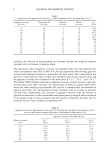
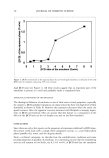
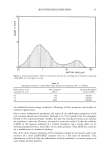
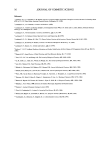
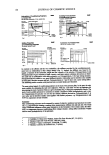
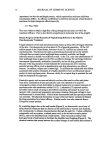
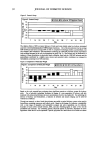
60 JOURNAL OF COSMETIC SCIENCE Adsorption of Conditioning Polymers to Huntan Hair 200 mg/I in'•al concentral]on -10 min. relclion brae pa•lUdefidum i •4 e. i PQ11 ß I 16:30• VI 16:5016 VI PQ6 16:95% VI Combing Force Decrease Barn= of Conditioning Polymers 1% polymer, Iolut•n In w•tir INCI n•me ½•bnK AJ•d•/ Po•qua•m•um 0 t,2 2,4 3,8 4,8 8 nm•g 2 8• on 111 #l• Setting Properties BJ.l: Tackiness of a Polymer Film of Conditioning Polymers 75• tel. hum., •Olu•on in wm•r Viscosity IHCl n•n* Pdyqud• •Y, solids (mPis) p•qud*n*Jm , IN3 4 , I 4 529 PQ 46 , , IN346 , I • PQ4 F)Q11 ,, ' • 192 PQ10 , IN3 10 , I 1 010 PQ 11 IN3 le HM s ' ] 72 PQ7 IN3 7 I I • pQ 16:50• VI HM IN3 6 ' I 11 PQ 16:95% VI IN3 16 I ' I 4-9 PVPNA Copo•mer 0 SO led 160 2Q• cN •lffl•m• lid e 6 4 • Z I Oi•8(mlktg) In conUast to the affmi• and the wet combability, the stiffness provided by the conditioning poly- mers bore no relationship to their charge density (Fig. 3). Instead, the sfiff•ess was found to be largely a function of the molecular weight and the viscosity of the solutiom Polyquatemium-4 and Polyquatemium-10 give solutions of high viscosity, and these cationic cellulose derivatives are there- fore used only in combination with other polymer, e.g. Polyquatemium-11 for hair styling mousses. Polyquatemium-46 exhibits a very good stiffness/viscosity relationship and is therefore also suitable for hair sprays besides mousses and gels. Polyquatemiums 6, 7 and 16 have only a poor setting effect. The sfiffenlng results correhte with practical tests on model heads and volunteers. The most critical aspect of conditioning polymers is the tack of the polymer film. In the past, the only tests awil•ble for esfimn•ing the tack were subjective. With our tack tester 4 we have an apparatus for determiniag the lack of polymer films at a given h. midity (Fig. 4) that gives reproducible results. The tack of water-soluble polymers for cosmetics is mainly a function of their hydrophubicity and is zero for Polquatemium-46 and also very low for the cationic cellulose derivatives. Polyquatemium-11 is very mc, ky and is therefore mainly used together with further polymers, e.g. Polyquatemium-4 and PVPNA copolyme• in hair mousses. Summary Hair conditioning polymers can be assessed by means of objective analytical and practical test meth- ods, e.g. polyclectrolyte tiUafion, combing force measurement, stiffness test and tack tesC The broad range of different substances offers many alternatives to the formldntor. But in many cases, the selec- tion is a compromise between conditio-ing effect (charge density), setting effect (molecular weight) and low tack (hydmphubicity of the polymer). U. SchrOder, D. Horn, K.H. Wallruer, Seij•n-Ole-Fette-Wachse, 117, 311 ( 1991 ). P. Hoossel, Seifen-Ole-Fette-Wachse, 120, 874 (1994). F. Fmsclg F. Vogel, Cosmet/ques• Aromes 89, 71 (1989). P. Hoessel, Cosmetics & Toiletties 111, 73 (1996).
Purchased for the exclusive use of nofirst nolast (unknown)
From: SCC Media Library & Resource Center (library.scconline.org)