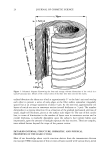
28 JOURNAL OF COSMETIC SCIENCE There is little doubt that the high level of crosslinking afforded by the exocuticle's cystine content will provide considerable strength and, in combination with the over- lying A-layer, will be fitting in the role of protecting the other surface of the hair from mechanical damage. THE ENDOCUTICLE The distinctive feature of this sheet-like proteinaceous subcomponent of highly variable thickness within each cuticle cell (ca. 50 to 300 nm) is the low concentration of cystine it contains as compared with the other major constituents of the cuticle. Reliable amino acid analyses have been obtained for the whole endocuticle and some of its substructures following differential digestion of physically isolated cuticle from human hair with a selection of proteases (6). Elevated levels of acidic and basic amino acid residues are in accord with moderately intense staining of the endocuticle seen under the TEM in sections stained with uranyl acetate/lead citrate (UA/LC) and phosphotungstic acid (PTA), respectively (5). The endocuticle seems to consist of the cellular debris remaining and pushed to one side as the A-layer and exocuticle have formed. Most TEM staining regimes show it to be of moderately coarse but irregular structure, even showing occa- sional pockets of cystine-rich material, which are evidently minor incursions from the adjacent exocuticle. Light microscope observations by Kassenbeck (25), in which he separated cuticle by high-temperature treatments with mixtures of ethylene glycol and toluene sulphonic acid, demonstrated the presence of a disk-like unit in the center of each cell sheet, undoubtedly defining the location of the cell's effete nucleus within the endocuticle. Using systematic protease digestions, Swift and Bews (6) were able to show that the endocuticle consists of at least three chemically and morphologically distinct protein components of relatively low cystine content, but all containing higher levels of acid and basic amino acids than other cuticle structures. These were identified as the chromatin of the effete nucleus, the non-chromatin components of the nucleus, and the non-nuclear debris. That these structures are so readily digested by non-reductive pro- tease treatments points to isodipeptides and disulphides being absent from them. Intact proteins have not been isolated, and so nothing is known of their amino acid sequences and likely conformations. The high basic and amino acid content of the endocuticle, coupled with the relative absence of intermolecular crosslinks in the form of cystine or isodipeptides, are likely to render this component mechanically soft and susceptible to significant swelling by water. These are in sharp contrast to the expected behavior of the other major compo- nents of the cuticle, the A-layer and exocuticle (see above). Atomic force microscope (AFM) observations of human hair (26) and wool (27) have indicated a considerable increase in the surface-scale step heights of the fibers as they are taken from a dry to a water-wet state. Most of this change is probably accommodated by swelling of the endocuticle and little by the cuticle's other structures. It is conjectural whether the endocuticle confers any special advantages to the owner's hair. One possibility is that it might offer some protection by providing a cushion beneath the tougher outer layers of each cuticle cell from forces impacting the hair surface. THE INNER LAYER This relatively minor lameliar subcomponent sits between the endocuticle and the CMC

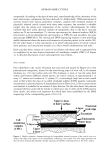
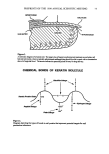
HUMAN HAIR CUTICLE 29 and is between 10 and 40 nm thick. The term "inner layer" seems to have been first coined by Orfanos and Ruska (28). Its appearance under the TEM, its high cystine content, and its susceptibility to protease attack all mimic the exocuticle. The proteins it contains are therefore probably identical to those of the exocuticle. Functionally it provides rigid support for the lipids of the lower [3-layer (see below). THE CELL MEMBRANE COMPLEX (CMC) This thin multicomponent layer separates all cuticle cells from each other. The detailed internal structure and today's accepted nomenclature for the components were first presented by Rogers (11) following his seminal observations with the TEM of stained sections of hair and wool. The CMC is more or less planar and separates cuticle cells from each other. It is of relatively constant thickness (in the range 25 to 28 nm). PTA staining provides excellent contrast in the TEM for the CMC to exhibit a tram-line appearance of two unstained layers ([3-1ayers) of between 2.5 and 4.0 nm thickness, separated by an intensely stained layer (8-layer, 8-band, intercellular cement or "glue") 15-18 nm thick. The CMC is generally considered to embrace the two [3-1ayers and the intervening 8-layer, although in the fullness of time, it might be considered appropriate to include other thin peripheral layers of protein. THE 8-LAYER Jones and Rivett (1) have shown in sections of human hair, pretreated by Rogers' (11) thioglycollic acid/osmium tetroxide procedure and then post-stained with UA/LC, that the 8-layer contains a central lamina of ca. 5 nm thickness and of lesser staining intensity. Great uncertainty remains about the chemical composition of the 8-layer and its substructures on account of the difficulty of isolating it chemically unchanged and uncontaminated by components from other parts of the hair shaft (29). There is ample evidence from electron histochemical observations that the 8-layer does not contain cystine (5), but one needs to keep an open mind about whether it's mainly proteinaceous or whether it might be polysaccharidic or a mixture of the two, like a glycoprotein. This author inclines to the latter viewpoints principally because of the resistance of the cuticular 8-layer to the action of the highly aggressive protease agent papain/dithiothreitol in treatments either of the bulk fibers or thin sections of them (15). The 8-layer stains with the periodic acid/silver methenamine procedure, a well-known method for polysaccharides in which vicinal-diols are oxidized by periodate to aldehydes, which in turn result in the deposition of granular silver with the silver reagent (5). Intense staining of the 8-layer seen with PTA can also be explained as due to the ionic interaction at low pH of the phosphotungstate trivalent anion with the protonated hydroxyls of a polysaccharide (5). There is also electron histochemical evidence for the presence of free amino groups that also bind PTA (30). Yet further, Orwin (31) in TEM investigations of sections of wool follicles observed a polysaccharidic coating on all the cells, and it is not unreasonable to suppose this material becomes incorporated as the principal component of an intercellular "glue" in the 8-layer. Allen eta/. (32) discovered glycoproteins in the residues extracted from a variety of keratin fibers (including human hair) with 98% formic acid, a reagent that is thought to remove material, albeit probably not specifically, from the CMC. Our knowledge of the chemical makeup of the 8-layer
Purchased for the exclusive use of nofirst nolast (unknown)
From: SCC Media Library & Resource Center (library.scconline.org)