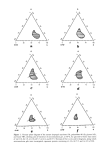
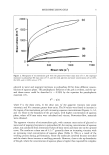
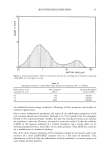
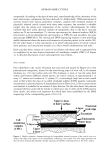
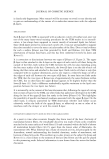
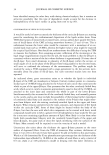
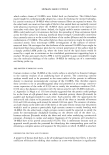
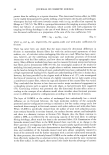
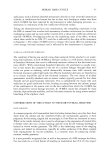
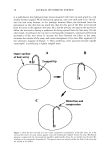
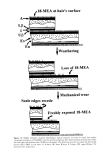
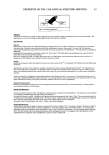
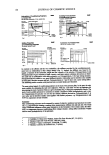
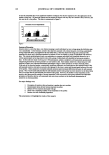
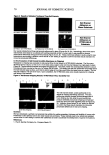
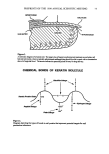
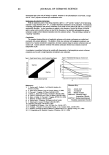
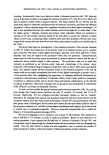
• 18-MEA at hair's surface Ex En Weathering Loss of 18-MEA Scale edges recede • Mechanical wear Freshly exposed 18-MEA Figure 10. Highly schematic diagram illustrating a typical sequence of events in which hair surface 18-methyl eicosanoic acid (18-MEA) is lost by natural weathering, after which mechanical interaction erodes the scale edges and discloses fresh 18-MEA at the surface. The latter process serves to sustain the directional friction effect (DFE) in the hairs. A: A-layer L[3: lower [3-layer 8: 8-layer U[3: upper [3-layer Ex: exocuticle En: endocuticle.

HUMAN HAIR CUTICLE 43 in the TEM, it is noticeable that portions of the CMC containing the 8-layer are located much more frequently on the endocuticular side of each fragment than on the side with the A-layer. This observation, taken with that of splitting seen in hair sections (noted above), points to the upper [•-layer as a plane of weakness and of preferred separation during dry combing. As to precisely where at the molecular level the split propagates, this is likely to be at the surface of the terminal anteiso-groups of the 18-MEA where the shear strength is predictably low. During the wet combing of hair, the softened endocuticle is a preferred plane for fracture, but even in this case, the granular endo- cuticular debris is very quickly eliminated in normal hair with shampooing and dry handling (65), again with a preference for revealing a fresh surface of 18-MEA. Combing of otherwise undamaged hair yields fragments the largest of which are platelets 1 to 2 lnm across. They are angular in shape and their edges are more or less perpen- dicular to each sheet, characteristics that seem consistent with brittle fracture, as the surface scale edges of the original fibers have been bent backwards. This is surprising, given the general traverse of the comb from root to tip in a "with-scales" direction. One presumes, therefore, that the local orientation of fibers in the array on rare occasions has conspired in against-scales frictional contacts, either between the tines of the comb and the hair or, more likely, between the hairs themselves, to produce the platelet-like fragments. The chipping away of scale edges on hair and the exposure of fresh 18-MEA at the hair surface is normally sufficiently gradual to sustain the hair for most of its lifetime, albeit the number of overlying cuticle cells also gradually diminishes from the root to the tip of the fiber (4). Indeed it is pertinent to mention that, since the average scale overlap distance is 5 lnm and the scale measure approximately 60 lnm in a longi- tudinal direction, there is the opportunity for complete restoration of 18-MEA at the hair surface twelve times before the cuticle is completely eliminated. The rate of loss of cuticle in the hairs of any person is determined by several factors, which include extent of exposure to sunlight and cosmetic habits. The layer of 18-MEA seems to have been conspired as a weak point in the upper I•-layer to facilitate preservation of the DFE, but then its interfacial strength is sufficiently high to maintain the structural cohesiveness of the cuticle as a whole. Even more remarkable is the fact that its strength is sufficiently high, coupled with a subtly balanced bending shear strength in the single thickness of a cuticle cell, to ensure that only small pieces mechanically fracture from the surface scale edges. SUMMARY AND CONCLUSIONS The hair cuticle presents: 1. Tough outer layers (A-layer and exocuticle) to help withstand chemical insult and an associated sublayer (the endocuticle) that helps the hair to withstand frictional and impactive insults. 2. Limited bending stress to brittle fracture, ensuring that only small pieces of cuticle are shed by mechanical abrasion. 3. A layer of 18-MEA located in the upper I•-layer of the CMC that is responsible for the low surface energy and low coefficient of with-scales friction of the hair's outer surface. 4. Low with-scales friction that, in association with the high against-scales friction, maintains directionally dependent frictional behavior.
Purchased for the exclusive use of nofirst nolast (unknown)
From: SCC Media Library & Resource Center (library.scconline.org)