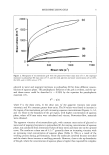
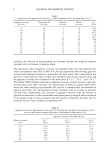
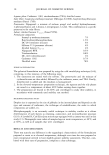
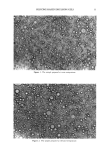
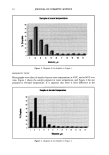
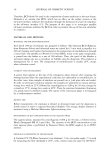
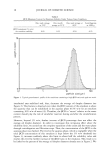
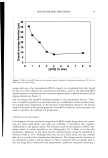
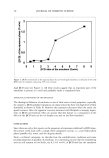
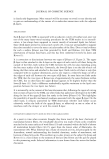
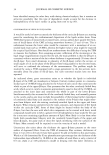
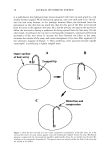
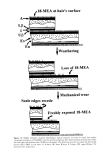
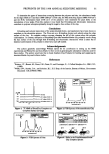
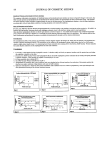
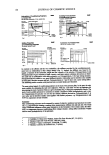
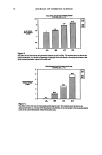
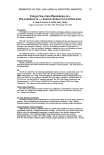
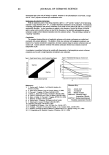
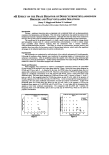
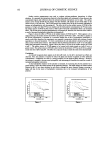
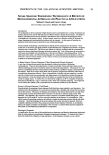
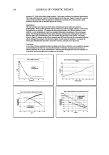
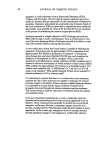
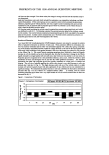
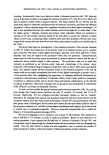
20 JOURNAL OF COSMETIC SCIENCE Q. •3 o 1,5 0,5 0 1 2 3 4 5 6 7 8 9 •CD ratio of the emulsion (%wlw) Figure 3. [3CD concentration in the aqueous phase of a one-week-aged emulsion as a function of the total [3CD ratio of emulsions containing 30% w/w of water. high [3CD ratio (see Figure 1). All these results suggest that an important part of the emulsifier is present as a solid and probably under a complexed form. RHEOLOGICAL PROPERTIES OF THE EMULSIONS The rheological behavior of emulsions is one of their most critical properties, especially for cosmetics. [3CD-stabilized emulsions are characterized by their very high level of flow threshold, as shown in Table II. However this parameter decreases when the strain rise speed increases. Also, the apparent viscosity measured with Helipath is strongly depen- dent on [3CD concentration. One can assume that this feature is a consequence of the effect of the [•CD ratio on the oil droplet size and on the flow threshold. CONCLUSION Since there are only a few reports on the properties of emulsions stabilized by [3CD alone, the present work deals with a simple three-component system, i.e., pure hydrocarbon phase (paraffin oil), water, and the oligosaccharide. From a technical viewpoint, we describe here the emulsification conditions and some peculiar properties of paraffin oil emulsions. It is interesting to note that the emulsifying activity still remains at low levels, say 0.2-0.5 w/w%, of [•CD and that the emulsions

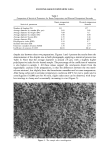
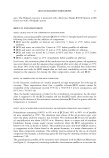
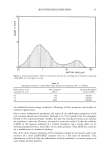
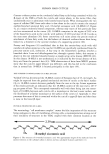
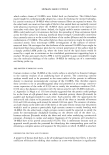
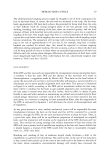
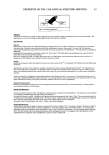
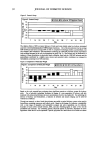
[3CD-STABILIZED EMULSIONS 21 10. o o,1 1 lO pc•rticle size { j_tm } Figure 4. Typical granulometric profile of the bottom obtained by centrifugation of emulsions containing a high [3CD ratio and aged one week. Table II Rheological Properties of One-Week-Aged Emulsions Containing 30% v/v of Water [3CD content of the Flow threshold emulsion (% w/w) (N/m 2) Helipath Brookfield viscosity (CPS) 0.4 540 80,000 1.5 650 160,000 5.0 2000 500,000 can withstand various storage conditions. Advantage of these properties can be taken in industrial applications. From a more fundamental standpoint, the origin of the stabilization properties of the cyclic oligosaccharide are still unclear. Shimada et al. (7,10) consider that the complexes formed at the triglyceride/water interface decrease the interfacial tension and stabilize the emulsion in this way. However, we noted in a previous work (14) that the addition of [3CD in the aqueous subphase of a triolein monolayer has a strong effect on its rheological properties but a weak effect on its surface pressure. Thus, [3CD also could act via a modification of interfacial rheology. One of the most amazing properties of the emulsions studied in the present work is the existence of a solid paraffin-[3CD complex even at a low ratio of emulsifier. This phenomenon could also help the stabilization of these emulsions--a known property of some highly divided powders.
Purchased for the exclusive use of nofirst nolast (unknown)
From: SCC Media Library & Resource Center (library.scconline.org)