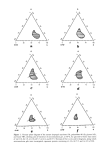
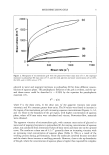
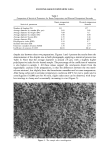
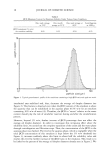
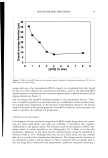
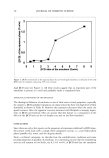
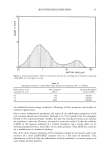
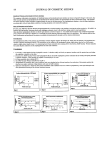
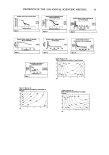
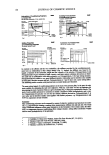
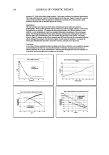
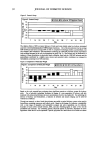
MICROEMULSION GELS 5 2000 1500 1000 500 (c) (b) (a) 0 500 1000 1500 Shear rate (s 4) Figure 2. Rheograms of microemulsion gels with the glycerol-to-water mass ratio of 3:7, the isopropyl myristate to polysorbate 80 mass ratio of 5:5, and the total glycerol and water concentration of: (a) 20%, (b) 30%, and (c) 40% w/w at 37øC. glycerol to water and isopropyl myristate to polysorbate 80 for three different concen- trations of aqueous phase. The pseudoplastic behavior of the gels is evident, and the up- and down-curves could be described (r 0.990) by the equation for pseudoplastic materials (15), F N = •'G where F is the shear stress, G the shear rate, •1' the apparent viscosity (one point viscosity), and N a constant greater than unity. The N values were found to increase in the region of microemulsion gel with increasing aqueous concentrations (Figures l c, ld, and le). Close to the boundary of the gel region, with higher concentration of aqueous phase, values of N near unity were calculated and viscous, Newtonjan-flow, materials were obtained. The apparent viscosity of microemulsion gels, with constant mass ratios of glycerol to water and of isopropyl myristate to polysorbate 80, for varying concentration of aqueous phase, was calculated from determined values of shear stress and shear rate on the upward curve. The results at a shear rate of 4.2 s -1 generally show an increasing viscosity with an increasing total concentration of aqueous phase (Table I). This is a result of the swelling process during gel formation, where the molecules involved become stretched and the elastic forces increase as swelling proceeds. However, close to the up-boundaries of the gel, where the concentration of aqueous phase is higher than required for complete

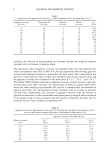
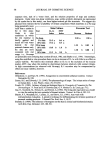
6 JOURNAL OF COSMETIC SCIENCE Table I Composition and Apparent Viscosity ('q'4.2) of Microemulsion Gels at the Shear Rate of 4.2 s -• Isopropyl myristate Polysorbate 80 Glycerol Water qq'4.2 (% w/w) (% w/w) (% w/w) (% w/w) (Pa s) 32 48 4 16 46.5 3O 46 5 19 56.8 28 42 6 24 103.2 26 40 7 27 111.8 24 36 8 32 110.1 20 30 10 40 56.8 25 37 19 19 3.8 24 36 2O 2O 4.1 23 35 21 21 5.4 22 34 22 22 4.5 21 33 23 23 4.3 2O 3O 25 25 4.1 swelling, the viscosity of microemulsion gel decreases because the molecule cohesion decreases with an increase of aqueous phase. The maximum value of apparent viscosity was obtained when the total glycerol-and- water concentration was close to 40% w/w, for all preparations with varying glycerol- to-water and isopropyl myristate to polysorbate 80 mass ratios. This concentration was selected to determine the values of shear rate and shear stress on the upward curve, and the apparent viscosity was calculated at the shear rates of 4.2 s -•, 34 s -•, and 136 s -• The results (Table II) show a decrease in apparent viscosity, with an increase in glycerol- to-water mass ratio. This is because the concentration of water in aqueous phase deter- mines the water swelling of polysorbate 80, and for a constant total concentration of glycerol and water, the concentration of water decreases with an increase in glycerol- to-water ratio. Additionally, this decrease in apparent viscosity with the increase in glycerol-to-water ratio, at the concentration of aqueous phase giving the most viscous gel in all systems, leads to the conclusion that the presence of glycerol decreases the po- tentiality for the water swelling of polysorbate 80. Table II Apparent Viscosity of Microemulsion Gels with the Total Glycerol and Water Concentration of 40% w/w and the Constant Isopropyl Myristate to Polysorbate 80 Mass Ratio of 4:6 Apparent viscosity at the shear rates of: Glycerol-to-water 4.2 s -• 34.1 s -• 136.0 s -• ratio (Pa s) (Pa s) (Pa s) 0:10 172.0 72.5 21.3 1:9 137.6 63.9 16.0 2:8 110.1 50.3 13.7 3:7 99.8 36.2 12.8 4:6 68.8 25.1 7.9 5:5 41.3 8.5 4.2 6:4 17.2 3.8 1.0
Purchased for the exclusive use of nofirst nolast (unknown)
From: SCC Media Library & Resource Center (library.scconline.org)