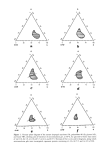
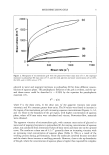
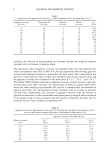
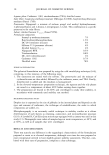
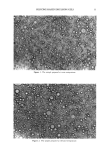
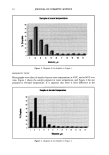
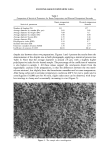
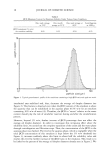
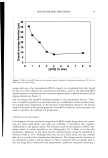
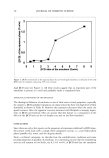
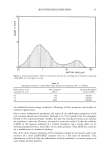
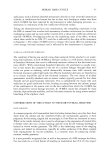
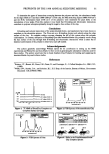
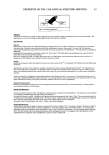
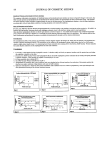
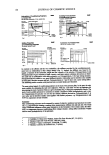
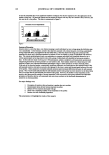
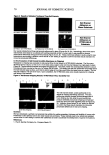
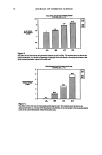
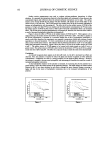
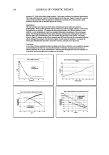
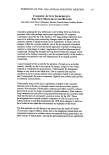
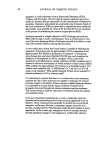
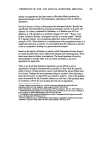
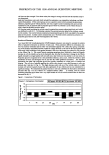
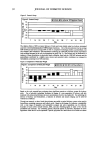
SILICONE-BASED EMULSION GELS 13 Table I Comparison of Statistical Parameters for Room-Temperature and Elevated-Temperature Formulas Statistical parameters Room-temperature Elevated-temperature formula formula Number of droplets (N) Average diameter by number (Dn, lam) Average diameter by weight (Dw) Average diameter by volume (Dv) Average diameter by area (Ds) Average diameter (Dz) Polydispersive index (PDI) Standard deviation (SD) Geometric standard deviation (GSD) Coefficient of variation % (CV) 231 357 2.81 2.81 7.O9 7.6 3.96 4.O9 3.35 3.41 8.27 8.89 2.52 2.7 1.82 1.93 1.76 1.77 64.81 68.42 droplet size between these two preparations. Figures 3 and 4 present the results from the determination of the droplet size in both photographs, applying a statistical process (see Table I). Note that the average diameter is around 2.8 !am, with a slightly higher polydispersive index for the heated sample. The percentage of the coefficient of variation is also higher in sample 2. All these values support the conclusions drawn from the organoleptic analysis of the preparations, in that the differences between the two meth- ods are minimal, but slightly favor the formulation manufactured at room temperature. After being subjected to extreme temperature conditions (60øC for over a week) and to centrifugation (10,000 rpm for 30 min), slight coalescence can be observed, with drop- lets tending to clump and occasionally increasing in size (Figure 5). & . Figure 5. The sample after centrifugation.

14 JOURNAL OF COSMETIC SCIENCE CONCLUSION The emulsion manufactured at room temperature has organoleptic characteristics similar to those of the emulsion prepared at elevated temperature, while its stability is slightly better, leading to the conclusion that the room-temperature preparation technique is preferable in silicone-based emulsions. ACKNOWLEDGMENT We thank Christine Marie Laurin for translating the original manuscript into English. REFERENCES (1) G. Dahms, Choosing emollients and emulsifiers for sunscreen products, Cosmet. Toi/etr. 109(11), 45-54 (1994). (2) D. T. Floyd, Formulation of sun protection emulsions with enhanced SPF response, Cosmet. Toi/etr. 112, 55-63 (1997). (3) A.J. Disapio and M. S. Starch, "Using Silicones in Topical Products," in Topical Drug Delivery For- mulations (Marcel Dekker, New York, 1990), pp. 389-409. (4) J. Smid-Korbar, J. Krist, and S. Srcic, Polydimethylsiloxane oil in ointments, Pharm. J. Slovenia, 37, 86-90 (1986). (5) M. A. Ruiz, A. Hernandez, A. Parera, and V. Gallardo, Dimethylsiloxane polymers: Vaporization rate test/freezing temperatures,J. Soc Cosmet. Chem. 46, 175-180 (1995). (6) C. Cabeza, Derivados organomodificados de silicona. Formulaciones cosm6ticas en emulsiones. Elabo- raci6n de emulsiones en frio. Aplicaciones. NCP, 173, 17-24 (1990). (7) A.J. Disapio and M. S. Starch, New silicones emulsifier technology, Cosmet. Toi/etr. 96, 55-57 (1981). (8) P. Hameyer and C. Bould, Organosilicone W/O emulsifiers, Man•f Chem., 20, 23-25 (1990). (9) R. Franquesa et al., Estabilidad de medicamentos A.E.F.I. (1985). (10) B. Artalejo, C. Fauli, and A. Del Pozo, Preformulaci6n de emulsiones: Estudio conductim6trico, Ind. Farm. 7/8, 91-99 (1987). (11) C. Phyllis, Am. Perf•m. Cosmet., 4, 77 (1962).
Purchased for the exclusive use of nofirst nolast (unknown)
From: SCC Media Library & Resource Center (library.scconline.org)