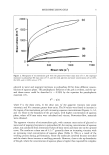
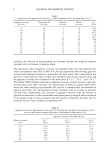
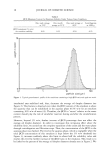
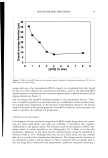
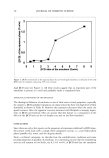
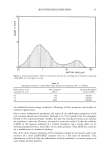
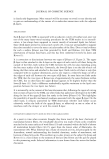
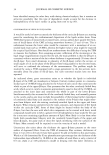
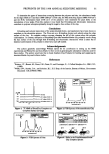
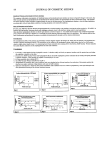
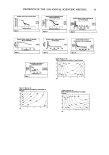
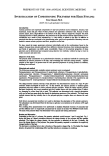
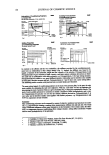
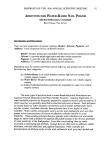
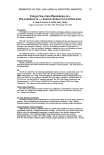
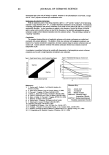
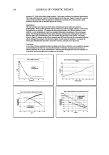
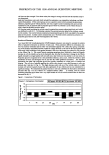
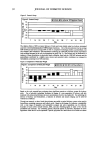
60 JOURNAL OF COSMETIC SCIENCE Adsorption of Conditioning Polymers to Huntan Hair 200 mg/I in'•al concentral]on -10 min. relclion brae pa•lUdefidum i •4 e. i PQ11 ß I 16:30• VI 16:5016 VI PQ6 16:95% VI Combing Force Decrease Barn= of Conditioning Polymers 1% polymer, Iolut•n In w•tir INCI n•me ½•bnK AJ•d•/ Po•qua•m•um 0 t,2 2,4 3,8 4,8 8 nm•g 2 8• on 111 #l• Setting Properties BJ.l: Tackiness of a Polymer Film of Conditioning Polymers 75• tel. hum., •Olu•on in wm•r Viscosity IHCl n•n* Pdyqud• •Y, solids (mPis) p•qud*n*Jm , IN3 4 , I 4 529 PQ 46 , , IN346 , I • PQ4 F)Q11 ,, ' • 192 PQ10 , IN3 10 , I 1 010 PQ 11 IN3 le HM s ' ] 72 PQ7 IN3 7 I I • pQ 16:50• VI HM IN3 6 ' I 11 PQ 16:95% VI IN3 16 I ' I 4-9 PVPNA Copo•mer 0 SO led 160 2Q• cN •lffl•m• lid e 6 4 • Z I Oi•8(mlktg) In conUast to the affmi• and the wet combability, the stiffness provided by the conditioning poly- mers bore no relationship to their charge density (Fig. 3). Instead, the sfiff•ess was found to be largely a function of the molecular weight and the viscosity of the solutiom Polyquatemium-4 and Polyquatemium-10 give solutions of high viscosity, and these cationic cellulose derivatives are there- fore used only in combination with other polymer, e.g. Polyquatemium-11 for hair styling mousses. Polyquatemium-46 exhibits a very good stiffness/viscosity relationship and is therefore also suitable for hair sprays besides mousses and gels. Polyquatemiums 6, 7 and 16 have only a poor setting effect. The sfiffenlng results correhte with practical tests on model heads and volunteers. The most critical aspect of conditioning polymers is the tack of the polymer film. In the past, the only tests awil•ble for esfimn•ing the tack were subjective. With our tack tester 4 we have an apparatus for determiniag the lack of polymer films at a given h. midity (Fig. 4) that gives reproducible results. The tack of water-soluble polymers for cosmetics is mainly a function of their hydrophubicity and is zero for Polquatemium-46 and also very low for the cationic cellulose derivatives. Polyquatemium-11 is very mc, ky and is therefore mainly used together with further polymers, e.g. Polyquatemium-4 and PVPNA copolyme• in hair mousses. Summary Hair conditioning polymers can be assessed by means of objective analytical and practical test meth- ods, e.g. polyclectrolyte tiUafion, combing force measurement, stiffness test and tack tesC The broad range of different substances offers many alternatives to the formldntor. But in many cases, the selec- tion is a compromise between conditio-ing effect (charge density), setting effect (molecular weight) and low tack (hydmphubicity of the polymer). U. SchrOder, D. Horn, K.H. Wallruer, Seij•n-Ole-Fette-Wachse, 117, 311 ( 1991 ). P. Hoossel, Seifen-Ole-Fette-Wachse, 120, 874 (1994). F. Fmsclg F. Vogel, Cosmet/ques• Aromes 89, 71 (1989). P. Hoessel, Cosmetics & Toiletties 111, 73 (1996).

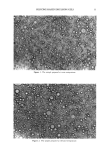
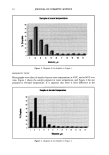
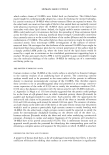
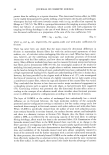
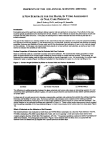
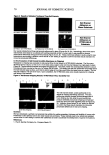
PREPRINTS OF THE 1998 ANNUAL SCIENTIFIC MEETING 61 THE USE OF THE MELANODERM TISSUE SYSTEM TO PREDICT THE EFFICACY OF SKIN LIGHTENING AND SKIN DARKENING MATERIALS Marie K. King,* M.S., Michael Caswell,* Ph.D., Hila A. Blochowitz,* M.S., Karen Adams,* M.S., James A. Greene, + M.S., and Richard L. Roberts, # Ph.D. *Stephens & Associates, Inc., Carrolton, Texas +Shaklee Corporation, Hayward, California #R.L. Roberts Product Development Consultants, Germantown, TN Introduction The ability to accurately predict the efficacy of skin lightening materials and skin darkening materials has, until recently, been limited to clinical test methods. With the introduction of the MelanoDerm tissue system from the MatTek Corporation and the protocol described in this paper, efficacy of these materials are effectively assayed using in vitro methods which offer a cost effective and rapid first step in screening test materials. A variety of raw materials and finished formulas, including skin lightening materials and skin darkening materials, were assayed in the MelanoDerm system to determine their potential to either prevent melanin production, remove melanin already present, or artificially stimulate tissue pigmentation. Measurement of skin lightening or skin darkening efficacy was accomplished by directly measuring changes in pigmentation of the tissue atter exposure to these various materials using three endpoints: photography, sodium hydroxide extraction of tissue melanin and Mexameter readings. Materhis and Methods The efficacy of the skin darkening test materials was evalunted by applying 100/zi of product to six tissues and incubnting for approximately 48 ho•rs. The negative control was treated with deionized water and the positive control was treated with 5mM DOPA. For the skin lightening assay to remove melanin already present, six tissues for each test material were exposed to 5mM DOPA for approximately 48 hours, rinsed, then dosed with 100/zl of test material for an additional 411 hours. The positive conuol was exposed to 5mM DOPA, rinsed, and dosed with 100/zl of deionized water. The negative control was exposed and dosed only with deionized water. For the skin lightening assay used to prevent melanin production, tissues in replicates of six were exposed for approximately 48 hours to test materials diluted to the desired concentration in DOPA solution. The dilutions were made to ensure that the concentration of DOPA in the test materials was the same as the concentration of DOPA in the positive control (SmM). The negative control for this procedure was deionized water. After the final 48 hour exposure for each procedure, the tissues were again rinsed and the melanin was quantitated photographically (all six replicates), instrumentally using the Mexameter (three replicates), and chemically using NaOH extraction (three replicates). The remaining three tissues not used for NaOH exlraction were used to determine post exposure tissue viability. Viability was measured using 3-(4,5- dimethylthiazol-2oyl)-2,5-diphenyltetrazolium bromide (MTT) (!=4). The mean absorbance of each well at $70 nm was divided by the mean absorbance of the negative controls at 570 nm and multiplied by 100 to calculate the mean percent MTT conversion value for each test material. Test materials with viability measurements of50% at•er 48 hours exposure would be considered cytotoxic and the data from these test materials would be viewed with caution. The Zeiss DermaVision TM Stereomicroscope/Vid• System with photographic capability was used to visually assess pigmentation diff, zrences in the tissue. Cross polarized light is used to reduce surfrice reflection. Photographs of the video images are printed for visual evaluation of test material efficacy. Color changes in the tissues were evaluated qualitatively. The Mexameter is an instrument designed to directly mensure the degree ofmelanogmesis and erythema seen
Purchased for the exclusive use of nofirst nolast (unknown)
From: SCC Media Library & Resource Center (library.scconline.org)