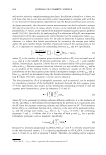
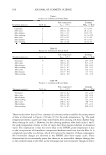
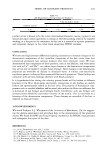
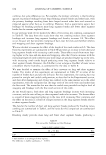
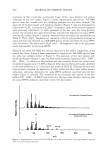
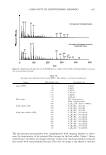
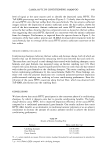
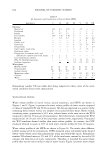
626 JOURNAL OF COSMETIC SCIENCE has been colored will extract metal ions out of the tap water used during the washing cycles between color treatments (6). In particular, hair that has been colored for multiple cycles can contain up to 10,000 ppm of calcium and magnesium, the most common metals found in tap water. It is hypothesized that the presence of the high level of metal ions is in some part responsible for the decrease in peak temperature and enthalpy observed. Table V summarizes the results of the tensile strength measurements for Product C, the commercial brown shade colorant at cycles 1 and 3. While the results from the tensile strength measurements have relatively large errors associated with them so that few differences in the table are statistically significant at the 95% confidence level, they do show a pattern and profile very similar to the HPDSC results, i.e., a drop in tensile strength after cycles 1 and 3 of coloring that does not significantly change after the washing cycles. However, after dialysis, directional changes toward the untreated values are observed in the tensile profiles at both cycles 1 and 3 that may be due to removal of the formulation components and the water hardness ions. To confirm the loss of the alkalizer during the dialysis process, the pH of the deionized water was monitored during this process. Table VI shows a selection of the pH values that were measured for Product C. These pH results support the hypothesis that dialysis is removing alkali species from the hair after the hair has been colored. In addition, the hair that had undergone three cycles of coloring followed by the 24 shampoo and 12 conditioning cycles was also dialyzed for one hour in one liter of deionized water. The pH of the dialysis water was found to be pH 6.19. The low pH of this dialysis solution indicates that there is no longer any alkalinity in the fiber after shampoo/conditioning. This is further evidence that the water hardness ions may be responsible for the significantly lower HPDSC peak temperature and enthalpy, as well as for the directional trends in fiber tensile properties observed after the washing cycles. The findings in this study demonstrate the need for careful interpretation of HPDSC data in the context of formulations that are designed to change morphological compo nents within the hair cortex, e.g., bleaches, perms, colorants, etc. Where the site of Product treatment Untreated After color After dialysis After washing After color . After dialysis After washing Cycle no. 0 1 3 3 3 Table V Tensile Strength of Product C Plateau load Gmf/sq. micron (x 103) 6.88 ± 0.53 6.43 ± 0.44 6.86 ± 0.57 6.46 ± 0.54 6.12 ± 0.50 6.59 ± 0.76 6.21 ± 0.60 Tensile strength measurements Load @ 25% Gmf/sq. micron (x 10') 8.22 ± 0.40 7.47 ± 0.48 8.23 ± 0.78 7.51±0.66 7.19 ± 0.64 7.92 ± 0.88 7.41 ± 0.82 Break load Gmf/sq. micron (x 103) 22.3 ± 1.8 21.9 ± 1.40 22.8 ± 1.6 21.7 ± 1.9 20.3 ± 1.3 20.9 ± 2.9 20.5 ± 1.7

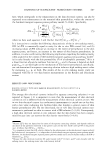
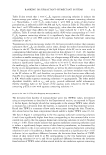
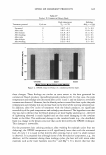
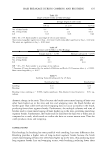
HPDSC OF COLORANT PRODUCTS 627 Table VI pH Measurements During Dialysis for Product C Time for dialysis (hours) DI water control 2 3 6 54 pH 5.59 9.01 7.03 6.86 6.66 5.72 product action is known to be the cortex (intermediate filaments, matrix, pigment), one should also expect some ingredients to remain in the fiber pending removal by repeated washing, as is the practice by consumers. In this case it is essential to separate permanent and temporary changes to the cortex when employing HPDSC methods. CONCLUSION We have used high-pressure differential scanning calorimetry to measure changes in the denaturation temperature of the crystalline component of the hair cortex from four commercial permanent hair coloring products over three treatment cycles. We have demonstrated that components of these products, such as the alkalizer, and other metal ions such as Ca2 + and Mg2 + , can induce large changes in the denaturation temperature that are not due to oxidative covalent bond cleavage. These changes in the denaturation properties are reversible on dialysis in deionized water. A similar, non-statistically significant pattern is observed from measured fiber tensile properties. These findings are consistent with previous findings observed with bleach products. It is hypothesized that during the coloring process bonds will be broken at different locations in the fiber. Close-range electrostatic interactions or salt bridges are readily broken and spontaneously reform as the hair dries. The presence of formulation com ponents such as residual alkalizer and/or metal salts within the fiber can influence the re-formation of salt bridges and hydrogen bonds. Interference with salt bridges will increase protein flexibility and reduce viscosity in the matrix. This in turn leads to a lowering of the denaturation temperature. These changes are reversible if the hair is dialyzed in deionized water. ACKNOWLEDGMENTS We thank Professor F.-J. Wortmann of the University of Manchester, UK, for suggest ing the dialysis experiment and providing help in the interpretation of the presented results. We thank the DWI and Crisan Popescu (Aachen) for the HPDSC measurements and subsequent discussion of the data. REFERENCES (1) J. Cao, Thermochimica Acta, 335, 5 (1999). (2) C. Popescu and F.-J. Wortmann, Revue Roumaine de Chemie, 48(12), 981 (2003). (3) P. Milczarek, M. Zielinski, and M. L. Garcia, Coll. Polym. Sci., 270, 1106 (1992). (4) J.M. Marsh, C. J. Clarke, K. Meinert, and R. M Dahlgren,]. Cosmet. Sci., 58, 319-327 (2007). (5) F.-J. Wortmann and H. Deutz,J. Appl. Polym. Sci., 48, 137 (1993). (6) J.M. Marsh, J. Flood, D. Domaschko, and N. Ramji,J. Cosmet. Sci., 58, 495-503 (2007).
Purchased for the exclusive use of nofirst nolast (unknown)
From: SCC Media Library & Resource Center (library.scconline.org)