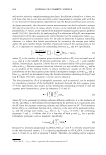
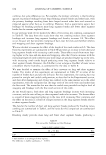
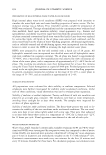
606 JOURNAL OF COSMETIC SCIENCE and involve relatively complex assaying procedures. In addition to benefits a -above, we will show that the in vitro skin electrical current measurements correlate well with the in vivo skin barrier measurements reported here (see the Results and Discussion section). As shown previously, skin electrical current measurements can also be related to average skin electrical resistivity, R, values, which, in turn, can be combined with mannitol skin permeability, P, values, in the context of the hindered-transport aqueous porous pathway model (5,6,9,41). Specifically, by analyzing Log Pas a function of Log R, two important characteristics of the skin aqueous pores can be obtained: (a) the average pore radius, r pore' and (b) the porosity-to-tortuosity ratio, elT. In order to determine if aqueous contacting solutions i-v induce skin barrier perturbation by increasing the average pore radius and/or the pore number density (number of pores/unit area) of the aqueous pores in the SC, it is important to consider the relationship between r pore and e/T. Specifically, � - (Np)(7rr ore ) ( � )- ( Np ) _ 'ITr2ore p - 7rpr2ore p T a total T atota!T (2) where NP is the number of aqueous pores contained within a SC cross-sectional area of atota/J and p is the number of tortuous pores/unit area = (N/atota!T) = pore number density. Interestingly, equation 2 shows that e/T increases linearly with p and quadrati cally with r pore · Because aqueous contacting solutions i-v may modify either r pore and/or p, an analysis of the ranking metric to obtain mechanistic insight on the extent of perturbation of the skin aqueous pores should incorporate changes in both r pore and p. Once r pore and e/T are determined using the theoretical analysis involving the Log P and Log R values (5,6,9,41), equation 2 can be used to obtain p. The skin permeability (P) of a hydrophilic permeant, such as mannitol, can be modeled by considering transport of the hydrophilic permeant through the skin aqueous pores (5-9,41). Specifically, this results in the well-known relationship between P and the aqueous pore characteristics, given by references 5-9 and 41: (3) where v is the permeant (p) infinite-dilution diffusion coefficient, L is the thickness of the SC, and HCA ;, ) is the hindrance factor experienced by permeant pas it partitions into the SC from the aqueous contacting solution and diffuses across the SC The hindrance factor, H(A ;, ), is a nonlinear function of"- ;, , where "- ;, is the ratio of the permeant radius, r p , and the average pore radius, r pore ' that is, "- p = r/r por e (5-10,41). By combining equations 2 and 3, it follows that P is a function of both p and r JJure for a specific hydrophilic permeant, such as mannitol. Specifically, (4) Because P is inversely proportional to {RH(l\.)IH(l\. p )J, 5 and R is inversely proportional to the skin electrical current, /, P is directly proportional to {IH(l\. 1 )/H(l\.)} (see refer ences 5-9 and 41, as well as equation 5 below). Therefore, the ranking metric adopted 5 Note that A. = r/r pore ' where i represents the current-carrying ion (5).

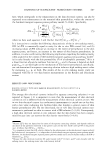
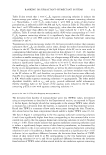
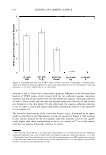
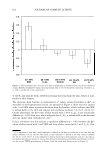
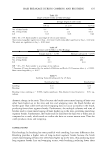
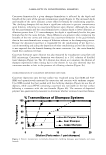
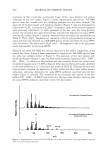
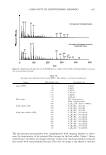
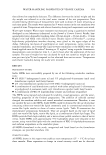
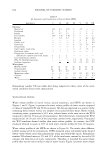
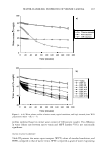
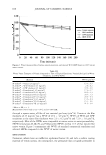
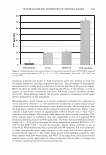
RANKING OF SURFACTANT-HUMECTANT SYSTEMS 607 here, which corresponds to the enhancement in the skin electrical current, can also be expressed as an enhancement in the mannitol skin permeability, within the context of the hindered-transport aqueous porous pathway model (5-10,41). Specifically, (p H(AJ ) ( � H(A )) IE H(A p E 'T t E p RM - - ----) - - ----- - ------EJ)A(Heor2r(p le -( p H(AJ ) - ( � H(AJ) - (prJ0reH(AJ)c H(A J ,) C T C where we have used equation 3 and the fact that (D /L) E = cv IL) C' 6 (5) It is instructive to consider the following characteristics of the in vitro ranking metric, RM: (a) RM is numerically equal to unity for the in vitro PBS control (iii), and (b) increasing values of RM indicate an increase in the extent of perturbation to the skin aqueous pores, and hence, an increase in the extent of skin barrier perturbation. In addition, it is also worth noting the following implications regarding the ranking metric when analyzed in the context of the hindered-transport aqueous porous pathway model: 7 (a) it scales linearly with the skin permeability (P) of a hydrophilic permeant,8 (b) it is a linear function of p and a nonlinear function of r p oreJ and (c) because it depends on both p and r p oreJ it can shed light on the mechanism of skin barrier perturbation specifically, one can determine if an aqueous contacting solution induces a high ranking metric value by increasing r p or e J p, or both. The results of the in vitro ranking metric study are compared with the in vivo skin barrier measurements in the Results and Discussion section. RESULTS AND DISCUSSION RESULTS OF THE IN VITRO SKIN BARRIER MEASUREMENTS IN THE CONTEXT OF A RANKING METRIC The average skin electrical currents induced by aqueous contacting solutions i-v are reported in Figure 1. It is important to note that the measurement of skin electrical currents in vivo is different from the measurement of skin electrical currents in vitro. The in vivo skin electrical current (or conductance) measurement is carried out on dry skin, with a low value indicating less hydrated skin that displays a greater extent of skin barrier perturbation (20). On the other hand, the in vitro skin electrical current mea surement is performed on skin in contact with a PBS solution (5-9,41). Consequently, a high skin electrical current in vitro indicates that the skin barrier has been compro mised because ions can traverse the skin barrier more freely (5-9,41). 6 Because v 1L does not depend on the nature of the aqueous contacting solution, and depends solely on the choice of the permeant (mannitol in the present case) and the skin model used (p-FTS in the present case), it follows that (D /L) E = (D /L) c 7 It is important to note that RM, which is defined as the enhancement in the skin electrical current induced by E relative to C (see equation 1), is independent of the hindered-transport aqueous porous pathway model. However, the hindered-transport aqueous porous pathway model can be used to further analyze the RM to determine r pore and p. 8 Because the skin electrical resistivity (R) scales linearly with P (5-9,41), and P scales linearly with the ranking metric, the ranking metric also scales linearly with R.
Purchased for the exclusive use of nofirst nolast (unknown)
From: SCC Media Library & Resource Center (library.scconline.org)