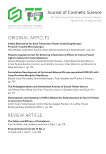
Journal of Cosmetic Science The Official Journal of the Society of Cosmetic Chemists Volume 73 No. 3 | May/June 2022 ORIGINAL ARTICLES A New Alternative for Acne Treatment: Plaster Containing Benzoyl Peroxide–Loaded Microsponges Nihal Atabay, Ayşe Merih Sariisik, Sinem Yaprak Karavana and Seda Rencber | pp. 114 Physalis angulata Cream for Reducing Inflammatory Effects of Intense Pulsed Light Treatment for Solar Melanosis Glaucia Rodrigues Cardoso, Paula Montanhini Favetta, Julieta Rahal Cardoso Barucci, Irinéia Paulina Baretta, Emerson Luiz Botelho Lourenço, Odair Alberton and Ricardo de Melo Germano | pp. 126 Formulation Development of Sustained-Release Microencapsulated IR3535® with Long-Duration Mosquito Repellency Eduard Casas-Terradellas, Emma Bebbington, Tycho Speaker and Thomas P. Dooley | pp. 140 The Antipigmentation and Antioxidant Activity of Sanchi Flower Extract Juan Wang, Peiyu Wang, Xue Shao, Tong Huo, Jitao Liu, Qianghua Quan and Quan An | pp. 154 Development and Validation of HPLC Method for Determination of Four UV Filters in Sunscreen Products Sumit Tiwari, Vishal Sareen, Yamini Sharma, Deepali Prashar, S.K. Luthra, Prasun Bandyopadhyay and Ranjan Mitra | pp. 166 REVIEW ARTICLE The Safety and Efficacy of Petrolatum Carol A. Bosko, Jean Adamus and John S. Bajor | pp. 178 Erratum Notice from Vol 73 No. 2 G. Gedik and T. Uğurlu | pp. 188

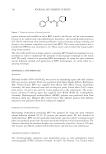
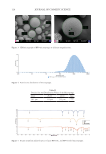
114 J. Cosmet. Sci., 73, 114–125 (May/June 2022) Address all correspondence to Sinem Yaprak Karavana, sinemyaprak@hotmail.com A New Alternative for Acne Treatment: Plaster Containing Benzoyl Peroxide–Loaded Microsponges NIHAL ATABAY, AYŞE MERIH SARIISIK, SINEM YAPRAK KARAVANA AND SEDA RENCBER Department of Textile Engineering, Faculty of Engineering, Dokuz Eylul University, Izmir, Turkey (N.A., A.M.S.) Department of Pharmaceutical Technology, Faculty of Pharmacy, Ege University, Izmir, Turkey (S.Y.K.) Department of Pharmaceutical Technology, Faculty of Pharmacy, Izmir Katip Celebi University, Izmir, Turkey (S.R.) 2022 Accepted for publication May 27, 2021. Synopsis Acne vulgaris is the most common dermatologic disorder, affecting approximately 85% of individuals, especially during adolescence. In this study, a plaster design was developed to support acne vulgaris treatment by using microsponge technology. To achieve this purpose, the microsponges containing benzoyl peroxide (BPO) were prepared by the quasi emulsion solvent diffusion method, and the obtained microparticles were examined in terms of surface morphology, particle size distribution, and encapsulation efficiency (EE). Fourier transform infrared and Brunauer-Emmett-Teller analyses were also performed. The microsponges were spherical in shape and around 110 µm in diameter. The EE and drug loading from the microsponge powder were found to be 60.879% and 38.929%, respectively. The optimum microsponge formulation was selected and applied onto textile material with a spraying technique by using acrylic binder and hydroxypropyl methylcellulose. The presence of BPO-loaded microsponges on the fabric surface was proved by scanning electron microscopy analyses. The EE of BPO from the fabric samples was found to be 84.193%. The release properties of microsponges and treated textile material were also investigated. No burst effect has been observed, indicating that BPO was homogeneously dispersed in the microsponge. With the in vitro BPO release from the fabric sample after 3 hours, the release rate of formulation was found to be very low (approximately 10%). This study presents a new approach to the use of microsponges in the textile field. INTRODUCTION Acne vulgaris is a common skin disorder. It is a chronic inflammatory disease of the pilosebaceous unit (1,2). Acne represents obstruction and inflammation of the sebaceous follicle (Figure 1). The normal function of sebaceous glands is to produce and secrete sebum, a group of complex oils including triglycerides and fatty acid breakdown products, wax esters, squalene, and cholesterol esters. Increased sebum excretion, alteration of lipid composition, and the oxidant/antioxidant ratio characteristic of the skin surface lipids are
Purchased for the exclusive use of nofirst nolast (unknown)
From: SCC Media Library & Resource Center (library.scconline.org)