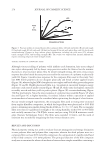
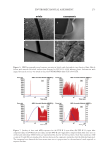
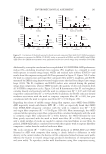
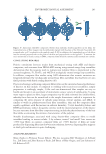
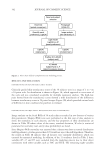
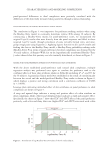
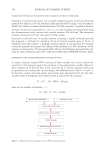
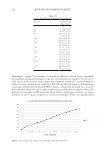
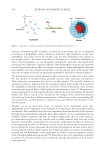
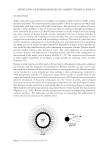
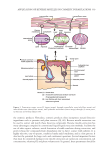
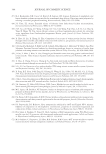
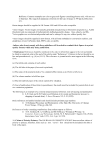
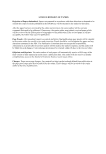
283 Enviromechanical Assessment CONCLUDING REMARKS Positive correlations between results from mechanical testing with AED and fixative composites, and outcomes from DHSA-AED testing using treated omega loop assemblies demonstrate that the requisite work to rupture neat polymer films is proportional to the assessed toughness, F1, E10/E1, and #AED of analogously treated omega loop assemblies. In addition, composite film studies using AED substantiate that acoustic emissions are frequently liberated by mechanically stressed hair fiber assemblies that had been set into fixed positions with brittle styling fixatives (16). Practical advantages with using composite films to forecast the enviromechanical performance of fixatives on hair include: 1) compared to working with treated tress assemblies, sample preparation is strikingly simple 2) flat and two-dimensional film samples are easy to handle and mount in an assortment of instruments using a variety of sample grips 3) using water vapor to plasticize films, larger composites may be safely trimmed into smaller films, whereby force data can be normalized to the sample dimensions—which is important for computing the stress response of cuboids using Instron, texture analysis, and DMA 4) similar to welds in polymer-treated hair fiber assemblies, thin and flat composite films rapidly equilibrate with fluctuations in ambient humidity 5) style durability failures and DHSA performance indices frequently correlate with the material properties of the fixative because outcomes from film-fiber composite testing include the physiochemistry of the hair fiber while accentuating the intrinsic characteristics of the polymer. Notable disadvantages associated with using fixative-fiber composite films to model interfiber bonding in tresses include: 1) by volume, treated “real world” hair tresses are 90% hair fibers in contrast, composite films are 90% fixative 2) films are easily produced by dispersing fibers into low-viscosity solutions however, dispersing fiber snippets in thick gels and mousses is quite challenging. ACKNOWLEDGMENTS Many thanks to Professor Steven Abbott. We also recognize Bill Thompson of Ashland Inc., Jeff Jones and John Rutsey of Rush, Jeff Bezos of Blue Origin, and Len Salvatore of GS Robotics LLC. +F -F +F -F +F -F +F -F (A) (B) (D) (C) l w t Figure 17. Anisotropic film-fiber composites. Rather than randomly distributing fibers in the films, the longitudinal axes of fiber snippets may be deliberately aligned with the plane of the film and (A) parallel (B) perpendicular or (C) crosshatch to the applied tensile F (D) in addition, the longitudinal axes of the fibers may be oriented perpendicular to the plane of the film and perpendicular to the applied F. To measure the stress and moduli in tensile testing or DMA, composite films should be symmetrically trimmed into cuboids.

284 JOURNAL OF COSMETIC SCIENCE REFERENCES (1) A. B. Reed and I. Bronfein, Curl retention with hair sprays, Drug Cosmet. Ind., 94, 178 (1964). (2) A. L. Micchelli and F. T. Koehler, Polymer properties influencing curl retention at high humidity, J. Cosmet. Sci., 19, 863–880 (1968). (3) Measuring Hair Properties using Laser Profiling. Stable Micro Systems. https://www.stablemicrosystems. com/MeasuringVolumeHair.html. (4) G. A. Erlemann, Objektive und subjektive methoden zur beurteilung von haarsprays, J. Cosmet. Sci., 22, 287–302 (1971). (5) S. H. Ganslaw and F. T. Koehler, Evaluation of hair fixatives—a new technic utilizing torsional measurements, J. Cosmet. Sci., 29, 65–78 (1978). (6) R. R. Wickett, J. A. Sramek, and C. Y. Trobaugh, Measurement of the adhesive strength of hair- hairspray junctions, J. Cosmet. Sci., 43, 169–178 (1992). (7) P. Hoessel, S. Riemann, R. Knebl, J. Schroeder, G. Schuh, and C. Castillo, Assessment of styling performance in hair gels and hair sprays by means of a new two-point stiffness test, J. Cosmet. Sci., 61, 343–352 (2010). (8) F. Frosch and F. Vogel, Une méthode simple pour mesurer la fixation des cheveux, Parfums, Cosmétiques, Arômes, 89, 71–72 (1989). (9) D. W. Rafferty, J. Zellia, D. Hasman, and J. Mullay, The mechanics of fixatives as explained by polymer composite principles, J. Cosmet. Sci., 60, 251–259 (2009). (10) J. Jachowicz and K. Yao, Dynamic hairspray analysis. I. Instrumentation and preliminary results, J. Cosmet. Sci., 47, 73–84 (1996). (11) J. Jachowicz and K. Yao, Dynamic hairspray analysis. II. Effect of polymer, hair type, and solvent composition, J. Cosmet. Sci., 52, 281–295 (2001). (12) J. Jachowicz, Dynamic hairspray analysis. III. Theoretical considerations, J. Cosmet. Sci., 53, 249–261 (2002). (13) J. Jachowicz and R. McMullen, Mechanical analysis of elasticity and flexibility of virgin and polymer- treated hair fiber assemblies, J. Cosmet. Sci., 53, 345–361 (2002). (14) R. McMullen, D. Laura, S. Chen, D. Koelmel, G. Zhang, and T. Gillece, Determination of physicochemical properties of delipidized hair, J. Cosmet. Sci., 64, 355–370 (2013). (15) C. R. Robbins, Chemical and Physical Behavior of Human Hair, 4th ed. (Springer-Verlag, New York, 2002), pp. 360–435. (16) T. W. Gillece and R. L. McMullen, Eavesdropping on the failure of mechanically stressed omega loop assemblies, J. Cosmet. Sci. (forthcoming). (17) R. Rigoletto, A. Mahadeshwar, L. Foltis, and D. Streuli, “Advances in hair styling,” in Practical Modern Hair Science, T. A. Evans and R. R. Wickett., Eds. (Allured Books, Carol Stream, IL, 2012), pp. 415–449. (18) S. Abbott, Adhesion Science: Principles and Practice (DEStech Publications Inc., Lancaster, PA, 2015), pp. 13–100. (19) Acoustic Envelope Detection Manual A4, ver. 3, Stable Micro Systems, Godalming, UK, 2008, pp. 3–17. (20) G. H. Michler, Electron Microscopy of Polymers (Springer-Verlag: Heidelberg, Germany, 2008), pp. 261–277. (21) M. S. Tirumkudulu and W. B. Russel, Role of capillary stresses in film formation, Langmuir, 20, 2004, 2947–2961. (22) K. P. Menard, Dynamic Mechanical Analysis: A Practical Introduction. (CRC Press, New York, 1999), pp. 1–197. (23) A. A. Griffith, The phenomena of rupture and flow in solids, Philos. Trans. Royal Soc. A, 221, 163–198 (1921). (24) L. J. Broutman and T. Kobayashi, Crack propagation studies in glassy polymers (AMMRC CR 71-14), Illinois Institute of Technology, Chicago, IL (1971). (25) C. Creton and M. Ciccotti, Fracture and adhesion of soft materials: a review, Rep. Prog. Phys., 79, 1–57 (2016).
Purchased for the exclusive use of nofirst nolast (unknown)
From: SCC Media Library & Resource Center (library.scconline.org)