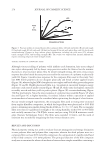
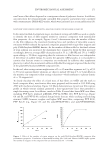
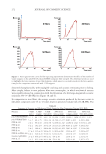
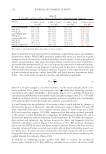
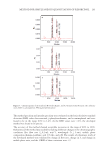
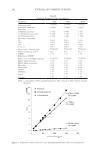
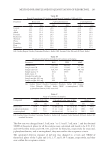
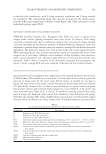
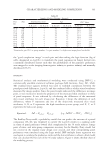
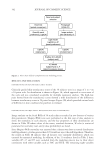
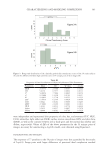
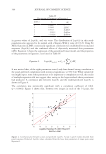
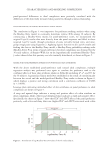
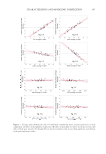
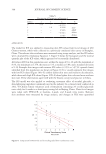
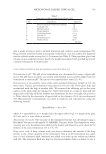
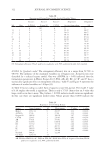
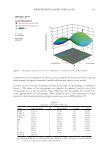
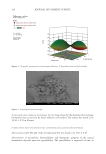
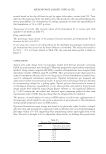
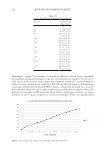
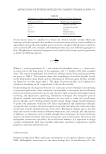
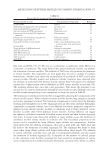
294 JOURNAL OF COSMETIC SCIENCE ACN was used as an organic modifier of the mobile phase. Methanol had played the vital role in the study especially in separating p-phenylenediamine and m-aminophenol by ion paring between the amine groups of these compounds. The effect of variation in mobile phase ratio was studied by varying the ratios of hexane-1-sulfonic acid by ±5 mL, and the results are summarized in Table II. The mobile phase compositions were adjusted as 2.5:2.5:95 v/v/v (mobile phase minus, 0.0094 M of ion pair agent), 5.0:5.0:90 v/v/v (optimized, 0.01 M), and 7.5:7.5:85 v/v/v (mobile phase plus, 0.0105 M of ion pair agent). The %RSD values of t R for resorcinol, p-phenylenediamine, and m-aminophenol at mobile phase ratio plus were found to be 0.18, 0.13, and 0.10, and those at mobile phase ratio minus were found to be 0.21, 0.07, and 0.14, respectively, which were in acceptable limits per ICH guidelines (27). The retention of resorcinol, p-phenylenediamine, and m-aminophenol is usually dependent on the pH of the mobile phase because of partial dissociation of the OH groups and protonation of NH 2 groups in acidic media. In accordance with the pKa values and owing to protonation of NH 2 ,the study of resorcinol, p-phenylenediamine, and m-aminophenol was conducted by changing pH from 2.8 to 2.5 and 3.1 by preparing standard solutions and injecting into the HPLC system. The results are given in Table II. The %RSD values of t R for resorcinol, p-phenylenediamine, and m-aminophenol at pH plus were found to be 0.01, 0.06, and 0.02, and those at pH minus were found to be 0.04, 0.11, and 0.16, respectively, which were within acceptance limits per ICH guidelines (27). The forced degradation studies were indicative of the compliance of method development as per ICH guidelines (32). Stability of sample solution was established, which indicated that the samples could be stored up to 24 hours at 25oC. The assay of commercial samples was consistent with the developed method. CONCLUSIONS The stability-indicating HPLC method optimized by chemometrics and validated per ICH guidelines could be employed for the determination of resorcinol, p-phenylenediamine, and m-aminophenol in hair-coloring products. It used a minimal amount of organic solvents in the mobile phase and thus could be considered more eco-friendly than existing methods. This method could facilitate as a reliable source of routine quality control analysis of the labeled compounds in combined hair dye formulations. ACKNOWLEDGMENTS The authors are thankful to Cystron Laboratories, Vijayawada, Andhra Pradesh, India for providing the necessary facilities to carry out the research work. REFERENCES (1) B. G. Chiari, M. G. J. de Almeida, M. A. Correa and V. L. B. Issac, VLB, “Cosmetics’ quality control,” in Latest Research in to Quality Control, I. Akyar. Ed. (IntechOpen Limited, London, 2012), pp. 337–364. (2) EUR-Lex, Regulation (EC) No 1223/2009 of the European Parliament and of the Council of 30 November 2009 on Cosmetic Products, accessed February 2, 2021, http://eur-lex.europa.eu/legal-content/EN/ ALL/?uri=CELEX%3A32009R1223.

295 METHOD FOR SIMULTANEOUS QUANTITATION OF RESORCINOL (3) Cosmetics Europe, Understanding the Cosmetics Regulation, accessed February 2, 2021, https://www. cosmeticseurope.eu/safety-and-science-cosmetics-europe/rules-and-regulations/the-eu-legislation.html. (4) Opinion on 2-methylresorcinol, adopted by the Scientific Committee on Consumer Products. Published by the European Commission Health &Consumer Protection Directorate-General, accessed February 2, 2021, http://ec.europa.eu/health/ph_risk/committees/04_sccp/docs/sccp_o_071.pdf. (5) Opinion on p-phenylenediamine, adopted by the Scientific Committee on Consumer Products. Published by the European Commission Health &Consumer Protection Directorate General, accessed February 2, 2021, http://ec.europa.eu/health/ph_risk/committees/04_sccp/docs/sccp_o_069.pdf. (6) Opinion on m-aminophenol, adopted by the Scientific Committee on Consumer Products. Published by the European Commission Health &Consumer Protection Directorate-General, accessed February 2, 2021, http://ec.europa.eu/health/ph_risk/committees/04_sccp/docs/sccp_o_088.pdf. (7) L. H. Wang and Y. P. Kuo, Simultaneous quantitative determination of resorcinol and 1-naphthol in haircolor products by high-performance liquid chromatography, Chromatographia, 49, 208–211 (1999). (8)V .Andrisano, R. Gotti, A. M. Di Pietra and V. Cavrini, HPLC analysis of oxidation hair dyes in permanent hair colourants, J. Liq Chromatogr, 17, 2919–2937 (1994). (9) B. H. Shao, X. Z. Xu, J. W. Yan and X. Y. Fu, Quantitative determination of commercial oxidation hair dyes by reversed-phase HPLC, J. Liq Chromatog, R T, 24, 241–249 (2001). (10) S. C. Rastogi, A method for the analysis of intermediates of oxidative hair dyes in cosmetic products, J. Sep Sci, 24, 173–178 (2001). (11) U. Vincent, G. Bordin and A. R. Rodriguez, Optimization and validation of an analytical procedure for the determination of oxidative hair dyes in commercial cosmetic formulations, J. Cosmet Sci, 53, 101–119 (2002). (12) I-J Kang and M. H. Lee, Quantification of para-phenylenediamine and heavy metals in henna dye, Contact Dermatitis, 655, 26–29 (2006). (13) J. H. Franco, B. F. Silva and M. V. B. Zanoni, Using ionic liquid combined with HPLC-DAD to analyze semi-permanent hair dyes in commercial formulations, Anal Methods, 7, 1115–1122 (2015). (14) M. Narita, K. Murakami and J-M. Kauffmann, Determination of dye precursors in hair coloring products by liquid chromatography with electrochemical detection, Anal Chim Acta, 588, 316–320 (2007). (15) L. J. Wang and S. J. Huang, Studies on the voltammetric behavior of azo dyes and its determination in cosmetic products, Russ J. Electrochem, 46, 1414–1418 (2010). (16) H. Dejmkova, J. Barek and J. Zima, Determination of aminonitrophenols in hair dyes using a carbon paste electrode and a boron-doped diamond film electrode—a comparative study, Int J. Electrochem Sci, 6, 3550–3563 (2011). (17) R. J. Turesky, J. P. Freeman, R. D. Holland, D. M. Nestorick, D. W. Miller, D. L. Ratnasinghe and F. F. Kadlubar, Identification of aminobiphenyl derivatives in commercial hair dyes, Chem Res Toxicol, 16, 1162–1173 (2003). (18) H. A. Ahmed, R. M. Maaboud, F. Latif, A. M. El-Dean, K. M. El-Shaieb, E. Vilanova and C. Estevan, Different analytical methods of para-phenylenediamine based hair dye, JCDSA, 3, 7–25 (2013). (19) M. L. Di Gioia, A. Leggio, A. Le Pera, A. Liguori, A. Napoli, F. Perri and C. Siciliano, Determination by gas chromatography/mass spectrometry of p-phenylenediamine in hair dyes after conversion to an imine derivative, J. Chromatogr A, 1066, 143–148 (2005). (20) E. Guerra, J. P. Lamas, M. Llompart and C. Garcia-Jares, Determination of oxidative hair dyes using miniaturized extraction techniques and gas chromatography-tandem mass spectrometry, Microchem J, 132, 308–318 (2017). (21) J. L. Nizzia, A. E. O’Leary, A. T. Ton and C. C. Mulligan, Screening of cosmetic ingredients from authentic formulations and environmental samples with desorption electrospray ionization mass spectrometry, Anal Methods, 5, 394–401 (2013). (22) Y. Masukawa, Separation and determination of basic dyes formulated in hair care products by capillary electrophoresis, J. Chromatogr A, 1108, 140–144 (2006).
Purchased for the exclusive use of nofirst nolast (unknown)
From: SCC Media Library & Resource Center (library.scconline.org)