51 Sustainable Fragrances
– Human ethical considerations are a rising concern for the industry and more needs to
be done. On the positive side, transparency concerning country of origin has markedly
increased, as have the number of on-site audits to a recognised standard. IFRA-UEBT
have recently launched a new initiative to work at industry level on selected supply
chains.
There are a number of cross-sectorial organisations aimed at improving sustainability
methodology, sharing best practices, facilitating data exchange and co-ordinating action.
The list is quite long and most act at the company and supply chain level, rather than at
the ingredient level. The list would include some which are more over-arching covering
multiple aspects of sustainability, like SBTi [16], Sedex [58], Ecovadis [59], CDP [17], and
some which are more focused on a specific aspect like carbon, such as TfS [18], PACT [60],
M2030 [61], deforestation, like Proforest [62], and human rights like AIM-progress [40].
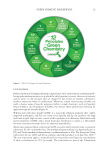
Using green chemistry to improve certain sustainability aspects of how a fragrance
ingredient is manufactured has been the subject of a recent article [63].
In this article, no reference has been made to the economic aspects of continuously setting
more and higher standards on the sustainability of the industry, but it is a very real concern in
Europe which is often at the forefront of sustainability initiatives. In response to the Draghi
report on the future of European competitiveness [64], the new European Commission, in
place since December 2024, made proposals in February 2025 called Omnibus packages, to
regain growth and unleash competitiveness, whilst maintaining the Green Deal objectives.
The aim is to address overlapping, unnecessary. or disproportionate rules that are creating
unnecessary burden for EU businesses, and they specifically include amendments to CSRD
and CSDDD – 2025/0044 (COD). In particular, one proposed adjustment is that only
companies with more than 1,000 employees and €50m turnover would be in scope of
CSRD, as is the case for CSDDD this is estimated to be 80% fewer companies compared to
the original scope of 250 employees and €50m turnover. Concerning CSDDD, the proposed
scope of due diligence assessment has been reduced, requiring full due diligence with
respect to the value chain beyond direct business partner only in cases where the company
has plausible information suggesting that adverse impacts have arisen or may arise there.
Additional delays are foreseen to the reporting timelines, and the legislative proposals
will now be submitted to the European Parliament and the European Council for their
consideration and eventual modification and/or adoption.
Whilst this initiative from the European Commission is clearly welcome and a step in the
right direction, it is nevertheless true that substantial costs are associated with additional
tests of fragrance raw materials, decarbonisation, ensuring compliance with legislation
(CSRD, EUDR, CSDDD etc) and eventually reformulation. It is always challenging to
pass these costs along the supply chain to the end consumer and there remains a wide gap
between what everyone wants for the future and what consumers are prepared to pay for or
perhaps can pay for. There is no simple solution to this equation. A more sustainable future
business model is essential which will carry additional costs authorities need to focus on
measures with a real cost-benefit impact and consider the accumulated costs of meeting
existing and future legislation. Legislation may also be necessary to enable a level playing
field and incentivise change to more sustainable products.
Disclaimer -All opinions stated in the article are the personal opinions of the author and
do not represent either Takasago or any other Organisation.
– Human ethical considerations are a rising concern for the industry and more needs to
be done. On the positive side, transparency concerning country of origin has markedly
increased, as have the number of on-site audits to a recognised standard. IFRA-UEBT
have recently launched a new initiative to work at industry level on selected supply
chains.
There are a number of cross-sectorial organisations aimed at improving sustainability
methodology, sharing best practices, facilitating data exchange and co-ordinating action.
The list is quite long and most act at the company and supply chain level, rather than at
the ingredient level. The list would include some which are more over-arching covering
multiple aspects of sustainability, like SBTi [16], Sedex [58], Ecovadis [59], CDP [17], and
some which are more focused on a specific aspect like carbon, such as TfS [18], PACT [60],
M2030 [61], deforestation, like Proforest [62], and human rights like AIM-progress [40].
Using green chemistry to improve certain sustainability aspects of how a fragrance
ingredient is manufactured has been the subject of a recent article [63].
In this article, no reference has been made to the economic aspects of continuously setting
more and higher standards on the sustainability of the industry, but it is a very real concern in
Europe which is often at the forefront of sustainability initiatives. In response to the Draghi
report on the future of European competitiveness [64], the new European Commission, in
place since December 2024, made proposals in February 2025 called Omnibus packages, to
regain growth and unleash competitiveness, whilst maintaining the Green Deal objectives.
The aim is to address overlapping, unnecessary. or disproportionate rules that are creating
unnecessary burden for EU businesses, and they specifically include amendments to CSRD
and CSDDD – 2025/0044 (COD). In particular, one proposed adjustment is that only
companies with more than 1,000 employees and €50m turnover would be in scope of
CSRD, as is the case for CSDDD this is estimated to be 80% fewer companies compared to
the original scope of 250 employees and €50m turnover. Concerning CSDDD, the proposed
scope of due diligence assessment has been reduced, requiring full due diligence with
respect to the value chain beyond direct business partner only in cases where the company
has plausible information suggesting that adverse impacts have arisen or may arise there.
Additional delays are foreseen to the reporting timelines, and the legislative proposals
will now be submitted to the European Parliament and the European Council for their
consideration and eventual modification and/or adoption.
Whilst this initiative from the European Commission is clearly welcome and a step in the
right direction, it is nevertheless true that substantial costs are associated with additional
tests of fragrance raw materials, decarbonisation, ensuring compliance with legislation
(CSRD, EUDR, CSDDD etc) and eventually reformulation. It is always challenging to
pass these costs along the supply chain to the end consumer and there remains a wide gap
between what everyone wants for the future and what consumers are prepared to pay for or
perhaps can pay for. There is no simple solution to this equation. A more sustainable future
business model is essential which will carry additional costs authorities need to focus on
measures with a real cost-benefit impact and consider the accumulated costs of meeting
existing and future legislation. Legislation may also be necessary to enable a level playing
field and incentivise change to more sustainable products.
Disclaimer -All opinions stated in the article are the personal opinions of the author and
do not represent either Takasago or any other Organisation.