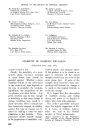
JOURNAL OF THE SOCIETY OF COSMETIC CHEMISTS •lement detergency and exercise re- kaint of lime scumming in hard water rinsing at temperatures up to about 60øC., presumably by pepris- ing the calcium soap. Various mem- bers of the polyoxyethylene ether class have secured wide acceptance as soapless textile and industrial de- tergents. At this jz•ncture the lecturer passed around several samples [or examination, including' the liquid shampoos previously mentioned. He adde•d: I have here a few specimens for any who care to inspect them. They are not intended to rank as fine quality cosmetics but merely to illu- strate points that I have tried to in- dicate. Parrs are by weight. (1) Cleansing Cream Liquid paraffin ......... 50 Landin absorption base ... 5 Polyethylene glycol 300 mono- stearate ......... 5 Water ............ 40 This could be made a little thicker by putting some of the polyglycol ester with the water portion, or by adding a very little triethanolamine. (2) Cleansing Cream Polyethylene glycol 400 mono- stearate ......... Lanolin ........ Beeswax ........ Liquid paraffin ........ Water ........... Triethanolamine ..... "Carbitol", etc ...... Here there are more saponifiable fats present and so a slightly more hydrophilic polyglycol ester is used. (3) Vanishing Cream Stearic acid ......... 20 "Carbowax" 1000 mono- stearate ......... 5 Water ............ 70 Polyethylene glycol 300 roche- stearate ......... 5 Here a strongly hydrophilic ester is used to emulsify the stearic acid. The addition of the polyethylene glycol 300 stearate to the aqueous portion increases emolliency and consistency. (4) Astringent Cream, similar to (3) but containing c. 3 per cent A12(SO4).•. (5) Acid Cream, for protection against fumes from organic bases. (6) Polyethylene Glycol Stearate Mucilaginous Hair Cream Polyethylene glycol 400 mono- stearate ......... 6 Lanolin ......... 1 Water ......... 90 Polyethylene glycol+ perfume 3 Polyethylene glycol 400 laurate ......... q. ß 5 The last named constituent is pre- sent as a dispersant for the perfume oil. (7) 11 Oily Hair Cream 6 Polyethylene glycol 400 mono- 10 stearate ......... 15 Lanolin ......... 2 52 Liquid paraffin ...... 20 1 Polyethylene glycol 400 roeno- S stearate ......... Citric acid ......... 1 Water ............ 70 Polyethylene Glycol Stearate 140

EMULSIONS AND THE COSMETIC CHEMIST By JACK PICKTHALL, F.R.I,C.* THE HIGH percentage of cos- roetic preparations in emulsified form makes the study of the under- lying principles of emulsification of paramount importance to the cos- metic chemist. Many excellent papers have been written on the theory of emulsification, and it is possible, by careful study o.f them, to form a fairly clear picture of the essential principles. From the practical viewpoint the chemist's own experiences and observations are of much greater value than the numerous formulae offered to the reader of many books and articles xvritten on the subject. The cosmetic chemist of to-day has knowledge of a comprehensive range of emulsified products and, backed by a great number of emul- sifying agents, has small difficulty in formulating attractive and effec- tive preparations. However, when new preparations, which mu•t possess specific properties or contain specific ingredients are required, then a deeper understanding of emulsion technique is necessary. Likewise, there is the emulsion "which has been made in the same way for years" but which suddenly separates after a relatively short shelf life. Also the question of sub- *Chief Chemist, Polak & Schwarz (England) Ltd. stitution of an emulsion ingredient for, perhaps, reasons of economy is best answered by a clear understand- ing of the part, if any, it plays in the emulsion. It is difficult, under the heading of "Cosmetic Emulsions", to intro- duce certain preparations which, while containing both oil and water, are not in the generally accepted state of emulsification. Thus a bath essence is an example of a clear dispersion of oil and water. Such a preparation may be designed to pro- duce a clear solution or an emulsion on dilution with water. The follow- ing classified list, certainly incom- plete, indicates how great is the cosmetic chemists' interest in the dis- persion of oil and water. (a) (b) (6) Transparent dispersion of oils designed to produce emul- sions when diluted with water, e.g. bath essences, disinfectants, p e r f u m e d sprays, etc. Transparent dispersions of oils designed to produce clear solutions on dilution with water, e.g., toilet water, bath essences, disinfectants, per- fumed sprays. Lotions or milks consisting of an oil base emulsified in water, e.g. beauty milks, 141
Purchased for the exclusive use of nofirst nolast (unknown)
From: SCC Media Library & Resource Center (library.scconline.org)