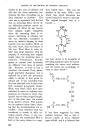
JOURNAL OF THE SOCIETY that the production of a thin emul- sion calls for much more stringent conditions than a cream where the favourable condition of high viscosity is obtained. The fact that a comprehensive range of non-ionic oil and water soluble agents is now available opens up a huge field of experimentation. One is, however, tempted to wonder whether some of the complex bodies now being offered will not defeat their own object. Dr. A. E. Alex- ander suggests that a complex hydrocarbon ring system with two polar heads in close proximity would give a condensed fihn at the inter- face, but if the polar groups are widely separated the molecule tends to lie flat on the surface, giving a gaseous or expanded fihn. This would point to a mono glyceride as a satisfacto•3z film forming substance, but would cast considerable doubt upon the efficiency of some of the recently developed emulsifiers, where the hydroxyl groups are widely separated. Before leaving o/w emulsifiers, some mention of the widely used triethanolamine soap should be made. The fatty acid soaps of triethanolamine are very efficacious in producing emulsions of low vis- cosity. They are usually regarded as forming an addition compound with stearic acid, although de Navarre suggests that, in the presence of water, triethanolamine forms a hydrate, and that the stearic acid reacts with the hydroxyl group with the elimination of water. Triethanolamino stearate, when dis- OF COSMETIC CHEMISTS solved in alcohol may be titrated with either acid or alkali. Using brom phenol blue as indicator, all the triethanolamine may be titrated with standard acid solution. With phenol phthalein, all the stearic acid may be titrated in spirit solution with standard alkali. On heating to fairly high temperatures, stearic acid reacts with one of the chain hydroxyl groups, in triethanolamine. This ester shows only a small amount of free stearic acid when titrated to phenol phthalein in alcohol. The di and tri esters can also be prepared. The mono ester offers possibilitie• a cationic emulsifier. An interesting example of the application of some of the theories so far described is the production of a hair-reconditioning cream. Such a preparation aims at the correction of the pH of the hair, subsequent to permanent waving, shampooing, etc. Even more important is the problem of redistributing a fine film of oil (let ns say synthetic sebum) to the hair in fact, it is the degreasing problem of the wool industry in reverse. The efficient, but not excessive, lubrication of the hair calls for an o/w emulsion. By a careful study of the adhesive properties of certain substances, the nature of the emulsifying agent and conditions of pH, it is possible to formulate a very effective recondi- tioner. In this way, an enmlsion may be produced which, when applied to the hair and then thoroughly rinsed •vith water, will leave all the oil originally contained in the emulsion, on the hair. By a suitable variation 150

EMULSIONS AND THE COSMETIC CHEMIST of the formula, it is possible to allow all the oil to be rinsed away while still in the emulsified condition. WATER-IN-OIL EMULSION,•q The w/o creams are important, even though these comprise but a small percentage of the cosmetical preparations. Unfortunately, the amount of work so far carried out on w/o emulsions is considerably less than that on the opposite type and, consequently, the specific require- ments of w/o emulsifiers are less clear. Most w/o emulsifiers contain a non-ionised polar' group in the molecule. A combination of a weak polar group such as hydroxyl and a long chain hydrocorbon results in an oil-soluble substance which will stabilise w/o emulsions. However, such a substance has relatively little power to lower surface tension and it is, therefore, necessary to introduce mechanical energy to bring about small particle size and force the emulsifier to the interface. For this reason, it is necessary to dissolve the emulsifier in the oil phase and slowly add the water with continual stir- ring and, in some cases, subsequen• homogenising. To fulfil the condi- tions of a rigid uncharged filrn at the interface and to form this film with a minimum of mechanical energy would appear to call for an oil- soluble body used in conjunction with a neutral water-soluble body. Thus, Drs. Shulman and Cockbain have shown that cholesterol and digitonin form water-in-oil emul- sions. This surely offer the chernist a line of investigation. Absorption bases made from mix- tures of woolwax and petroleum bodies are well-known to the indus- try. They absorb large quantities of water and work best at tempera- ture._• between 35øC and 40øC. In making creams from these bases it is essential to add the water to the stirred oil phase in small quantities, making sure that emulsification is complete before further addition is made. Important as the purity of the wool wax is, it is doubtful whether it is generally realised that the petro- leum bodies have a great effect upon the efficiency of the base. Prior to the last war it was possible to buy a petroleum jelly which, on the addi- tion of from 5-10% of wool wax, would absorb large quantities of water with relatively small effort. The grades of jelly now available are far less accommodating, and re-- course has often to be given to supplementary emulsifying agents. It is possible to rectify the position to some extent by fortifying the jelly with mixtures of petroleum wax and oil. While little information on the constitution of the various petroleum jellies is available, it is possible that the products which are most satis~ factory are mainly branch-chain hydrocarbons, and that those now available are mainly of a straight- chain structure. An emulsion made from the correct type of petroleum jelly will tolerate relatively' large amounts of acids, alkali and electro- lytes, but this is not true of all enmlsions made from present-day 151
Purchased for the exclusive use of nofirst nolast (unknown)
From: SCC Media Library & Resource Center (library.scconline.org)