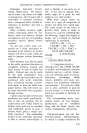
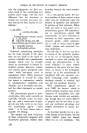
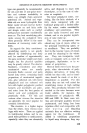
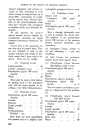
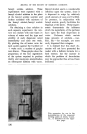
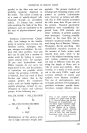
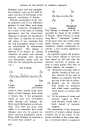
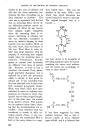
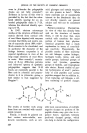
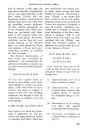
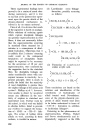
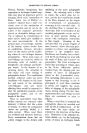
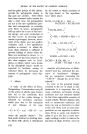
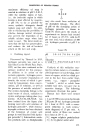
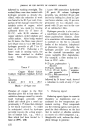
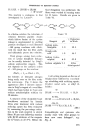
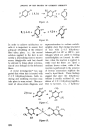
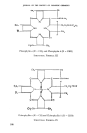
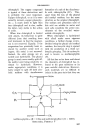
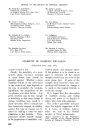
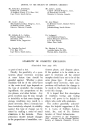
JOURNAL OF THE SOCIETY stances known as porphyrins. It will be noted that this applies in the case of chlorophyll, which is a porphyrin derivative. One does not need to consider the detail of the various sub- stituents on the dihydro-porphin ring other than that shown as "R ", since it is the only one that differs in the two chlorophylIs a and b. In the case of chlorophyll a, R is a methyl group whereas in chloro- phyll b it is an aldehyde grouping. Chlorophyll has a magnesium atom bound by covalent and co-ordinate linkages to the nitrogen atoms. It is also a diester. One of the acid groupings in the porphyrin molecule is estertried with methyl alcohol, and the other with phytol, C2oH:• OH. Phytol is• a primary, unsatur- ated, fatty alcohol that appears in several naturally occurring sub- stances. For example, it forms part of the molecule of the tocopherols (vitamin E). The chlorophyll mole- cule also possesses a characteristic isocyclic ring. It is worth looking at the similari- ties betwea the structure•, of chloro- phyll and of haem (II). The latter, in combination with the protein globulin, forms haemoglobin, the red colouring matter of blood. It will be remembered that chlorophyll is also thought to be associated with protein in the living cell. The struc- ture of haem is remarkably similar to that ooe chlorophyll. It also is a porphyrin derivative, and most of the substituents on the pyrrole tings are identical with those of the chloro- phylis. The important differences are that in haem the magnesium 184 OF COSI•IETIC CHEMISTS ato•n of chlorophyll is replaced by a similarly-bound iron atom that haem does not possess the character- istic isocyclic ring of chlorophyll and that it is not an ester, the two carboxyl groups being free. It is this remarkable similarity in struc- ture of ,these two substances that has undoubtedly prompted the at- tempts to treat anaemias, resulting in haemoglobin deficiency, by the administration of chlorophyll deriv- atives. Changes which can be made in the chlorophyll molecule were next dis- cussed, special attention being paid to the relation of these changes to the production of technical chloro- phylis. When chlorophyll isl treated with acids, the co-ordinately-bound magnesium atom is removed in fact this removal takes place very easily indedd. The product, which con- tains two hydrogen atoms attached to two. of the nitrogen atoms, is known as phaeophytin (III). Phaeo- phytin is still a neutral ester, con- taining the phytyl and methyl resi- dues unchanged. Like chlorophyll it is insoluble in water but soluble in many organic solvents. Unlike the original bright green chlorophyll, it is a dull olive-green substance. It is very easy to displace the magnesimn from chlorophyll by other metals such as copper, zinc, nickel, iron or silver. Equally, any of these metals is readily introduced into phaeophytin, the two hydro- gens directly attached to the nitro- gen atoms being replaced the re- suitant metallic derivative is identi- cal with that produced directly from

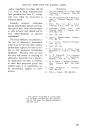
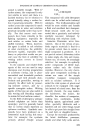
CHLOROPHYLL C • CH CO.O.CH• CH[CH r • • CH• , CHs Chlorophyll a (R -- CH•) and Chlorophyll b (R = CHO) •TRUCTURAL FORMULA I 185
Purchased for the exclusive use of nofirst nolast (unknown)
From: SCC Media Library & Resource Center (library.scconline.org)