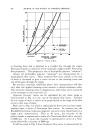
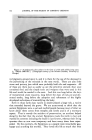
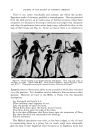
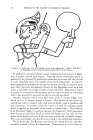
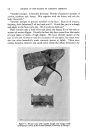
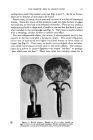
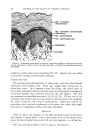
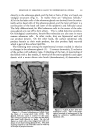
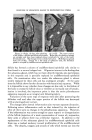
170 JOURNAL OF THE SOCIETY OF COSMETIC CHEMISTS Figure. 5.--Caricature of a girl holding mirror and rouging lips. (About 1200 B.C.) (Photograph courtesy of the Oriental Institute, University of Chicago.) In addition to eye-paint there is some evidence that the women of Egyp- tian antiquity colored their cheeks. Painting of the whole body, which is believed to be indicated by prehistoric statuettes of women, fell out of style in early historical times, the middle of the third millennium. In historic times pigment was applied to the lips by women (see Fig. 5), and this must have been the only red pigment known to the Egyptians until very late times, a naturally occurring red oxide of iron, red ochre. Red ochre is found in graves in connection with palettes and as stains on palettes indicating that it was ground for personal use just as was the eye-paint. Another cosmetic which must have been used in ancient Egypt very much as it is in modern Egypt is henna. The flowers of the shrub are odoriferous with a pungent odor and were probably used to perfume oils and ointments. In modern times the leaves are used for making a paste which is applied to the palms of the hands to redden them. The evidence from Pharaonic Egypt is dubious because the frequently cited arguments that mummies have been found on which the finger and toe nails and the palms of the hands and soles of the feet were stained red are highly suspect. The stain is probably only discoloration owing to the embalming materials. We do know that the Romans used henna for dying the hair, and they probably learned it from the Egyptians. There seems to be no other ex-

THE COSMETIC ARTS IN ANCIENT EGYPT 171 planation for the brilliantly red-dyed hair on the mummy of a royal lady of the 18th Dynasty (14th century B.C.) than that it was dyed with henna. I cannot discover anyone's guess as to why palms of hands and soles of feet should be dyed red except vanity, and I do not quite see how the prac- tice serves vanity. Perhaps the light colored palms of a dark-skinned people did not appeal to them as quite pleasant or decent. Nor do I know why finger and toe nails might have been dyed, but then I do not know why that is done in the present day either, so perhaps the reason in antiquity was just as obscure. Of course, one must always remember that there may have been some primitive, perhaps religious or superstitious, reason ini- tially for many a practice of this sort, but if so we have no idea what it was. Hairdressing and wig making must have been an industry of large scale in ancient Egypt, for the Egyptians were addicted to the most elaborate wigs of many curls and braids (see Fig. 4). The wigs have been analyzed and, contrary to statements sometimes made, they never consisted of animal hair or wool but only of human hair with an occasional introduction of something like palm fiber. Analysis also shows that they were coated with beeswax to keep the elaborate curls in place. Frequently, although perhaps not always, both men and women shaved their heads and wore wigs. Men probably commonly shaved their heads just as modern Egyptian men do. At least priests, as we have said, always appear with shaven heads and without wigs. In the beautiful make-up chest of a 12th Dynasty (20th century B.C.) princess along with the other necessities there were two hammered bronze razors and the whet stones or slip stones on which to sharpen them. The box and its contents are in the Metropolitan Museum of Art in New York. Ancient Egyptian men were always clean shaven. On ceremonial oc- casions the Pharaoh wore a false beard and in some depictions of him one can see the strap by which it was held in place. The statues of the gods also show them wearing false beards similarly fastened but their beards were braided and curved outward at the end whereas the king's beard was straight. It may be of some interest to cosmetic chemists to consider some of the numerous guaranteed recipes which the ancient Egyptian physician--for this came within the province of the physician--prescribed to be used in a cosmetic manner. These are found recorded in a so-called medical papyrus and, like the remedies for ailments of all sorts, were no doubt accumulations of observations and experimentation and lore transmitted over generations before they were put down in writing. These particular recipes are taken from one text, Papyrus Ebers, which was written in the 16th century B.C. Its recipes and remedies are not to be taken as the best representatives of the medical and surgical knowledge of the ancient Egyptians as we know it from other remarkably objective and astute compilations.
Purchased for the exclusive use of nofirst nolast (unknown)
From: SCC Media Library & Resource Center (library.scconline.org)