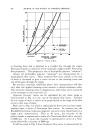
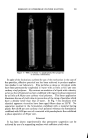
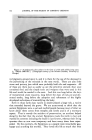
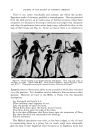
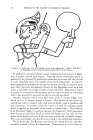
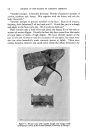
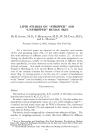
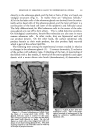
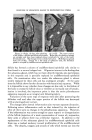
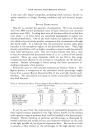
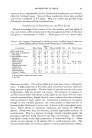
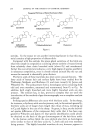
174 JOURNAL OF THE SOCIETY OF COSMETIC CHEMIS2S "Another (recipe): to beautify the body: Powder of alabaster, powder of natron, northern salt, honey. Mix together with the honey and rub the body therewith." "Another (recipe) to prevent wrinkles of the face: Gum(?) of incense, beeswax, fresh balanites(?) oil and rush-nut(?). Grind fine, put in a dough and apply to the face every day. Do it and you shall see." There remains only a little to be said about the beauty kit of the man or woman of ancient Egypt. Usually the best kits have come from the tombs of royal ladies or ladies of high degree. We have already spoken of the jars of oils and ointments and the containers of eye-paint, but there were also the often beautifully made cosmetic spoons or ladeIs. There were combs, hairpins, tweezers and small metal clamp-like affairs believed to be • ..•k•..-.r•. -:,•.- ............ • . ...... . Figure"7.--Brcnze razor with wooden handle and wooden comb. (Pt•otograpt• courtesy o• tt•e Oriental Institute, Uniwrsity o• CiVicago.)

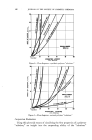
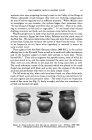
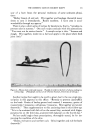
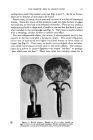
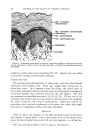
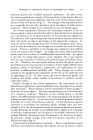
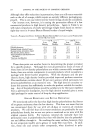
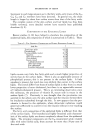
THE COSMETIC ARTS IN ANCIENT EGYPT 175 curling irons much like modern ones (see Figs. 6 and 7). So far as I know there are no brushes of any kind to be found. Razors were, of course, not of steel and not even of iron but of hammered bronze. Naturally razors of this material would not take the best of edges nor hold one, so they had to be whetted constantly. They are not unlike a modern putty knife in shape with a handle on one end but the blade is some- what rounded on the cutting edge (see Fig. 7). They were no doubt wielded with a sweeping, circular motion to achieve any effect. The one indispensable object, the mirror, is always present and it is fre- quently in the best examples a handsome object. The ancient Egyptian mirror was of hammered and highly burnished bronze or more rarely of copper (see Fig. 8). There were, no doubt, mirrors of gold, silver and elec- trum which have long since fallen prey to the tomb robbers. The ordinary name for a mirror in ancient Egyptian was simply "see-face" or perhaps "that which sees the face." There were other less common names for it . .' :., •.• •... ' ,•' •' ' v :-- ß ...-gq ... ? ..5' :... $•. - ...:...... - : :.:... '•½ • ..'• :•.- •: '"- ..':}.•,.... • ,.a-.----,: •::• %..'? •.,. • e• '-.:•..-.',.., .r ..... :,. • :•. ::• .: .•?•7•.•. :?, .,, :.: }• i-"' . '%. -• •:•":•:• '75•:'.•?i:? • 'v "?%v •: ::' f' .... ' .. '% '.2 •.. Figure 8.--Bronze mirrors. Handle on left is ivory handle on right in form of cow-eared head of goddess Hathor and papyrus stalk. (Photograph courtesy of the Oriental Institute, University of Chicago.)
Purchased for the exclusive use of nofirst nolast (unknown)
From: SCC Media Library & Resource Center (library.scconline.org)