296 JOURNAL OF THE SOCIETY OF COSMETIC CHEMISTS ß formulation by reducing the number of components. Studies of this sort are well worth making if your product will contain pH dependent dyes. The pH sensitivity of acid dyes is related directly to their basicity. Diserens (6) classifies them in increasing order of sensitivity as follows: 1. Triarylmethane dyes 2. Monosulfonates 3. Disulfonates 4. Trisulfonates Level colors are not generally used in hair dyes since good levellin'g is ob- tained only at the expense of exhaustion, while the paramount problem in hair coloring is to get maximum color from a cold dyebath in a short period of time. Generally speaking also, level dyes have poor wash fastness. The sensitivity of anion-cation complexes to pH is also critical. When such complexes are formed by reacting ionic dyes with surfactants of oppo- site charge, it will generally be found that the maximum color yield occurs at a rather specific pH for each combination of agents. The particular pH which will be crucial often cannot be predicted, apparently depending on the relative "ionic strengths" of the materials being reacted. This is par- ticularly true when amphoteric surfactants are used as part of the color complex. SOME D,z•.-HAIR REACTIONS The protein keratin consists of long polypeptide chains cross linked in several ways. One is a salt linkage between acidic and basic amino acids, giving the protein its amphoteric character. Another cross ]ink is the di- sulfide one, cystine, which is easily reduced to the mercaptan cysteine. Most of the major classes of dyes react readily with the amphoteric kera- tin fibers. Studies by Meyer (11) and others show that 1200 grams of wool react with one gram equivalent of acid. This, of course, includes acid dyes. It can be presumed that one equivalent of base will titrate about 1600 grams of wool since only 8 per cent of the keratin side chains are basic while ] ] per cent of them are acid. In any case, these acid-base equivalents ex- plain the stoichiometric limitation on total dye uptake by the hair. Keratin fibers swell excessively when the disulfide crosslinkage has been broken. Reducing the cystine to cysteine during permanent waving of hair, or oxidizing it to cysteic acid by peroxide bleaching, will result in such increased swelling. If the swelling is done with dye solutions instead of just water, the hair can obviously take up more color than usual. Furthermore, acidified dye solutions will harden such swollen hair, contracting it, and thus be less able to wash out again later. This accounts for some of the difficulty encountered in removing "temporary rinses" from damaged hair. These are some of the physical prope• ties of damaged hair which affect the dye uptake.

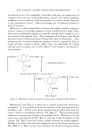
HAIR COLORING--MODERN FORMULATION CONSIDERATIONS 297 There is a second reason why such hair takes up more dye. Not only are more of the usual dye sites accessible due to the swelling, but the su./fhydry/ group of cystei,e provides a new type of dye site. Cysteine will react with sulfonic acid dyes to such an extent that it is possible to re-crosslink reduced hair by use of disulfonated colors. They can take the place of the usual oxidizing bath. Several years ago, the author helped formulate a permanent dye based on this principle, using disulfonated U.S. certified dyes in combination with an alkaline thioglycolate. Tensile strength measurements showed that it was not necessary to follow this treatment with the usual oxidizing step since the hair was substantially cross linked by the dyes. The British chemist Deadman also came to the same general conclusions, receiving a patent (31) in 1955 as a result of his work. D,zEs UsEr •s HAIP. COLOP.•N'G Metallic Dyes. The deliberate application of lead and other heavy metal salts to the hair has been practiced for several thousand years. Currently known as "progressive dyes" due to the slow additive manner in which the the color develops on repeated application, an "instant" version is also sometimes offered. In this version, there are two solutions the first (the "dye") containing the heavy metal salt, and the second (the developer) containing a sulfide or pyrogallol which produces a brown or black precipi- tate on the hair. One really modern version recently appeared with a thio- glycolate as the developer. In spite of their rather dubious toxicity and sometimes unnatural appearance on the hair, such products will always find a market since they are water-white liquids which do not look messy. In the field of hair dyes, this is a tremendous advantage. Fegetable Dyes. There is only one of commercial importance today (7), henna. Henna extracts are used alone, sometimes modified with pyrogallol or logwood, and sometimes mixed with acid dyes. Safe and nonirritating, henna gives colorfast dyeings which have a rather unsubtle look on repeated application. Oxidation Dyes. These constitute the major type of colorant used in the United States for permanent hair dyeing. They include the aromatic amines (the para dyes) and polyhydric phenols such as resorcinol and pyro- gallol. Harry (8) gives an excellent concise review of these oxidation colors. Kass gave a longer one in a series of articles (12) which appeared a few years ago. These dyes are unique in one notable respect--the use of peroxide required to form the final color pigment. This allows "lightening" at the same time as dyeing, but also requires a two-bottle product which must be used shortly after mixing. The hair damage occasionally caused by such dyes is due to the combination of peroxide and alkaline conditions. Unfortunately, questions of toxicity, skin irritation, sensitization and eye damage caused by the oxidation dyes seem to have become rather academic
Purchased for the exclusive use of nofirst nolast (unknown)
From: SCC Media Library & Resource Center (library.scconline.org)