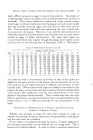
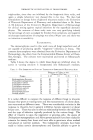
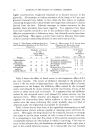
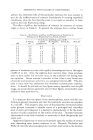
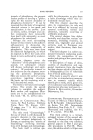
DENTAL CARIES CONTROl. WITH DENTIFRICES AND MOUTH WASHES 289 high a diffusion pressure as sugar in concentrated solution. The simple act of refining sugar makes it possible to form markedly hypertonic solutions in foodstuffs. Thus, many confections, candies and syrups contain concen- trated sugar and hence would penetrate the plaque and tooth more rapidly than the naturally occurring sugars and such items as fruit juices and the like. There has been little work done concerning the rate at which solu- tions penetrate the plaque. However, it was recently demonstrated that artificially prepared microbial plaques and microbial mats are quite imper- meable to sugar of dilute concentration. Yet when these sugars are in concentrated form they migrate through the plaque quite rapidly so that acids can form on the inner portions of the plaque, Table 1. When dilute TABLE 1--D•FFtrS•ON OF GLtrCOSE--gm./ml. t .Diffusion Time, Minutes- Slice 5 15 30 5 15 30 5 15 30 5 15 30 5 15 3O 0 100 100 100 300 300 300 500 500 500 800 800 1 31 44 49 78 130 142 95 142 167 219 339 2 30 42 45 73 110 131 88 132 149 170 292 3 30 40 43 67 95 125 85 122 145 161 280 4 30 37 40 62 78 123 83 113 143 157 272 5 29 31 37 57 69 120 71 101 141 153 265 6 25 28 35 49 62 111 52 88 140 148 255 7 22 27 33 37 54 95 40 79 130 138 237 8 20 26 31 28 49 88 33 72 109 120 218 9 18 25 30 25 45 81 29 62 98 95 197 10 17 25 28 21 42 78 27 52 89 71 177 800 1000 1000 1000 424 325 452 515 396 276 416 498 378 246 399 490 339 215 376 478 331 178 323 468 320 152 258 464 314 133 215 456 306 113 195 443 290 92 190 429 273 71 182 410 acid solutions with a concentration equivalent to that of fruit juices are applied to the outer portions of the plaque, the inner portions do not be- come acid nor do the sugars permeate in sufficient concentration to form harmful acids. When concentrated sugars are added to the surface of the plaque, the sugar concentration becomes isotonic on the inner surface within a few minutes after application and the acid concentration in the inner depths of the plaque become harmful. Thus it would seem that one of the primary mechanisms associated with dental caries is the permeability of the plaque which in turn is effected materially by the concentration of the sugar. , '['HE EFFECT OF PERMEABILITY OF PLAQUE AND TOOTH IN THE CONTROL OF DENTAL CARIES Whether one attempts to make the tooth more resistant to acids, or whether one attempts to halt acid formation, the permeability of the plaque and the tooth must be considered. If one wishes to incorporate fluorides by means of topical application, the maximum penetration can be obtained only on young teeth. This is borne out by clinical evidence. In order to obtain a maximum penetration

290 JOURNAL OF THE SOCIETY OF COSMETIC CHEMISTS one should use as concentrated a solution as possible. This also has been indicated by clinical evidence. If the permeability of the tooth normally changes with the time after eruption, then it should be possible to "age the tooth" by the application of appropriate chemicals. There have been some attempts along these lines but not on a systematic or rational basis. One cannot rely on in vitro experiments unless the teeth are set up as a semipermeable membrane. If one wishes to control acid formation by means of enzyme inhibitors in oral preparations it is necessary to know the effect of the inhibitor on the dental plaque. It is not enough that the inhibitor absorb on or in the plaque. It must be present under the plaque on the tooth surface before effectiveness is assured. The inhibitor may absorb on the plaque surface but never reach the tooth surface. If enzyme inhibitors are incorporated in the diet along with the sugar substrate, it may be of little use unless it penetrates the plaque, as fast or faster than the sugar. It would be of little value even when incorporated in the sugar or confection if it did not rapidly diffuse to the tooth surface. SUMMARY On the basis of the modern concept of dental caries, control of this disease should be readily obtained by the prevention of acid formation on the tooth surface or by making the tooth more resistant to the penetration of ions and the decalcification of acids. There are certain variables inherent to the oral cavity which make the successful application of these methods very difficult. In so far as the permeability of the tooth varies with age, sus- ceptibility of the tooth to attack changes. In so far as the penetration of the plaque is a multi-functioned variable, it is possible to have enzyme inhibitors present without affecting caries activity. Any program of caries control must be cognizant of these variables and attempts to circumvent them must be made. REFERENCES (1) Easlick, K. A., "Dental Caries," St. Louis, C. V. Mosby Co. (1948). (2) Leicester, H. M., "Biochemistry of the Teeth," St. Ixmis, C. V. Mosby Co. (1949). (3) Wendt, G. L., and Clarke, A. H., )t. •'lm. $oc., 45, 882 (1923). (4) Holt, L. E., LaMer, V. K., and H. B. Chown, •7. Biol. Chem., 64, 509 (1925). (5) Suess, P. H., and Fosdick, L. S., •7. Dental Research, all 177 (1951). (6) Williams, J. I,, Cosmos, 46, 981 (1940). (7) Williams, J. L., Ibid., 47, 18 (1905). (8) Hemmens, E. S., Blaney, J. R., and Bradel, S. F., •7. Dental Research, 25, 195 (1946). (9) Blaney, J. R., Bradel, S. F., Harrison, R. W., and Hemmens, E. S., )t. •'lm. Dental •'lssoc., 29, 1645 (1948). (10) Moore, B., Carter, W., Dunn, J., and Fosdick, I. S., •7. Dental Research, $5, 778 (1956). (l 1) Englander, H., Carter, W., and Fosdick, L. S., Ibid., 35, 792 (1956). (12) Clement, A. J., Plotkin, R., and Fosdick, L. S., Ibid., $5, 786 (1956). (13) Jay, P., )t. •'lm. Dental •'lssoc., 27, 393 (1940). (14) Becks, H., •7. •lm. Coil. Dentists, 9, 184 (1942). (15) Shaw, J. H., Schweigert, B. S., McIntire, J. M., Elvehjem, C. A., and Philips, P. H., •. Nutrition, 28, 333 (1944). (16) Kite, O. W., Shaw, J. H., and Sognnaes, R. F., •7. Dental Research, 29, 688 (1950).
Purchased for the exclusive use of nofirst nolast (unknown)
From: SCC Media Library & Resource Center (library.scconline.org)