WATER ON TROUBLED SKINS--OIL ON TROUBLED WATERS 365 Possibly one reason why the cosmetic chemists have in the past refrained from such discussions among themselves is that they have been under the impression that management discourages such freedom of intellectual intercourse. I hope that I am correct in thinking that management has relaxed some of its restrictions in recent years, and that, on the scientific level, communication can now be more free. This brings us to the third area of communication--that between cosmetic chemists and management. Here I feel insecure, since I have had no opportunity to observe this area of communication first hand. But somehow or other, I have sensed that in this relationship many cosmetic chemists have been a bit reticent. The cosmetic industry has built up its foundation of scientific facts in order to be in a position to supply prod- ucts which do more than simply mask a few cutaneous blemishes. The cosmetic chemist knows these facts. Management depends upon him to supply them. Management should certainly be willing to listen to the chemist, and he, in turn, should be equally willing to listen to management. As with the cosmetic chemist and the dermatologist, each group can con- tribute to the other's fund of information. And now, finally, what about communication between the cosmetic chemist and the advertising copywriter? I am sure that some of the things which have been said in cosmetic advertising have not been communicated to the copywriter by any of you. In this relationship, it is very important to attempt to establish a sympathetic and mutual understanding of each other's goals. The goal of the advertising copywriter is to sell the com- pany's products. The cosmetic chemist can help him. He can supply the facts from which the copy can be written. He can work with the copy- writer. He can help him. The copywriter must not be led to feel that he is being harnessed by the chemist. Each must listen to the other. The necessity for adequate communication is, of course, not limited to these four groups of people. It is of universal importance: father to child, student to teacher, saint to sinner, technician to investigator, Democrat to Republican, vice-president to labor-organizer, Eisenhower to Khrushchev, person to person. It must now be apparent why I have said that the oil which will help to quiet the cosmetic chemists' troubled seas of communication is the ever enlarging body of sound basic facts. As one's factual knowledge increases, one becomes more secure. As one feels more secure, one is more willing to listen. The more willing one is to listen, the easier it becomes to exchange ideas in an atmosphere of sympathetic understanding of each other's needs and goals. This award, which you, the cosmetic chemists, have established, rec- ognizes the importance of enlarging this body of sound basic facts. It stimulates research which will result in more rapid accumulation of these

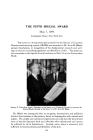
366 JOURNAL OF THE SOCIETY OF COSMETIC CHEMISTS facts. Let us all work together to build up bigger and more sturdy founda- tions--cos•netic che•nists, bioche•nists, physical che•nists, biologists, derma- tologists, management, advertising copywriters. Let us open all possible channels for free communication. From such communication ideas origi- nate profit comes to all. A SURVEY OF DR. IRVIN H. BLANK'S SCIENTIFIC PUBLICATIONS TUE LITERA'rURE REVIEW COMMITTEE has p•epared the following few summary paragraphs in orde• to acquaint the membership of the Society of Cosmetic Chemists with the work of Dr. Irvin H. Blank, the recipient of the 1958 Special Award of the Society. Dr. Irvin H. Blank has studied the physical and chemical properties of human skin for over twenty years. These properties have been deduced and put into proper focus by Dr. Blank from observations of the reactions of skin with a wide variety of chemicals. The chemicals so studied range from plain water (5) through soap and detergents (2) to "degerming" agents (4) and finally to the very toxic sarin (11). As early as 1939 Blank--while searching for the active etiologic agent of soap in itation--drew attention to the importance of chain length and unsaturation of the fatty acid of the soap in causing irritation during extensive patch testing (1). He later confirmed the differences he sus- pected (3). Armed with the evidence on hydration of the stratum corneum and on the diffusion of water through the skin, Blank (5) argued against the old concept that the lipid film on the cutaneous surface was the major factor in preventing dehydration of the stratum corneum. Instead, he suggested that hydration depended primarily on the relative humidity of the environ- ment. The barrier at or near the base of the stratum corneum allows very little water to reach the cornified epithelium from the underlying lavers. A year later (6) Blank presented further evidence that the barrier does exist in human skin near the base of the stratum corneum. Blank also attributed chapping or "dry skin" to moisture loss from the stratum cor- neum when the relative humidity of the environment was low (5). The concept that flexibility... of cornified epithelium... is obtained with water, not with oils or greases, was further expanded by Blank before the scientific meeting of the Toilet Goods Association in May, 1955 (9). Blank also reported (6) that, although organic solvents remove very little lipid from callus, the solvents so modify the callus that water ex- traction following solvent extraction removes large amounts of hydro-
Purchased for the exclusive use of nofirst nolast (unknown)
From: SCC Media Library & Resource Center (library.scconline.org)