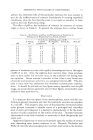
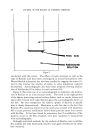
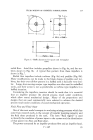
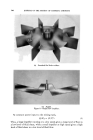
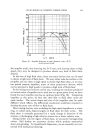
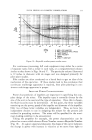
354 JOURNAL OF THE SOCIETY OF COSMETIC CHEMISTS left. Thus, as viscosity increases, the power remains relatively constant for any wide change in viscosity and then begins to increase. For a turbine type unit at a given speed and diameter, the power re- mains constant with viscosity increases up to about 50 c.p. It then drops slightly, rising again to its water value at about 50,000 c.p. Power rises rapidly with further increases in viscosity. There is a large latitude in the viscosity that may be accommodated by a turbine type unit without overloading the unit. The power drawn at the high viscosity stage must be sufficient to give the proper mixing action. Where the curve shown in Fig. 18 is fiat, the power varies with the cube of the speed and the fifth power of the impeller diameter, p o: N•D • (7) Thus, small changes in speed and diameter cause large changes in power consumption, and normally should not be done without consulting formulas to see what effect it will have on the power drawn by the unit. Additional data for various impeller types are given by Rushton, Cosrich and Everett (4). TABLE 2--NoM ENCLA'rUP, E Cp = specific heat N = rotational speed D = turbine diameter N• = Reynolds Number, D2No/i• d = tube diameter P = power Fo = gravitational force • = impeller flow Fi = inertia force •p = impeller flow at constant power F0 = surface tension R = process resttit Fv = viscous force T -- tank diameter H = impeller head o = density h = film heat transfer /• = viscosity k = thermal conductivit? SCALE-UP Similarity relationships are of great value in scale-up calculations. Since the fluid regime controls the mixing result, we can use the laws of hydraulic similarity. Two types of similarity are important, geometric similarity and dynamic similarity. Geometric similarity is the first requirement in all scale-up procedures. Dynamic similarity deals with fluid forces. There are four of these fluid forces. The first of these forces is inertia force, Ft. This is the force we apply to the system. It is related to the power, speed and diameter of the impeller. The other three forces are the ones which resist the accomplishment of our process, namely viscosity, F,, surface tension, Fo, and gravity Fa. One of these forces are usually negligible if baffles are used in the tank.

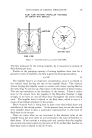
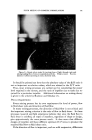
FLUID MIXING OF COSMETIC FORMULATIONS 355 Surface tension af[ects the formation of surface area in a two-phase system, but is usually not of great importance in those systems. Viscosity is the predominant force which influences the fluid regime in the vessel. The ratio of inertia force to the viscous force, F•/F,, is the Reynolds Number and has the value ND"p/I•. This is the ratio of what we apply to the system divided by the resisting force of viscosity. This determines the motion of the fluid in the tank. The process result is represented by R. The process result alone cannot be correlated with Reynolds Numbers, since (R) has units and depends upon the process definition given to it, while the Reynolds Number is a dimension less ratio. In heat transfer for example, the heat transfer coefficient (h) alone cannot be correlated with the Reynolds Number, but it can be combined by the principles of dimensional analysis to give a group (hd/k) which relates the process performance in the system to the fluid conductivity which governs the rate at which this process result will be obtained. Thus, the correlation of hd/k with Nae holds for all sizes of systems as illustrated in equation 4. When a dimensionless ratio involving (R) cannot be used, a second method of analysis for a particular process in both a small scale and a large scale in which the fluid properties are constant in both scales, takes the form of R = f(F•) (scale factor) (8) Geometric similarity is implied in this relationship. The group repre- senting the inertia force can either be speed, peripheral speed, power or power per unit volume, or even a dimensionless number such as Reynolds Number. The choice of which index to use is determined by the scale factor that results. The choice of horsepower per unit volume for Fz has several advantages. One advantage of this choice is that the scale factor varies the least above and below unit of any group that can be chosen. For scale-up, the factor must be known either by previous information, such as research or plant scale data, or must be determined as part of the pilot plant procedure. PILOT PLANTING Purpose of Pilot Plantin• The ultimate aim of all process designers is to design a process which successfully meets the requirements of the plant. To meet this aim, a complete investigation of the current mixing knowledge relative to the application should be made. By the most practical method, data should be extrapolated to the plant size process. At this point, the accuracy of
Purchased for the exclusive use of nofirst nolast (unknown)
From: SCC Media Library & Resource Center (library.scconline.org)