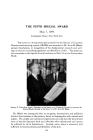
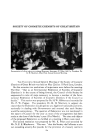
THE FIFTH SPECIAL AWARD 361 research group in large centers of dermatology which has taken upon itself the specific purpose of studying in a very systematic fashion this basic work. Some institutions have done more basic, as opposed to project research, than others but none has done as much as the Harvard group. For those of you, who of necessity must know practical applications of basic work, I will give you an illustration of last month's Grand Rounds in ray, small department in Cincinnati. (1) The presentation of a case of shoe dermatitis. Dr. Blank made important contributions on this as regards the antioxidants and the controlled usage test. His studies were reported in this conference. (2) The survey of our studies with simple wet applications with '"'• colored water over a period of four years. Dr. Blank had suggested and initiated this form of clinical therapy. (3) The review of our interest and the increasing importance of geri- atric dermatology. through the use of agents for the softening of the skin of elderly individuals. As you know, this is Dr. Blank's basic work on hydradon of the skin. There in a short space of time in clinical conferences for postgraduate teach- ing were only three of Dr. Blank's studies. Now as regards his own teach- ing interests, Dr. Blank's work in presenting dermatology to both under- graduates and postgraduates, and his simplified exhibits for practicing dermatologists of the modern concepts of chemistry and physiology are but some of his other interests. For you, his active membership and active participation in the Committee on Cosmetics of the American Medical Association is of g•eat interest and importance. He is on the Board of Directors of the Society of Investigative Dermatology. I should like to quote Dr. Raymond R. Suskind of our department about his picture of Dr. Blank. 'Here is a quiet and humble person, who through clear thinking, lack of archaic medical prejudices and a rather special talent for experi- mental design, has thrown a great deal of new light on old problems.' "So, in behalf of dermatology, I wish to compliment your Society for recognizing finally for his great works in our specialty, Irvin H. Blank." Dr. Blank's acceptance of the Award follows. WATER ON TROUBLED SKINS--OIL ON TROUBLED WATERS By IRviN H. BL^NK IT IS WITH great pleasure that I accept this award today and join the distinguished company of investigators on whom this honor has been con- ferred. The fact that, within the short space of five years, men who work in several different scientific fields--dermatology, chemistry and biology--

362 JOURNAL OF THE SOCIETY OF COSMETIC CHEMISTS have received this award is evidence of your breadth of view and your appreciation of a multidisciplinary approach to cosmetic chemistry. I suspect that the years to come will continue to bring evidence bf your recognition of the value of broad horizons. If your Literature Review Committee, on which I served for one year, were to have even broader representation from the various scientific fields, it would not surprise me to find among future recipients of the award a man whose interests appear far removed from cosmetic chemistry, perhaps a nuclear physicist, an anthropologist or a psychologist. It would be wrong for me to accept this award without acknowledging the help I have received in my work. It is not possible to list all the sources of this help. In addition to the assistance given by willing technicians and the stimulation derived from books, conversations with many people have been of inestimable value--conversations with friends and acquaintances (both lay and scientific), with co-workers, with colleagues at a meeting like this, with scientists in other departments of the University, with members of one's own family. Conversation with anyone may help with the organi- zation of one's thoughts--may result in the genesis of an idea. From such communication comes much help. Some years ago, when my main interest was the use of sulfated oils for cutaneous hygiene, I was talking with Dr. Sidney Burwell, who was then the Dean of the Harvard Medical School, and, with a twinkle in his eye, he parodied the phrase "oil on troubled waters" and said to me, "It looks as though you are now using oil on troubled skins." As time went on, my interests turned from sulfated oils to water, and for some years I have advocated water on troubled skins. Today I am completing the cycle and I should like to return to a discussion of oil on troubled waters. Do not misunderstand me! I am not suggesting that the water I have advocated for troubled skins is now itself in trouble. I still recommend water for troubled skins, but possibly, as is so often the case, time may have tempered my enthusiasm a bit. The role of the naturally occurring lipids and the externally applied fats and oils in maintaining a pleasing cutaneous appearance is perhaps becoming more apparent to me. Oil on troubled waters! The troubled waters that I want to talk about are exemplified by an unsigned note which was printed in a recent issue of one of your trade journals. I quote: "The relation between chemists and dermatologists in cosmetics remains an uneasy one, aggravated more often than eased when there is direct contact between the two. The dermatolo- gists as practising physicians, as research investigators, or as teachers are prone to assume the customary physician's stance of infallibility. This is naturally accompanied by an unconcealed attitude of superiority, impolite even if it were warranted. Dermatologic language seems to call for the patronizing use, in talks if not in writing, of words like 'cosmetologist' and
Purchased for the exclusive use of nofirst nolast (unknown)
From: SCC Media Library & Resource Center (library.scconline.org)