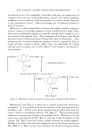
304 JOURNAI. OF THE SOCIETY OF COSMETIC CHEMISTS does not ionize. It is a color complex with some properties strikingly different from. the soluble parent color. These differences lessen as the complex is solubilized and the parent color can ionize once again. Rhodamine itself is exceptionally substantive to keratin, giving strong dyeings which are very difficult to remove, as one unhappy manufacturer of pink cold wave lotions discovered a few years ago! It will also stain the skin quite deeply, thus being of interest in some types of lipsticks, but un- fortunately it will stain the scalp just as nicely and so does not excite the hair colorist at all. In contrast, rhodamine stearate (when properly dispersed) is also quite substantive to keratin, but tends to give water insoluble transparent surface coatings which can be removed much more easily, depending on the pH from which they were applied. Confining the dye to the surface also means that ]ess will be needed for any given apparent depth of shade on the skin or hair. These facts may give pause to the lipstick formulatots who use D.C. Red 19 as a stain and then add a little soap to their paste to stiffen it up. On the other hand, it may be useful to know that many waler soluble certified dyes are usable in lipsticks if they are first complexed in such a manner. What we find to be true of the anion-cation complex of rhodamine can be generalized to all such color complexes. In effect, we are producing in situ modifications of the dyes to suit our purposes. Among the cationic agents used to precipitate the certified and other acid dyes in today's color creme rinse formulations are the following: 1. Surfactanls with a qualernized nitrogen, such as the quaternary am- monium, pyridinium or quinolinium compounds. More rarely, Julfonium and phosphonium compounds have been explored for the same purpose. This general group is often used i,n the alkaline pH range to reduce irritation and to give better color yields. 2. Tertiary amines, especially the fatty amines, can be used. They usually give most satisfactory results in media which are slightly acid to neutral. 3. atlkylolamides, not normally considered cationic, will give desirable complexes in very acid (usually below pH 4) media. The Kritchevsky con- densates seem to work better for this use. In general, when working with these complexes, it must always be re- membered that the state of the dispersion is all-important. A perfectly useful combination will suddenly lose much or all of its color yield value if too well solubilized with nonionics. Yet if you do not solubilize it some- what, an awful precipitate may form, leaving ugly blotches of color on the hair which will rub off all over the place. A perfectly innocent nonionic gum may be added to the formulation to help suspend the dispersion, but unless it is added at the right time in the manufacturing process to keep the particle size of the complex at a particular point, it too may reduce the

HAIR COLORING--MODERN FORMULATION CONSIDERATIONS 305 color yield. Silicone and other antifoams are excellent dispersants in minute quantities and their effect must not be discounted. A perfume can occasionally act as a solvent for the complex and upset a carefully achieved balance. In developing or changing such formulations as these, every new factor introduced, no matter how minute, must immediately be checked for its effect on the color yield of the product. For these reasons, the translation from laboratory to production size batches is often a tedious operation requiring several intermediate pilot size steps to determine all the variables. GENERAL CONSIDERATIONS The major problem of the hair dye formulatot is that he must give a uniform coloration to an unbelievably nonuniGrm fiber. Generally speaking, he cannot do it with a simple all-covering coat of paint-like pig- ment because such a procedure gives dull, solid looking shades which do not appear natural. Working, therefore, with processes which are primarily chemical in nature rather than physical, he finds to his dismay that while many of the things women do to their hair change its chemical properties, unfortunately they are not done homogeneously. Thus, permanent waves are applied only to some strands of hair, and then often only to the ends of these particular strands. Bleaching is done over-all the first few times but the ends of the hair are inevitably more bleach-damaged than the roots. This is due to natural growth, to overlapping subsequent opera- tions and because the ends of the hair get most of the natural bleaching from sunlight. Cationic creme rinses are generally applied uniformly and their effects are not cumulative due to the weekly anionic shampoo, but women occasionally use them pure as a pomade--only on the outer top areas which they can reach easily of course! Our typical customer may have used your competitor's dye product, gotten stains on her face, and tried to use "Clorox" to remove them, thus incidentally chlorinating some of the nearby strands of hair. Perhaps her husband is feeding her arsenic, or perhaps she is pregnant and taking iron pills, or perhaps she just likes to swim in the ocean, but somehow she has gotten a lot of heavy metals in her hair, inactivating the cysteine and later catalyzing various disasterous occurrences when she uses hair products. Any of the above rather common occurrences will affect the color uptake by the hair from dye solutions. Since any combination of them in any de- gree is likely to have occurred, and since the customer is further likely to use any of your shades on any color hair she may have, the possibilities in favor of something going wrong are staggering. There is no such thing as normal hair except in the hair dye formulator's book of shade samples and in the Pollyanna-like direction booklets accompanying the product on the market.
Purchased for the exclusive use of nofirst nolast (unknown)
From: SCC Media Library & Resource Center (library.scconline.org)