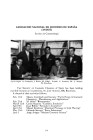
ASOCIACION NACIONAL DE QUIMICOS DE ESPAlqA (ANQUE) Section de Cosmetologia THE SOCIETY OF Cosmetic Chemists of Spain has been holding monthly lectures on its premises, Av. Josd Antonio, 608, Barcelona. A r•sum& of their activities follows: Feb. 11 th Feb. 25th March 12th April 9th April 21st May 13th June 3 Messrs. Contijoch and Castany "Fatty Esters in Cosmetic Chemistry: Manufacture and Applications" M. Albiol "Biocosmetics" Carlos Susanna "Cosmetic Emulsions" Juan R•fols "Aerosols in Cosmetics" Miguel Fenollosa "Chemical Processes in Cold Waving" Eduardo Servent "Fatty Substances" Jorge Artigas "Modern Cosmetic Science" 372

BOOK REVIEWS 'I'ASCHENBUCH FUR DIE •rACHSIN- DUSTR1E, edited by C. Ludecke with L. Ivanovszky. Wissenschaftliche Verlagsanstalt M.b.H., Stuttgart, Germany. 1958. 718 pages, illus- trated and indexed, size 6a/4 X 4l/2 inches. Price DM 48. This is the fourth edition of a book which in its comprehensive coverage and authoritative treat- ment reflects the author's experience in this field extending over a period of more than half a century. The book is divided into the following nine parts: I. Introduction, For- mation, History, Definitions, and Classification, II. Natural Waxes, III. Mineral Waxes, IV. Chemi- cally Modified and Synthetic Waxes, V. Commercial Grades of Waxes, Their Properties and Their Evalu- ation, VI. Auxiliary Products for the Wax Industry, VII. Applica- tion of Waxes, VIII. Analysis of Waxes and Wax-Based Products, and IX. Tables, Index and Refer- ences. Part II deals with the natural waxes grouped as follows: (a) animal waxes, including beeswax, chinese insect wax, shellac wax, spermaced and lanolin, (b) vege- tablewaxes, including the palmwaxes (carnauba, ouricoury and caranday) and grass waxes (candelilla, sugar cane and esparto), (c) vegetable tallows of wax-like character (e.g., Japan wax, bay-berry wax), (d) fossil waxes and (e) compounded waxes. Part III discusses the different mineral waxes, their composition, production and purification. Part IV considers not onlv the effects of oxidation, reductionl con- densation, hydrogenation, chlorina- tion, polymerization, and depoly- merization procedures upon waxes of vegetable and mineral origin, but it concerns itself also with wax acids and wax alcohols. Reference is made in this chapter to the pro- duction of fatty acids from paraffin, also to the IG-waxes derived from lignite (montan) wax. There is also a listing of polyoxyethylene waxes (Carbowaxes), their esters and condensation products. Part V discusses, among other things, the qualities which are im- parted to the finished product by particular waxes, e.g., in terms of gloss, body, homogeneity, emul- siftability, etc. It also gives a se- lection of tests relevant to the ul- timate use of wax compositions, such as film forming, hardness of film, its duration, slip etc. Among the auxiliary materials discussed in Part VI are stearin, olein, dyes, plasticizers, resins, sili- cones, solvents, also aerosol pro- pellents. The application of waxes, as reviewed in Part VII, covers the production of candles, of floor and automobile waxes, and shoe pol- ishes. The book contains a wealth of data not only for the wax chemist and technologist, but also for the businessman concerned with com- merce in, or use of waxes and wax products.--EM•L G. Lehn and Fink Products Corp. 373
Purchased for the exclusive use of nofirst nolast (unknown)
From: SCC Media Library & Resource Center (library.scconline.org)