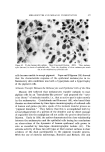
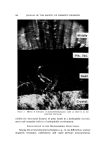
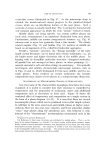
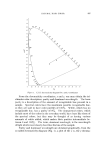
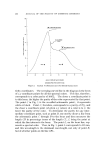
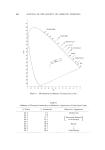
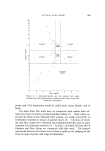
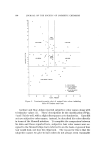
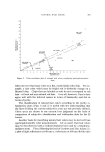
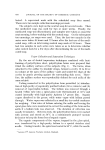
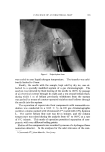
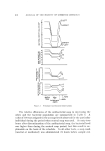
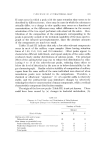
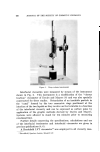
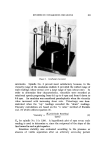
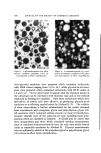
NATURAL HAIR COLOR 599 Purity and dominant wavelength do not completely describe a color. For example, white has a purity of zero and neither black nor white has a determinable dominant wavelength. Of course, black and white differ in the amount of light they reflect. Black reflects no light, and true white reflects all of the light that strikes it. In tristimulus notation the amount of light reflected is measured in terms of the Y or green reflec- tance. The Y reflectance of the sample is taken relative to the Y reflec- tance of a standard (often a block of magnesium oxide or carbonate) and then expressed in percentage terms. This expression, which is given the name luminosity, is used because the human eye is most responsive to light in the green portion of the spectrum, and the amount of green light reflected may be correlated with the lightness or darkness of a sample. It may Be seen, then, that a coordinate point on the chromaticity diagram does not represent a single color. Just as point C represents from black through gray to white, any other given point represents a range of colors, from light to dark, all having the same purity and domi- nant wavelength but differing in luminosity. The chromaticity diagram (Fig. 1) is merely a slice taken from a three dimensional figure. It is useful for determining purity and dominant wavelength, but does not re- late to luminosity. (For a further description of color and its measure- ment, see reference 8.) EXPERIMENTAL Instrument Description and Method of Measurement The instrument used in this study was built in this laboratory (6). Basically, its operation is as follows: A hair tress is mounted in a special jig so that a straight flat surface is presented to an incident light beam at an angle of 30 ø A photocell, mounted on an arm, moves in a circle about the tress and measures the total light reflected as a function of angle. Measurements start at an angle of 30 ø and end at an angle of 100 from the incident Beam. A reflectance vs. angle of scan (i.e., angle of reflection) curve is ob- tained from the output of the photocdl. A curve is obtained with each of the three color filters, X, Y, and Z. Figure 2 shows a sample Y reflectance curve for a hair sample. The appurtenant X and Z curves would be similar in character but usually somewhat different in magnitude. The curve is divided into two sec- tions, labeled a and b the division is made at an angle corresponding

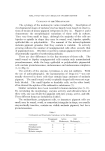
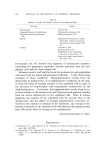
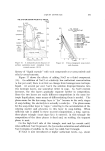
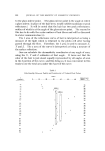
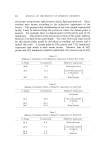
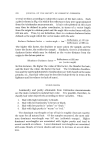
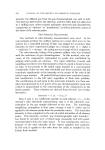
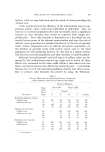
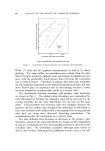
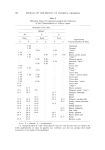
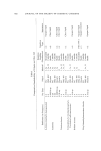
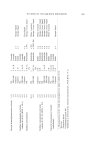
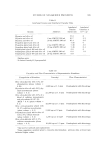
600 JOURNAL OF THE SOCIETY OF COSMETIC CHEMISTS to the glass mirror point. (The glass mirror point is the angle at which a glass mirror, in place of the hair tress, would exhibit maximum or peak reflectance.) It will be noted that the hair has two peak reflectances, neither of which is at the angle of the glass mirror point. The reason for this has to do with the scalar surface of hair fibers and will be discussed in a later communication (6). The b area of the reflectance curve of hair is interpreted as being a measure of the light which is returned to the photo cell after having passed through the fiber. Therefore, the b area is used to measure X, Y and Z. The a area of the curve is interpreted as being a measure of the surface reflection. One can calculate the chromaticity coordinates at any angle of scan, using the X, Y and Z ordinates at that angle. It turns out that the color of the hair is just about equally represented by all angles of scan in the b portion of the curve, and this being so, it was convenient in this study to use the total area under the b part of the curve. % LUMINOSITY Table I Relationship Between Purity and Luminosity of Natural Hair Colors PURITY DOkUNANT WAVE 0 ........ 10 ........ 20 ........ 30 ........ 40 ........ 50 ........ 60 LENGTH ..... 1.8 2.3 3.2 3.5 5.1 6.6 7.3 7.8 8.3 10.7 10.8 11.2 11.7 12.1 15.6 17.8 18.8 19.9 22.7 23.3 26.4 26.8 29.1 44.6 68.2 90.0 X X X X SERIES 1 x '• SERl__[•s 2 x x x x 596 606 586 588 587 587 591 594 590 588 586 588 587 587 590 588 587 588 587 586 588 584 582 584 586 588
Purchased for the exclusive use of nofirst nolast (unknown)
From: SCC Media Library & Resource Center (library.scconline.org)