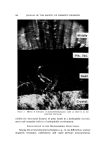
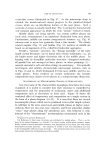
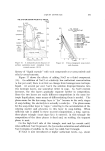
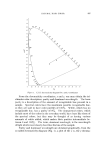
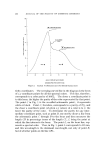
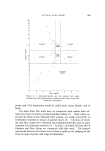
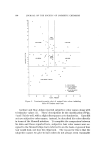
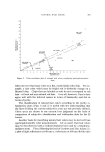
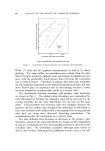
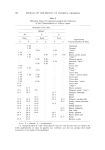
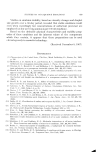
NATURAL HAIR COLOR 607 14- 13- 12 I1 VERY L1GHT BLONDE $ 7 6 ASH BLONDE MORE ASHEN o OR DRABER 4 LIGHT RED o DARK BROWN •,. 1 - o /- k WARM ER REDDER 1 2 3 4 5 6 7 8 REFLECTANCE • 600 nm (IRBITRARY UN ITS) Figure 6. Polar coordinate plot of natural hair colors employing spectrophotometric data when one sees that same color on a flat, matte finish color chip. For ex- ample, a hair color which may be bright red is distinctly orange on a Munsell chip. Chips that are labeled as reds do not correspond to red hair--at least not any natural red hair. Over-all, however, Garn's data agree well with the inferred names in terms of luminosity and fair in terms of purity. The classification of natural hair colors according to the purity rs. luminosity plots (Figs. 4 and 5) is useful with the understanding that the lines dividing the various subjective areas are not precisely defined. These areas are drawn to our current best judgment on the basis of comparison of subjective classification and tristimulus data for the 26 tresses. Another basis for classifying natural hair colors may be derived from spectrophotometric color measurements. Let us assert that hair colors may be described by both a redness-drabness term and by a blondhess- darkness term. Then, following the lead of Gardner and Mac Adam (5), a plot of light reflectance at 440 nm vs. reflectance at 600 nm divides into

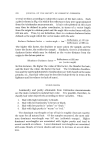
(308 JOURNAL OF THE SOCIETY OF COSMETIC CHEMISTS several sections according to subjective names of the hair colors. Such a plot is shown in Fig. 6 in which the reflectance data were approximated from the tristimulus measurements. A hair color plotted on this chart may then be defined in polar coordinates, in terms of a vector length from the origin to a datum point and the angle this vector forms with the 600 nm axis. Thus, by our definition, there is a redness-drabness factor defined as the angle which the vector makes with the axis: Reflectance at 440 nm Redness-Drabness factor = vector angle = tan -• Reflectance at 600 nm The higher this factor, the drabber or more ashen the sample, and the lower the factor, the redder the sample. Similarly, there is a blondness- darkness factor which may be defined as the vector distance from the origin to the datum point or: Reflectance at 600 nm Blondness-Darkness factor = cos (vector angle) In this instance, the higher the value of this factor, the blonder the hak and the lower the value, the darker the hair. The tristimulus classifica- tion and the spectrophotometric classifications are both based on the same premise, viz., that hair color may be described subjectively in terms of its lightness and its redness (or lack of same). CONCLUSIONS Luminosity and purity obtainable from tristimulus measurements are the main variants in natural hair color. It is possible, therefore, to classify hair color objectively according to these variables. Thus: 1. Hair with high luminosity is blonde. 2. Hair with low luminosity is brown or black. 3. Hair with low purity is "ashen" or "drab." 4. Hair with high purity is "warm" or "red." The dominant wavelength or hue of hair is roughly (but not exactly) the same for all natural hair. Of the samples measured, the most com- mon dominant wavelength was 587 nm (yellowish orange). Higher dominant wavelengths are associated with higher purity and tend to accent warmth or redness. Lower dominant wavelengths are associated with some blonde or brown shades and seem to increase or accent drab- heSS.
Purchased for the exclusive use of nofirst nolast (unknown)
From: SCC Media Library & Resource Center (library.scconline.org)