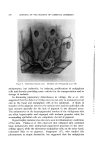
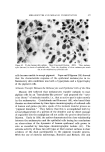
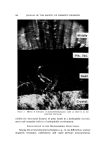
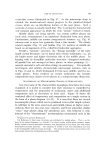
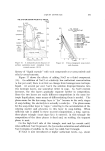
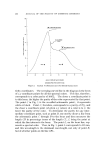
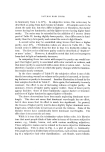
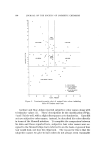
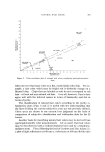
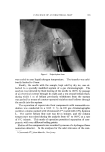
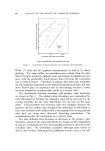
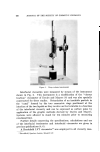
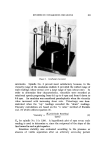
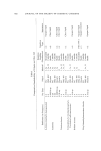
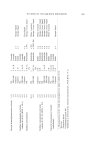
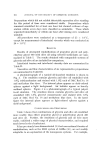
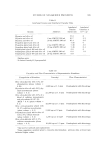
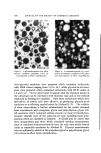
STUDIES ON NONAQUEOUS EMULSIONS 631 Figure 2. Interfacial viscomcter surements. Spindle No. 3 proved most satisfactory because, in the viscosity range of the emulsions studied, it provided the widest range of scale readings (shear stress) over a large range of rpm (shear rate). In order to determine flow characteristics, viscosities were recorded at rotational speeds progressing from 0.6 up to 6 rpm and from 6 down to 0.6 rpm. An emulsion was considered pseudoplastic when the viscosity value increased with increasing shear rate. Thixotropy was dem- onstrated when the "up" readings exceeded the "down" readings. Viscosity calculations are based on the "n value" method of Runikis et al. ((.)) which utilizes equation (2). Viscosity = (K•) (n) (Scale Reading) (2) (rpm) K• for spindle No. 3 is 1200. A logarithmic plot of rpm versus scale reading is used to determine n, since the reciprocal of the slope of the line formed in such a plot equals n. Emulsion stability was evaluated according to the presence or absence of visible separation after an arbitrary seven-day period.

032 JOURNAL OF THE SOCIETY OF COSMETIC CHEMISTS
Purchased for the exclusive use of nofirst nolast (unknown)
From: SCC Media Library & Resource Center (library.scconline.org)