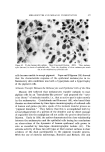
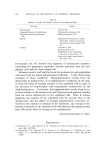
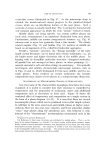
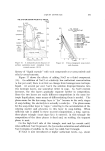
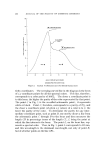
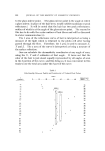
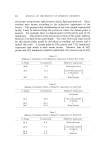
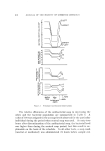
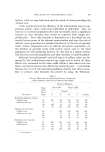
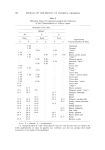
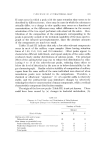
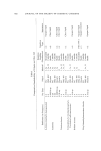
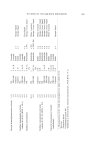
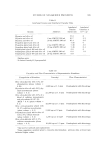
INFLUENCE OF AXTIBACTERIAL SOAP 623 II cases occur in which a peak with the same retention time seems to be described by different terms these may be cases in which the substances actually differ, or a change in odor quality may occur as a function of concentration, or the differences may reflect differences in the sensory orientation of the two expert perfumers who observed the odors. Iden- tification of the composition of the components corresponding to the peaks is presently outside of the technical capability of the mass spectro- graph or the infrared spectrophotometer, since the absolute amounts of the components are much too small. Tables II and III indicate that only a few odor-relevant components occur in mcst of the axillary vapor samples (those having retention times of 1.90, 15.3, 18.8, and 20.0 minutes). Other peaks appear to characterize different individuals, and repeat analysis of the same axilla produced closely similar distributions of odorous peaks. The principal effect of the antibacterial soap was to reduce this distribution by dim- i:mting $ to 14 of the odor-relevant peaks, reducing them either to below the level of detection by the nose or to below detectability by the gas chromatograph. Similar relative stability of composition of axillary vapors from the same axilla of the same individual was observed when nonodorous peaks were included in the comparisons. Therefore, a chemical or olfactronic "signature" (1) of a specific axilla is relatively stable, and the antibacterial soap introduces changes by selectively reducing the relative concentration of many components, while a residual characteristic component distribution remains. The origin of the few new peaks (Table III) is not yet known. These could have been caused by (a) changes in bacterial metabolism, (b) Table III Changes in Total Xumber and Distribution of Odor-Relevant Peaks upon Change from Xeutral to Antibacterial Soap Kind of Peaks Number of Peaks Subject M U Z During care with neutral soap: Odor-relevant peaks 21 After change to germicidal soap: Peaks remaining odor-relevant 12 Peaks that disappeared or became odor-irrelevant 9 New peaks 6 Total peaks 18 16 11 2 3 14 2 3 4

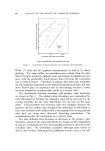
624 JOURNAL OF THE SOCIETY OF COSMETIC CHEMISTS some component of the antibacterial soap (e.g., perfume) or a conversion product thereof, (c) some random processes in which contaminants occur, (d) some components that randomly occur in concentrations near the odor thresholds, and (e) changes in the subject's diet, health, or me- tabolism. The composition of vapors from the two axillae of the same individual tended to be more similar than the composition of vapors from different individuals. Tables II and III indicate that the processes that produce the odor- relevant components in different people differ considerably. The causes may be differences in the composition of nutrients and for odor precursors as well as in the nature of microorganisms and their relative abundance in the axillary area. Correspondingly, it may be that germicides do not act equally efficiently on all bacterialfnutrient precursor systems, in which case the efficiency of odor control would vary considerably among individuals. Since the odor-producing pro- cesses in the two axillae of the same subject are more similar than in axillae of different subjects, the practice of comparing the opposite axillae of the same subject with different soap formulations, after first establishing a baseline for both axillae on a neutral soap, seems well warranted. SUMMARY AND CONCLUSIONS The effects of an antibacterial soap* containing 0.75% hexachlo- rophene and 0.75% 3,4,4'-trichlorocarbanilide on the axillary bacterial population density, primary and secondary odor intensity, and water production were studied in detail over a period of several weeks on four subjects kept on a carefully controlled skin-care regime. Novel tech- niques of vapor collection and odor-intensity measurement from gas chromatographically-resolved primary vapors were used. The antibacterial soap had no systematic influence on the water pro- duction rates but significantly depressed the bacterial population and the odor intensities from both sources. For any individual test, the correlations between the odor intensity and the bacterial population density were poor, while some correlation existed between the primary and secondary odor intensities. The odor-relevant composition of the vapors was characteristic for each individual, with only a few compo- nents probably identical for most or all cases. The antibacterial soap depressed the number and the intensity of the odor-relevant peaks, while fragments of the pattern distribution of the characteristic peaks from * Dial ©, supplied by Armour and Co.
Purchased for the exclusive use of nofirst nolast (unknown)
From: SCC Media Library & Resource Center (library.scconline.org)