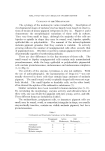
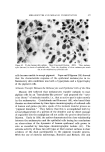
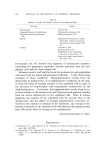
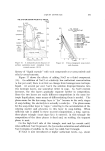
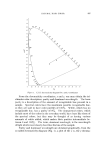
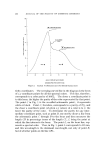
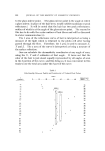
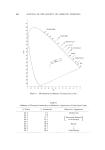
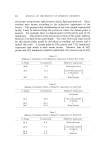
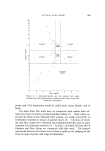
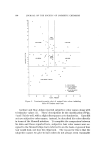
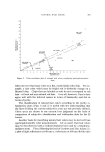
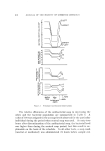
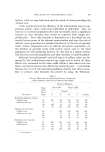
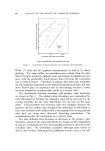
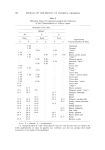
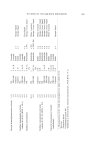
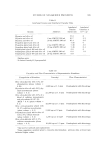
NATURAL HAIR COLOR 603 in luminosity from 5 to 27%. In subjective terms, this series may be described as going from dark brown to blonde. All samples seem to be about the same hue, but they differ in lightness or blondness, the darker tresses having low luminosity and the lighter tresses having higher lumi- nosity. The series may be extended by the addition of 3 tresses (lower part of Table II) having slightly lower purity they differ more in lumi- nosity than they do in purity and extend the series to light blonde. A second series may be assembled using tresses that have a higher purity, near 40%. (Tristimulus values are sho•'n in Table III.) The second series is different from the first in that it is distinctly redder in tone. The first series with lower purity could be described as "drabBer" or more ':ashen." However, it should be noted that both series progress from dark to light as luminosity increases. In comparing these two series with respect to purity one would sus- pect that higher purity is associated with color warmth or redness, and that lower purity is associated with a more drab or ashen color. Let us, therefore, examine a series in which the purity changes while the luminos- ity remains nearly constant. In the three samples of Table IV the subjective effect is one of dis- tinctly increasing warmth or redness as the purity is increased, or increas- ing drabness as purity is decreased. Another illustration is found in the four samples described in Table V. Here again, the luminosity is nearly constant the effect is one of increasing redness at higher purity. In summary, tresses of higher purity appear redder those of lower purity appear drabber those of lower luminosity appear darker or browner and those of higher luminosity appear lighter or blonder. The above observations have been made neglecting dominant wave- length. This does not mean that dominant wavelength has no effect, but it does mean that its effect is much less significant. In general, the tresses of higher purity tend to have slightly higher dominant wave- length also, which tends to increase or accent the redness. Some of the blonder tresses have considerably lower dominant wavelengths. The effect here is to accent the ash tone. While it is true that the tristimulus values define color, it is likewise true that most people think of hair color in terms of the more subjective names, e.g., blonde, brown, red, with various modifying adjectives. These subjective names can be related to the more objective tristimulus designations. This is done in Fig. 4, a plot of purity vs. luminosity. The graph has been divided into seven sections, each section correspond- ing to a subjective hair color classification: ash blonde, warm blonde,

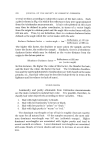
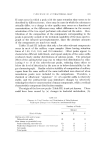
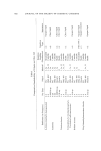
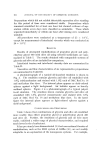
604 JOURNAL OF THE SOCIETY OF COSMETIC CHEMISTS ash brown, warm brown, dark brown to black, light and dark red. These sections were drawn according to the subjective appearance of the tresses. The general color classification of any hair sample represented in Fig. 4 may be inferred from the section in which the datum point is located. For example, there is a datum point at 31% purity and 10.7% luminosity. This point is in the ash brown section of the graph, halfway between very dark brown and blonde. The color of the hair represented by this datum point would be described as medium ash brown and is indeed this color. A datum point at 39% purity and 7.3% luminosity represents hair which is dark warm brown. Likewise, hair of 46% purity and 18% luminosity would be called light red, whereas hair of 42% Table III Influence of Luminosity on the Subjective Appearance of Warm Hair Colors Purity % Luminosity Subjective Appearance 39.8 7.3 Dark warm brown I 38.4 11.2 [ Increasing lightness 1 [_ or blondeness _] 38.7 23.3 Warnl blonde Table IV Influence of Changing Purity on Subjective Appearance of Light Hair Purity % Luminosity Subjective Appearance 33.1 26.8 35.2 26.4 38.7 23.3 Ash blonde I Increasing warmth] or redness _J Warm blonde Table V Influence of Changing Purity on Subjective Appearance of Dark Hair Purity % Luminosity Subjective Appearance 33.2 6.6 Dark ash brown 39.8 7.3 [Increasing warmth 1 L or redness _] 46.0 7.8 49.9 8.3 Dark red
Purchased for the exclusive use of nofirst nolast (unknown)
From: SCC Media Library & Resource Center (library.scconline.org)