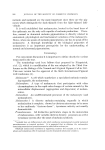
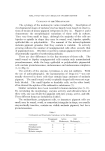
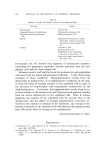
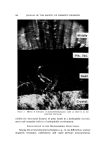
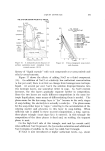
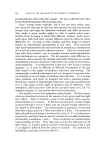
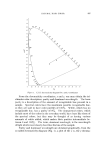
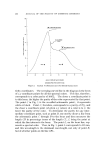
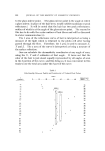
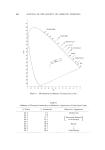
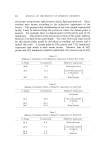
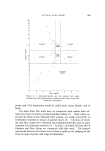
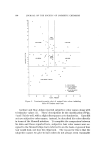
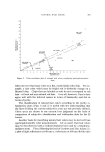
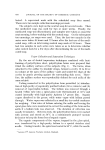
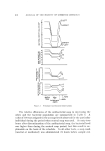
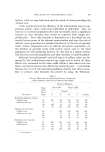
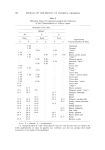
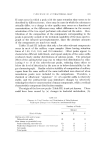
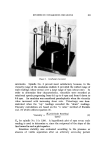
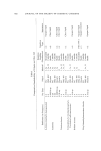
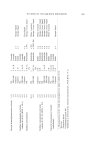
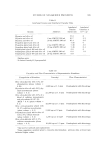
NATURAL HAIR COLOR 601 Selection and Preparation of Hair for Color Measurement This laboratory maintains a large file of human hair samples, ranging in color from black to white and from ash blonde to carrot red. Tresses were selected from this collection so as to represent the broadest possible range of naturally occurring colors. Twenty-six tresses of hair in all were selected, each chosen to be of uniform color. Multicolored tresses were rejected except where the strands were distinct enough to allow a clean separation to be made. The hair was cut to tresses of a size de- signed especially for the colorimeter, then shampooed and air-dried before being mounted and measured in the colorimeter. RESULTS AND DISCUSSION The results of the color measurements are expressed in terms of domi- nant wavelength, purity, and luminosity. The data are presented in Table I in a semigraphic form the measured luminosity for each tress is listed from top to bottom in increasing order the measured purities are indicated by the left and right positions of data points. The third di- mension of the graph, dominant wavelength, is shown in a separate col- umn. The x and y tristimulus values of these tresses are plotted on a chroma- ticity diagram in Fig. 3. It will be noted that all 26 samples fall within a sort of curving band, the limits of which are small compared to the total color space of the diagram. From Fig. 3 it is apparent that the range of possible hues in hair color occupies only a small part of the over- all color spectrum. This is likewise indicated from Table I which re- veals that the range of dominant wavelength of the 26 samples is from 581 to (306 nm with but one sample higher than 600. Most of the sam- ples are in the very narrow range 586-588 nm. There are, of course, many more than 26 different hair colors. However, these 26 present a broad representation between the extremes of white, black, ashen (or drab) and red. Conceivably, hair colors having tristimulus coordinates outside the drawn limits in Fig. 3 would be unnatural in appearance. The luminosity and purity values have a much broader range than the dominant wavelength. Lu.minosity varies from about 2 to 90% and purity varies from about 10 to nearly 60%. Let us examine the manner in which variations in luminosity and purity affect hair color. Using Table I, it is possible to select a series of tresses which have aprroxi- mately the same purity but which vary considerably in luminosity. One such selected series of 6 samples is given in the upper part of Table II. All of these tresses have a purity of about 32 to 33%, but they vary

602 JOURNAL OF THE SOCIETY OF COSMETIC CHEMISTS .90- .80 - .75- .70' .65. .60- .55. .50- .45- .35. .25 .15- .10- .05- • .•j•j,•Y El I OI//ISH GREEN YELLOW/GREEN • •, GREENISH YELLO¾1 •/ • YELLOW •/ •%'• YELLOWISH ORANGE '• •,• ORANGE GE ß ß 05 .10 .15 .20 .25 .30 .35 .40 .45 .50 .55 .60 .65 .7g 25 % Figure 3. Chromaticity coordinates of natural hair colors Table II Influence of Changing Luminosity on Subjective Appearance of Drab Hair Colors Purity % Luminosity Subjective Appearance 32.5 5.1 Dark brown 33.2 6.6 I 32.1 11.7 [Increasing lightness 7 33.4 12.1 L or blondehess _] 32.0 22.7 33.1 26.8 Blonde 30.4 29.1 I 28.2 44.7 • 25.1 68.2 Light blonde
Purchased for the exclusive use of nofirst nolast (unknown)
From: SCC Media Library & Resource Center (library.scconline.org)