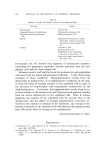
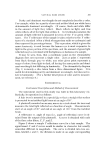
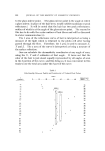
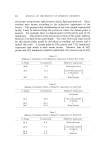
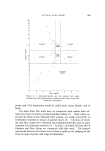
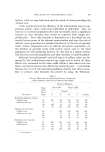
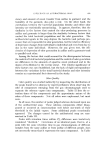
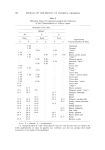
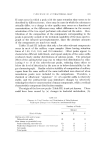
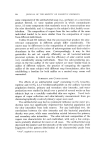
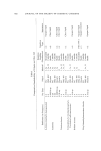
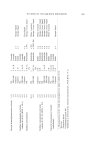
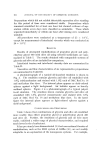
IXFLUEXCE OF ANTIBACTERIAL SOAP 621 ciency and amount of sweat transfer from axillae to garment and the humidity of the garment, also play a role. On the other hand, the correlations between the bacterial population density and either odor intensity are statistically unconvincing. It appears, therefore, that the similarity in the factors that control the odor-producing processes in axillae and garments is larger than the similarity between factors that control the total bacterial population and the odor generation. The antibacterial agents in the soap depress the bacteria (and perhaps pro- cesses) that are responsible for odor generation, but the relative efficiency of depression changes from individual to individual and even from day to day in the same individual. However, for any given test, the effi- ciencies of depression of odor generation in axillae and in garments tend to parallel each other. Among the factors that could account for the discrepancies between the control of total bacterial population and the control of odor generation are differences in the amounts of apocrine sweat produced and in the degree of its dilution by the eccrine sweat. The relative significance of these factors was not established, but the lack of rigid correspondence between the variations in the total bacterial density and odor intensity remains an experimental fact observed in the study. Odor Quality Odor quality was studied indirectly by inspecting the distribution of the peaks found to be odorous by expert perfumers when observing the odor of components emerging from the gas chromatograph used to separate the odorous vapors into components. Table II lists the re- tention times of the components and the approximate nature of the odors of these components. Not all odors were unpleasant, but most were. In all cases, the number of peaks judged odorous decreased upon use of the antibacterial soap. These odorous components either disap- peared or occurred at concentrations well below one-tenth of their threshold in the initial vapors. Some additional peaks occasionally appeared. The changes caused by the antibacterial soap are sum- marized in Table III. Peaks with retention times within 5% difference were tentatively considered "identical." 0ceurrence of an identical peak, that is, of a peak with the same retention time in gas chromatograms of different samples from the same axillae or from axillae of different people, does not necessarily mean that it represents the same component. In Table

622 JOURNAL OF THE SOCIETY OF COSMETIC CHEMISTS Table II Retention Times of Components Judged Odor Relevant in Gas Chromatograms of Axillary Vapors Retention Time, Min Subject M U Z Soap Soap Soap X A N A N A Approximate Characterization of Odor 1.43 1.90 . . . ß . . . . . . . . 4.45 5.14 ß . . 6.47 7.05 7.90 8.03 9.60 10.5 10.9 . . . 13.1 13.7 . . . . . . 15.3 16.2 16.9 17.5 18.8 . . . 20.0 20.5 . . . 21.6 O. 29 O. 52 . . . . . . 1.90 2.51 . . . . . . . . . . . . 5.14 . . . . . . 7.05 11 7 13 1 13 7 15.3 16 2 17 5 18 8 19 5 2O 0 2O 5 21.0 21.6 0 2 69 3 38 5 76 7 05 7.90 . . . 9.60 . . . . . , . . . 13.1 . . . . . , 14.7 15.3 16.2 16.9 17.5 18.8 19.5 20.0 . . . . . . . . , 80 ... O. 80 1.90 1.90 2.69 ... 3.08 3. OS 3.38 ... . . 13.7 14.1 14.7 15.3 . . . 16.9 . . ß 20.0 20.5 21.0 . . . 1 90 15.3 16.2 . . . . . . 18.8 19.5 . . . . . . 21.0 ß . . Medicinal Pungent ,,Odor,,• Burnt Sharp, earthy, musty ,,Odor,,a Ethereal, musty Ethereal, "odor' "• Bland Trace odor Soapy ,,Odor,,a Trace odor "Odor,"" rotten cheese Trace odor Trace odor Trace odor, "odor TM Trace odor "Odor"a Sharp, pungent Pungent, sweet, "odor"" Pungent, aldehydic Bland Bland Pungent, acrolein-like Fruity, musty, phenolic Fruity Mildly pungent Burnt, aldehydic Oily, fatty Sharp, pungent Burnt, fatty acid Fatty Butyric, acidic Note: N = neutral A = antibacterial. "A characterization of "odor" was assigned when the odor detected was too weak to de- scribe qualitatively or when its quality was indefinite and did not produce fast recall association in the minds of the perfumers.
Purchased for the exclusive use of nofirst nolast (unknown)
From: SCC Media Library & Resource Center (library.scconline.org)